
 My Inquiry
 My Account


Diodes Incorporated DESD3V3E1BL-7B
- Part No.:
- DESD3V3E1BL-7B
- Manufacturer:
- Diodes Incorporated
- Category:
- TVS Diodes
- Package:
- 0402 (1006 Metric)
- Datasheet:
-
 DESD3V3E1BL-7B.pdf
- Description:
- TVS DIODE 3.3VWM 7VC DFN1006-2
- Quantity:
- Payment:

- Shipping:

Inventory:271,273
Please send an inquiry. Send us your inquiry, and we will respond immediately.
Product details
Overview
DESD3V3E1BL-7B from Diodes Incorporated is a low-capacitance bidirectional TVS diode designed for ESD protection of high-speed data lines in portable electronics. It features a 3.3 V reverse standoff voltage, ±25 kV IEC61000-4-2 contact/air ESD rating, 13 pF channel capacitance at 0 V, 5 A peak pulse current (8/20 µs), and X1-DFN1006-2 package. It is commonly deployed on USB 2.0, HDMI, and audio interface lines.
For engineers reviewing the DESD3V3E1BL-7B datasheet, DESD3V3E1BL-7B pinout, DESD3V3E1BL-7B application, or DESD3V3E1BL-7B equivalent, key selection criteria include clamping voltage under 5.4 V at 1 A, ultra-low 13 pF input capacitance for signal integrity, bidirectional polarity, and compatibility with space-constrained 0.68 mm × 1.08 mm PCB footprints.
Technical Context
This TVS diode operates as a voltage-clamped transient suppressor across a single I/O-to-VSS path. Its bidirectional structure enables symmetric clamping for AC-coupled or differential signaling lines, and its low 0.3 Ω differential resistance ensures minimal voltage overshoot during fast ESD events.
The device uses silicon avalanche junction technology optimized for sub-5 V operation, with breakdown voltage specified at 3.8–6.5 V (IR = 1 mA) and clamping voltage tightly bounded at 4.5–5.4 V (IPP = 1 A, 8/20 µs). Thermal resistance is 500 °C/W on standard FR-4 layout, supporting continuous power dissipation up to 250 mW at 25 °C ambient.
Key Specifications
| Parameter | Value and Actual Design Meaning |
|---|---|
| Reverse Standoff Voltage | 3.3 V - Maximum working voltage before conduction; preserves signal integrity on 3.3 V logic/data lines |
| Clamping Voltage (1 A) | 4.5–5.4 V - Limits transient overvoltage to safe levels for downstream 3.3 V ICs |
| ESD Rating (IEC61000-4-2) | ±25 kV air & contact - Meets highest industrial ESD immunity requirement |
| Channel Capacitance | 13 pF @ 0 V, 1 MHz - Enables use on USB 2.0 (480 Mbps) and audio interfaces without signal distortion |
| Peak Pulse Current | 5 A (8/20 µs) - Withstands multiple high-energy transients per IEC61000-4-5 Level 2 |
| Breakdown Voltage | 3.8–6.5 V @ 1 mA - Ensures reliable turn-on margin above 3.3 V rail while avoiding false triggering |
| Differential Resistance | 0.3 Ω - Minimizes IR drop during clamping, reducing residual voltage stress on protected IC |
Pinout & Package
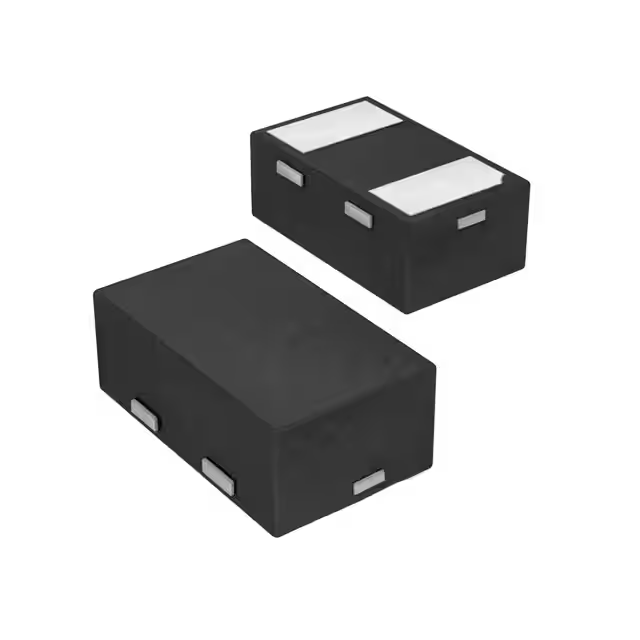
Package: X1-DFN1006-2 - ultra-compact 2-terminal surface-mount package (1.08 mm × 0.68 mm, 0.53 mm max height), cathode band marked on top surface.
| Pin/Terminal | Circuit Role | Design Meaning |
|---|---|---|
| Anode (Pin 1) | I/O line connection | Connected to protected data line (e.g., USB D+, HDMI TMDS+); bidirectional conduction path |
| Cathode (Pin 2) | VSS reference | Connected to system ground plane; forms low-inductance return path for ESD current |
Key Features
| Feature | Design Value |
|---|---|
| Bidirectional ESD suppression | Enables protection of AC-coupled or differential signals (e.g., USB, HDMI) without polarity constraints |
| 13 pF channel capacitance | Preserves signal rise time and eye diagram integrity on 480 Mbps USB 2.0 links |
| ±25 kV IEC61000-4-2 rating | Meets full-system ESD compliance for handheld consumer devices without additional shielding |
| X1-DFN1006-2 footprint | Reduces PCB area by >50% vs. SOD-323, enabling placement directly at connector entry points |
| Lead-free & halogen-free construction | Fully compliant with RoHS 3 (2015/863/EU) and JEDEC J-STD-020 moisture sensitivity level 1 |
Applications
| USB 2.0 Interface Protection | HDMI Signal Line Protection |
|---|---|
Use Scenario: ESD protection for D+ and D− lines in smartphone USB OTG ports and tablet host controllers. IC Role / Device Role / Timing Role: Bidirectional transient voltage suppressor placed within 2 mm of USB connector to shunt ESD energy before reaching PHY IC. Use Value: 13 pF capacitance avoids signal degradation at 480 Mbps; ±25 kV rating eliminates need for secondary board-level shielding. | Use Scenario: Clamping transients on TMDS clock and data channels in portable media players and docking stations. IC Role / Device Role / Timing Role: Low-capacitance TVS placed adjacent to HDMI receptacle to limit voltage excursion during hot-plug or cable discharge events. Use Value: Sub-5.4 V clamping at 1 A ensures TMDS receivers (typically 3.3 V tolerant) remain within absolute maximum ratings. |
| Smartphone Audio Jack Protection | Industrial Sensor Interface Protection |
Use Scenario: ESD safeguarding of analog audio paths (MIC, HP_L/R) in compact handsets exposed to frequent human handling. IC Role / Device Role / Timing Role: Single-channel bidirectional TVS bridging audio line to ground, leveraging low leakage (<100 nA) to avoid DC bias shift. Use Value: 3.3 V standoff matches typical audio codec I/O voltage; 0.3 Ω dynamic resistance minimizes audible pop during discharge. | Use Scenario: Transient suppression on RS-485 or CAN FD data lines in factory automation gateways operating in electrically noisy environments. IC Role / Device Role / Timing Role: Front-end protection element on communication bus lines, rated for repeated 5 A surges per IEC61000-4-5. Use Value: 35 W peak pulse power and 500 °C/W thermal resistance enable robust operation at elevated ambient temperatures (up to +125 °C). |
Equivalent & Alternatives
The following parts are listed as comparable options for similar bidirectional TVS diode applications.
| Alternative Part | Technical Difference | Application Difference | Selection Advice |
|---|---|---|---|
| SMAJ3.3A-Q | Unidirectional, higher 200 pF capacitance, SMA package (4.5 mm × 2.7 mm) | Requires polarity-aware layout; unsuitable for AC-coupled or differential lines | Select only when unidirectional protection suffices and board space permits larger footprint |
| SP1003-030 | 3.3 V standoff, 0.35 pF capacitance, 3-pin μDFN (1.0 mm × 0.6 mm), integrated GND pin | Offers lower capacitance but requires 3-layer routing for dedicated ground return | Prefer for RF-sensitive applications like LTE antenna switches where <1 pF is critical |
Compared with SMAJ3.3A-Q and SP1003-030, DESD3V3E1BL-7B uniquely balances ultra-low capacitance (13 pF), bidirectional symmetry, and minimal 1.08 mm × 0.68 mm footprint-making it optimal for space-constrained, high-speed digital interfaces requiring polarity-agnostic ESD hardening.
Availability
DESD3V3E1BL-7B is available at Aetrix Electronics and suitable for USB 2.0 interface protection, HDMI signal line hardening, and smartphone audio jack safeguarding requiring stable component supply across high-volume consumer electronics programs.
Supply support for DESD3V3E1BL-7B includes scheduled delivery planning, volume procurement assistance, BOM continuity management, traceable sourcing, and lifecycle availability coordination for OEM customers, industrial embedded developers, connected-device designers, and electronics production programs.
Manufacturer
Diodes Incorporated is a global manufacturer of discrete semiconductors and analog ICs, specializing in high-reliability protection, power management, and signal integrity solutions for consumer, industrial, and automotive markets.
The DESD3V3E1BL-7B belongs to Diodes' low-capacitance TVS diode product line, engineered specifically for ESD-hardening of high-speed serial interfaces in compact portable electronics without compromising signal fidelity.
FAQ
What is the maximum clamping voltage of DESD3V3E1BL-7B at 5 A?
The clamping voltage is 5.8–7.0 V under 8/20 µs pulse conditions at 5 A peak current, as specified in the Electrical Characteristics table. This value reflects worst-case transient suppression performance during high-energy ESD events and must be verified against the protected IC's absolute maximum voltage rating.
Is DESD3V3E1BL-7B suitable for protecting USB 3.0 lines?
No-its 13 pF capacitance exceeds the typical ≤1 pF requirement for SuperSpeed (5 Gbps) USB 3.0 differential pairs. It is validated for USB 2.0 (480 Mbps) and other sub-100 MHz interfaces where 13 pF introduces negligible insertion loss and maintains acceptable eye opening.
How is polarity identified on the X1-DFN1006-2 package?
Polarity is indicated by a cathode band mark on the top surface of the device, aligned with Pin 2 (cathode terminal). The bottom-view schematic in the datasheet confirms Pin 1 as anode and Pin 2 as cathode, with the marking bar adjacent to Pin 1 per standard DFN orientation conventions.
Does DESD3V3E1BL-7B require external series impedance for optimal ESD performance?
No external series resistor is required-the device is designed for direct placement between I/O line and ground. However, minimizing PCB trace inductance (short, wide traces; ground via within 1 mm) is critical to achieve the specified ±25 kV ESD rating and prevent voltage overshoot during nanosecond-scale transients.
DESD3V3E1BL-7B Specifications
- Product attributes
- Attribute value
- Manufacturer:
- Diodes Incorporated
- Package/Case:
- 0402 (1006 Metric)
- Series:
- -
- Packaging:
- Tape & Reel (TR)
- Product Status:
- Active
- Type:
- Zener
- Unidirectional Channels:
- -
- Bidirectional Channels:
- 1
- Voltage - Reverse Standoff (Typ):
- 3.3V (Max)
- Voltage - Breakdown (Min):
- 3.8V
- Voltage - Clamping (Max) @ Ipp:
- 7V
- Current - Peak Pulse (10/1000µs):
- 5A (8/20µs)
- Power - Peak Pulse:
- 35W
- Power Line Protection:
- No
- Applications:
- General Purpose
- Capacitance @ Frequency:
- 13pF @ 1MHz
- Operating Temperature:
- -65°C ~ 150°C (TJ)
- Grade:
- -
- Qualification:
- -
- Mounting Type:
- Surface Mount
- Supplier Device Package:
- X1-DFN1006-2
DESD3V3E1BL-7B FAQ
1.How can I place an order for DESD3V3E1BL-7B through Aetrix?
Please submit a Request for Quotation (RFQ) for DESD3V3E1BL-7B on Aetrix. Our sales agent will provide a competitive quotation and guide you through the order confirmation once you accept the terms.
2.Are the price and stock information for DESD3V3E1BL-7B reliable?
The price and inventory of DESD3V3E1BL-7B are updated periodically and may fluctuate due to market conditions. Stock and pricing data are typically refreshed every 24 hours. Quotation validity for DESD3V3E1BL-7B is usually 5 days.
3.What payment methods are accepted for DESD3V3E1BL-7B?
We accept Wire Transfer, PayPal, Credit Card, Western Union, MoneyGram, and Escrow for DESD3V3E1BL-7B transactions.
Note: Certain payment methods may incur a processing fee.
4.How is shipping managed for DESD3V3E1BL-7B?
DESD3V3E1BL-7B orders can be shipped via leading logistics carriers, including DHL, UPS, FedEx, TNT, or Registered Mail.
Once your DESD3V3E1BL-7B order is processed, you will receive an email with the shipment details and tracking number.
Note: Tracking information may take up to 24 hours to appear. Express delivery typically takes 3–5 business days.
5.How can I obtain technical support or documentation for DESD3V3E1BL-7B?
For technical support, including DESD3V3E1BL-7B datasheets, pinout diagrams, or application guidance, please contact our engineering support team. They can provide detailed documentation and assistance for your DESD3V3E1BL-7B requirements.
6.How does Aetrix verify that DESD3V3E1BL-7B is sourced from the original manufacturer or authorized distributors?
All DESD3V3E1BL-7B products on Aetrix are procured from qualified distributors and authorized channels. Our dedicated quality assurance team conducts strict verification, including traceability checks and, if necessary, third-party testing. This ensures that DESD3V3E1BL-7B meets industry standards.
7.What is the process for return or replacement of DESD3V3E1BL-7B?
All DESD3V3E1BL-7B units undergo pre-shipment inspection (PSI). If there is an issue with DESD3V3E1BL-7B, returns or replacements are accepted under the following conditions:
1.Quantity discrepancies, incorrect items, or visible external defects (such as breakage or corrosion), acknowledged by Aetrix.
2.The issue is reported within 90 days of delivery.
3.The DESD3V3E1BL-7B part is unused and in its original packaging.
Return procedure for DESD3V3E1BL-7B:
1.Submit a request within 90 days.
2.Obtain a Return Material Authorization (RMA) from Aetrix.
DESD3V3E1BL-7B Tags
-
ESD9B5.0ST5G
onsemi
-
DESD3V3E1BL-7B
Diodes Incorporated
-
ESD5Z3.3T1G
onsemi
-
D5V0H1B2LP-7B
Diodes Incorporated
-
D5V0P1B2LP-7B
Diodes Incorporated
-
DESD5V0U1BA-7
Diodes Incorporated
-
ESD5Z5.0T1G
onsemi
-
DESD5V0U1BB-7
Diodes Incorporated
-
D12V0L1B2LP-7B
Diodes Incorporated
-
PESD2V0Y1BSFYL
Nexperia USA Inc.
-
DF2S5M4CT,L3F
Toshiba Semiconductor and Storage
-
D5V0L1B2WS-7
Diodes Incorporated
Tech Hub

Jumper cables guide covering safe connection order, red and black clamp placement, final ground connection, cable gauge, length, clamp quality, copper vs CCA cables, jump starter comparison and battery…

LDO regulator guide covering low dropout voltage, power dissipation, thermal design, PSRR, output noise, capacitor stability, adjustable LDO circuits, LDO vs buck converter and datasheet selection chec…

Conditional Access Module guide covering CAM meaning, CI/CI+ interface, smart card authorization, DVB security workflow, TV and set-top box compatibility, internal electronics, ESD protection, connecto…

Guide to electronic component obsolescence covering EOL risk, PCN/PDN notices, last-time buy planning, replacement options, form-fit-function validation, counterfeit risk and BOM lifecycle management.

18650 battery guide covering lithium-ion cell basics, 3.6V/3.7V voltage, 4.2V charging, mAh and Wh capacity, protected cells, chargers, BMS, series-parallel packs, holders, welding and sourcing checks.…

Hall effect sensor guide covering working principle, linear and digital sensors, Arduino circuits, current sensing, speed detection, automotive applications, A3144 examples, signal filtering and datash…

Product Change Notification guide for electronic components, covering PCN meaning, PCN vs PDN/EOL, common change types, risk levels, form-fit-function review, engineering validation, BOM control, LTB/L…

A practical guide to blend door actuators, covering HVAC function, symptoms, location, AC and heater issues, reset and calibration, replacement cost, electrical diagnosis, compatibility checks, and rep…

Engineering guide to Raspberry Pi alternatives, covering chip-level differences, Orange Pi, ROCK, Jetson, Banana Pi, NanoPi, Compute Module, Pico, GPIO, camera, HAT compatibility, and replacement risks…
Engineering guide to dynamic load response testing for high-current buck converters, covering load step setup, slew rate, Vcore undershoot, overshoot, recovery time, probe location, output capacitors a…


