
 My Inquiry
 My Account


NXP Semiconductors HTCM400/EAE,122
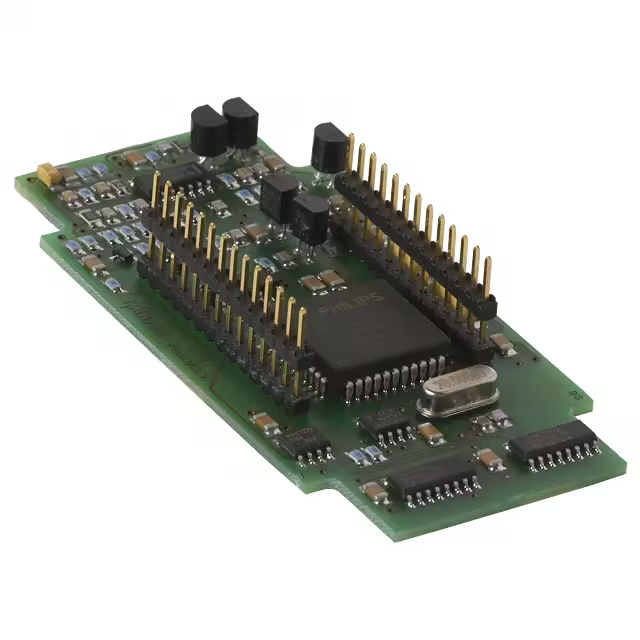
- Part No.:
- HTCM400/EAE,122
- Manufacturer:
- NXP Semiconductors
- Category:
- RFID, RF Access, Monitoring ICs
- Package:
- Module
- Datasheet:
-
 HTCM400/EAE,122.pdf
- Description:
- IC RFID READER 125KHZ MODULE
- Quantity:
- Payment:

- Shipping:

Inventory:1,972
Please send an inquiry. Send us your inquiry, and we will respond immediately.
Product details
Overview
HTCM400/EAE,122 from Philips Semiconductors is a 125 kHz contactless read/write core module for RFID proximity and long-range reader systems. It integrates a microcontroller, EEPROM, ASK transmitter/receiver, and serial CMOS interface, operates at 5 V, supports HITAG 1 and HITAG 2 transponders, and enables secure communication via cryptography and CRC-8 error checking in access control and ticketing applications.
For engineers reviewing the HTCM400/EAE,122 datasheet, HTCM400/EAE,122 pinout, HTCM400/EAE,122 application, or HTCM400/EAE,122 equivalent, this page delivers verified electrical specs (5 V supply, 100 mA max current, −25 to +85 °C operation), antenna interface design guidance (TX1/RX pins, 125 kHz tuning), security features (mutual authentication, stream cipher), and integration constraints (RS232/RS485 host interface, 20-pin I/O mapping).
Technical Context
The HTCM400/EAE,122 implements a dedicated 125 kHz ASK-based RFID reader architecture with separate analog (AVDD/AGND) and digital (DVDD/DGND) power domains, integrated antenna driver (TX1 output) and receiver (RX input), and on-board microcontroller executing protocol conversion between host serial commands and transponder data frames. It supports both proximity (up to ~200 mm) and long-range (up to ~1000 mm with HTRM800 add-on) modes.
Its functional partitioning includes EEPROM storage for keys/logdata (preloaded transport values), hardware-level CRC-8 generation (polynomial 0x1D, preassignment 0xFF), watchdog-based supply monitoring (reset below 4.75 V), and antenna fault tolerance against short-circuit or rupture. Anticollision is implemented only in long-range mode via DSP-linked interface pins (RXLOW_DSP, RXHIGH_DSP, etc.), while proximity mode relies on signal strength arbitration.
Key Specifications
| Parameter | Value and Actual Design Meaning |
|---|---|
| Supply Voltage | 5.0 V ± 5% DC - requires low-impedance source (<0.7 Ω) and separate analog/digital filtering per Section 7.4.2 |
| Supply Current | ≤100 mA - defines minimum power supply capacity and thermal dissipation (0.5 W max) |
| Operating Temperature | −25 °C to +85 °C - validated for industrial embedded reader deployments without active cooling |
| Carrier Frequency | 125 kHz - fixed-frequency ASK modulation; antenna must be tuned to 125 ± 4 kHz per Section 11.5 |
| Receiver Input Limit | 32 Vp-p at RX pin - mandates external R1 (22 Ω) current limiting and voltage clamping per Fig.12 |
| Serial Interface | 9600 baud, 8N1 CMOS level - direct host connection; TXDEN enables RS485 half-duplex control |
| CRC Algorithm | Poly 0x1D, preassign 0xFF - hardware-accelerated 8-bit CRC applied to all transponder command/data streams |
Pinout & Package
HTCM400/EAE,122 is housed in a custom PCB-based module measuring 86 × 40 × 7 mm (PCB only), with dual pin connectors (14-pin + 13-pin) protruding ~18 mm total height. Mounting is via solder or plug-in baseboard interface.
| Pin/Terminal | Circuit Role | Design Meaning |
|---|---|---|
| TX1 | Antenna driver output | Drives tuned LC antenna circuit at 125 kHz; internal 22 Ω current limiter protects against short-circuit |
| RX | Antenna receiver input | Accepts demodulated ASK signal from antenna; max 32 Vp-p input limit requires external clamping |
| TxD / RxD | Host serial interface | CMOS-level UART (9600 baud, 8N1); supports RS232/RS422/RS485 with optional TXDEN control |
| DVDD / DGND / AVDD / AGND | Digital/analog power rails | Separate 5 V supplies required; analog rail (AVDD/AGND) demands dedicated 100 nF + 22 µF filtering per Fig.6 |
| OUT1 / OUT2 | Microcontroller GPIO outputs | Drive LEDs or MOSFETs (e.g., BS170/BSS123); 1.5 mA sink/source capability, 80 pF max capacitive load |
| IN1 / IN2 | Microcontroller GPIO inputs | Active-low switch inputs with internal pull-ups; max 5 V tolerant, used for button/trigger detection |
| NRESET | Power-on reset output | Sink-capable reset signal (2–10 mA); can initialize external logic or microcontroller upon power-up |
Key Features
| Feature | Design Value |
|---|---|
| Integrated HITAG protocol stack | Hardware-accelerated support for HITAG 1 and HITAG 2 transponders including mutual authentication and stream cipher encryption |
| Secure key management | On-chip EEPROM stores transport keys/logdata (e.g., HITAG 2 key = 0x4D494B524F44, password RWD = 0x4D494B52) |
| Antenna interface robustness | Withstands antenna rupture/short-circuit events without permanent damage; supports up to 100 mAp-p antenna current |
| EMI-compliant design foundation | Meets FTZ 17 TR 2100 and ETS 300 683 emission/immunity requirements when implemented with common-mode filtering (Fig.5) |
| Proximity vs. long-range mode separation | Dedicated DSP interface pins (RXLOW_DSP, ACNMAN_DSP, etc.) remain unconnected in proximity-only builds; enable HTRM800 integration |
Applications
| Access Control Reader | Public Transport Ticketing Terminal |
|---|---|
|
Use Scenario: Wall-mounted door entry system reading HID-compatible HITAG 2 credentials within 150 mm range. IC Role / Device Role / Timing Role: Central RFID controller handling transponder polling, encrypted key exchange, and real-time access decision via serial host link. Use Value: Enables tamper-resistant credential verification using preloaded transport keys and CRC-8 integrity checks on every command frame. |
Use Scenario: Handheld validator scanning ski passes or transit cards in high-throughput gate environments. IC Role / Device Role / Timing Role: Proximity-mode reader IC managing rapid tag arbitration, LED feedback (via OUT1/OUT2), and battery-efficient 5 V operation. Use Value: Delivers consistent 200 mm read range using simple LC antenna design and built-in supply monitoring to prevent false reboots during voltage sag. |
| Long-Range Vehicle Identification | Industrial Asset Tracking Station |
|
Use Scenario: Drive-through toll booth reading multiple HITAG 1 tags simultaneously on vehicles moving at ≤10 km/h. IC Role / Device Role / Timing Role: Core module interfacing with HTRM800 DSP board to execute anticollision protocol supporting up to 232 transponders. Use Value: Achieves ~1000 mm operational range with deterministic multi-tag resolution-critical for unattended vehicle identification without manual alignment. |
Use Scenario: Fixed-mount warehouse station verifying tooling or pallet IDs in metal-rich environments with EMI sources. IC Role / Device Role / Timing Role: Ruggedized RFID engine with common-mode filtering (Fig.5), metal-shielded housing, and antenna detuning compensation. Use Value: Maintains reliable 125 kHz coupling despite nearby motors or monitors by enforcing 4× antenna diameter spacing and ferrite shielding per Section 10.1–10.2. |
Equivalent & Alternatives
The following parts are listed as comparable options for similar RFID reader core module applications.
| Alternative Part | Technical Difference | Application Difference | Selection Advice |
|---|---|---|---|
| HTRM440/EAE,122 | Same Philips HITAG family; integrates RF front-end + DSP but lacks on-board microcontroller and EEPROM - requires external host processor for protocol handling | Targeted at cost-sensitive proximity readers where host MCU handles crypto and memory; no standalone operation | Select HTRM440/EAE,122 only if external microcontroller already manages HITAG protocol and key storage |
| HTRM800/EAE,122 | Full long-range reader module with integrated high-frequency amplifier and DSP; uses HTCM400/EAE,122 as base but adds RF stage and extended anticollision firmware | Enables true 1000 mm range and simultaneous multi-tag reads; requires HTCM400/EAE,122 interface pins (RXLOW_DSP, etc.) to be connected | Choose HTRM800/EAE,122 when building certified long-range systems - HTCM400/EAE,122 alone cannot achieve >200 mm without it |
Compared with HTRM440/EAE,122, HTCM400/EAE,122 provides self-contained protocol execution and secure storage, eliminating host MCU dependency; versus HTRM800/EAE,122, it serves as the foundational core but requires external RF augmentation to unlock full long-range capability.
Availability
HTCM400/EAE,122 is available at Aetrix Electronics and suitable for access control systems, public transport validators, and industrial asset tracking stations requiring stable component supply across extended production lifecycles.
Supply support for HTCM400/EAE,122 includes scheduled delivery planning, volume procurement assistance, BOM continuity management, traceable sourcing, and lifecycle availability coordination for OEM customers, industrial embedded developers, connected-device designers, and electronics production programs.
Manufacturer
Philips Semiconductors (now NXP Semiconductors) is a pioneer in contactless identification ICs, delivering secure, standards-compliant RFID solutions for industrial and consumer applications since the 1990s.
The HTCM400/EAE,122 belongs to the HITAG 125 kHz product line designed specifically for cost-effective, high-security proximity and long-range reader implementations in physical access and automated identification systems.
FAQ
What is the primary function of the HTCM400/EAE,122 in an RFID system?
The HTCM400/EAE,122 serves as the central read/write core module in 125 kHz RFID systems, integrating microcontroller, EEPROM, ASK transmitter/receiver, and serial interface to manage communication with HITAG 1 and HITAG 2 transponders. It executes protocol conversion, cryptographic operations, and antenna control - enabling complete proximity or long-range reader functionality when combined with appropriate external components like antennas and interface drivers. The HTCM400/EAE,122 eliminates the need for discrete protocol handling in host systems.
Does the HTCM400/EAE,122 support both proximity and long-range operation natively?
The HTCM400/EAE,122 natively supports proximity operation (up to ~200 mm) with built-in antenna driver (TX1) and receiver (RX). Long-range operation (up to ~1000 mm) requires connection to the Philips HTRM800/EAE,122 long-range board via dedicated DSP interface pins (RXLOW_DSP, RXHIGH_DSP, ACNMAN_DSP, etc.). Without the HTRM800/EAE,122, the HTCM400/EAE,122 cannot perform long-range anticollision or extended-range communication - its hardware and firmware are optimized for proximity-first use cases.
What security mechanisms are implemented in the HTCM400/EAE,122?
The HTCM400/EAE,122 implements four layered security mechanisms: (1) Stream cipher-based data encryption, (2) Mutual authentication using preloaded keys and logdata (e.g., HITAG 2 key = 0x4D494B524F44), (3) Password verification for access control, and (4) Hardware-accelerated CRC-8 (polynomial 0x1D, preassign 0xFF) for all transponder command/data streams. These features collectively protect against eavesdropping, cloning, and data corruption - making the HTCM400/EAE,122 suitable for high-assurance applications like secure access and payment validation.
How should the antenna be designed and tuned for optimal performance with the HTCM400/EAE,122?
Per Section 11 of the datasheet, the antenna coil must have inductance between 350–500 µH and quality factor Q ≈ 40. Tuning requires adjusting capacitor C to achieve resonance at 125 ± 4 kHz using a 125 kHz sine wave source (Fig.14). Maximum antenna current is limited to 100 mAp-p, and receiver input voltage (VL) must not exceed 32 Vp-p. An internal 22 Ω resistor (R1) provides current limiting; R2 (~600–1000 Ω) is added only for antenna cables >500 mm. Antenna cable length must not exceed 5 m for stable operation.
Can the HTCM400/EAE,122 operate with standard RS232 or RS485 interfaces?
Yes - the HTCM400/EAE,122 provides CMOS-level serial interface (TxD/RxD) compatible with RS232 drivers for short-distance connections. For longer distances or noise-prone environments, it supports RS422 or RS485 using external transceivers; pin TXDEN serves as the RS485 driver enable control signal. All configurations use 9600 baud, 8 data bits, no parity, 1 stop bit (8N1), LSB-first transmission. No level-shifting is required for CMOS hosts, but RS232/RS485 transceivers must be externally added per application requirements.
HTCM400/EAE,122 Specifications
- Product attributes
- Attribute value
- Manufacturer:
- NXP Semiconductors
- Series:
- -
- Package/Case:
- Module
- Packaging:
- -
- Product Status:
- Obsolete
- Type:
- RFID Reader
- Frequency:
- 125kHz
- Standards:
- -
- Interface:
- RS 232, RS 422, RS 485
- Voltage - Supply:
- 4.75V ~ 5.25V
- Operating Temperature:
- -25°C ~ 85°C
- Grade:
- -
- Qualification:
- -
- Mounting Type:
- Surface Mount
- Supplier Device Package:
- Module
HTCM400/EAE,122 FAQ
1.How can I place an order for HTCM400/EAE,122 through Aetrix?
Please submit a Request for Quotation (RFQ) for HTCM400/EAE,122 on Aetrix. Our sales agent will provide a competitive quotation and guide you through the order confirmation once you accept the terms.
2.Are the price and stock information for HTCM400/EAE,122 reliable?
The price and inventory of HTCM400/EAE,122 are updated periodically and may fluctuate due to market conditions. Stock and pricing data are typically refreshed every 24 hours. Quotation validity for HTCM400/EAE,122 is usually 5 days.
3.What payment methods are accepted for HTCM400/EAE,122?
We accept Wire Transfer, PayPal, Credit Card, Western Union, MoneyGram, and Escrow for HTCM400/EAE,122 transactions.
Note: Certain payment methods may incur a processing fee.
4.How is shipping managed for HTCM400/EAE,122?
HTCM400/EAE,122 orders can be shipped via leading logistics carriers, including DHL, UPS, FedEx, TNT, or Registered Mail.
Once your HTCM400/EAE,122 order is processed, you will receive an email with the shipment details and tracking number.
Note: Tracking information may take up to 24 hours to appear. Express delivery typically takes 3–5 business days.
5.How can I obtain technical support or documentation for HTCM400/EAE,122?
For technical support, including HTCM400/EAE,122 datasheets, pinout diagrams, or application guidance, please contact our engineering support team. They can provide detailed documentation and assistance for your HTCM400/EAE,122 requirements.
6.How does Aetrix verify that HTCM400/EAE,122 is sourced from the original manufacturer or authorized distributors?
All HTCM400/EAE,122 products on Aetrix are procured from qualified distributors and authorized channels. Our dedicated quality assurance team conducts strict verification, including traceability checks and, if necessary, third-party testing. This ensures that HTCM400/EAE,122 meets industry standards.
7.What is the process for return or replacement of HTCM400/EAE,122?
All HTCM400/EAE,122 units undergo pre-shipment inspection (PSI). If there is an issue with HTCM400/EAE,122, returns or replacements are accepted under the following conditions:
1.Quantity discrepancies, incorrect items, or visible external defects (such as breakage or corrosion), acknowledged by Aetrix.
2.The issue is reported within 90 days of delivery.
3.The HTCM400/EAE,122 part is unused and in its original packaging.
Return procedure for HTCM400/EAE,122:
1.Submit a request within 90 days.
2.Obtain a Return Material Authorization (RMA) from Aetrix.
HTCM400/EAE,122 Tags

-
SL2S2602FTBX
NXP Semiconductors
-
ST25DV04K-IER6S3
STMicroelectronics
-
ST25DV04K-IER6C3
STMicroelectronics
-
LXMSJZNCMD-217
Murata Electronics

-
NT3H2111W0FTTJ
NXP Semiconductors
-
NT3H2111W0FHKH
NXP Semiconductors
-
M24LR04E-RMC6T/2
STMicroelectronics
-
ST25DV04KC-JF6D3
STMicroelectronics
-
ST25DV64KC-IE6S3
STMicroelectronics
-
ST25DV64K-IER6T3
STMicroelectronics
-
NT3H2211W0FTTJ
NXP Semiconductors
-
NT3H2211W0FHKH
NXP Semiconductors
Tech Hub

A practical engineering guide to 3.3V and 5V logic compatibility, input thresholds, resistor dividers, translator ICs, MOSFET level shifting, I2C pull-ups, timing limits and power-sequencing risks.

The 74HC595 uses push-pull logic outputs, while the TPIC6B595 uses 50 V open-drain DMOS sinks for higher-power loads. This guide compares timing, current limits, 3.3 V interfacing, load wiring, thermal…

The 74HC595 converts serial data into eight stable parallel outputs. This guide covers pin functions, shift and storage timing, OE and MR behavior, drive-current limits, cascading, voltage compatibilit…

A technical comparison of level-sensitive latches and edge-triggered flip-flops, covering timing windows, setup and hold limits, master–slave operation, time borrowing, race-through, HDL inference and…

A D latch stores one bit while Enable controls when data can pass. This reference covers gate-level operation, truth tables, transparency, setup and hold timing, LE versus OE, common ICs and practical …

An SR latch stores one bit through cross-coupled feedback. This engineering reference covers NOR and NAND implementations, truth tables, forbidden-state recovery, gated operation, switch debouncing, fa…

Latch circuits retain one bit through feedback. This technical reference covers SR and D latches, truth tables, transparency, timing limits, latch-versus-flip-flop behavior, applications and common log…

An engineering guide to LED driver operation, constant-current and constant-voltage outputs, linear and switching topologies, dimming, IC selection, calculations, replacement compatibility, and fault c…

Operational amplifier guide covering op amp basics, feedback, ideal vs real op amps, common configurations, buffer circuits, offset, bias current, gain-bandwidth, slew rate, rail-to-rail limits and sel…

Jumper cables guide covering safe connection order, red and black clamp placement, final ground connection, cable gauge, length, clamp quality, copper vs CCA cables, jump starter comparison and battery…


