
 My Inquiry
 My Account


NXP Semiconductors HTSMOH5601EV,118
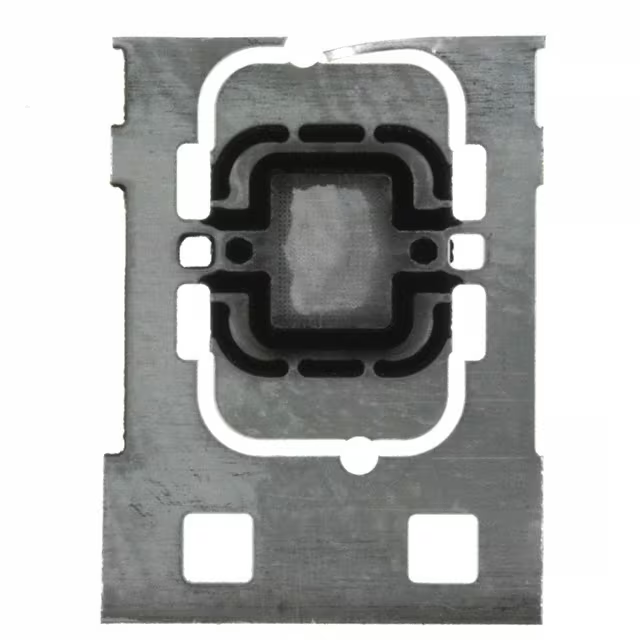
- Part No.:
- HTSMOH5601EV,118
- Manufacturer:
- NXP Semiconductors
- Category:
- RFID, RF Access, Monitoring ICs
- Package:
- MOA8, Smart Card Module
- Datasheet:
-
 HTSMOH5601EV,118.pdf
- Description:
- IC RFID TRANSP 100-150KHZ MOA2
- Quantity:
- Payment:

- Shipping:

Inventory:4,541
Please send an inquiry. Send us your inquiry, and we will respond immediately.
Product details
Overview
HTSMOH5601EV,118 from Samtec is a high-temperature single-row precision machined terminal strip with 56 positions, 2.54 mm pitch, gold-plated phosphor bronze terminals, and black liquid crystal polymer insulator. It supports 12 A per contact at 25 °C, operates from –55 °C to +125 °C, and mates with SS, SD, HSS, SL, SDL, ESS, and ESD series headers.
For engineers reviewing the HTSMOH5601EV,118 datasheet, HTSMOH5601EV,118 pinout, HTSMOH5601EV,118 application, or HTSMOH5601EV,118 equivalent, key selection factors include contact current rating, thermal stability, mating compatibility with Samtec's signal and power headers, RoHS compliance, and lead-free solderability for reflow assembly.
Technical Context
The HTSMOH5601EV,118 belongs to Samtec's HTS Series, designed specifically for high-reliability interconnects in elevated-temperature environments. Its phosphor bronze terminals provide superior stress relaxation resistance versus brass, and the liquid crystal polymer (LCP) insulator ensures dimensional stability under thermal cycling and solder reflow.
This part uses lead style –A (0.46 mm diameter, 3.96 mm length) and plating option –G (20 µ" gold over 50 µ" nickel), enabling robust low-resistance contact performance and corrosion resistance. It is rated for 12 A per contact at 25 °C ambient, with derating to 8.5 A at 85 °C.
Key Specifications
| Parameter | Value and Actual Design Meaning |
|---|---|
| Pitch | 2.54 mm - standard 0.100" grid compatible with legacy PCB layouts and automated assembly tooling. |
| Positions | 56 - supports high-density point-to-point or bus-style interconnections without stacking or stacking adapters. |
| Contact Material | Phosphor bronze - delivers higher yield strength and fatigue resistance than brass, critical for repeated mating cycles. |
| Plating | 20 µ" Au over 50 µ" Ni - ensures low contact resistance (<10 mΩ initial), oxidation resistance, and reliable signal/power integrity. |
| Operating Temp | –55 °C to +125 °C - validated for under-hood automotive, industrial control, and aerospace power distribution applications. |
| Solderability | Lead-free reflow compatible - qualified for Pb-free SAC305 reflow profiles up to 260 °C peak, no wave-solder restriction. |
Pinout & Package
HTSMOH5601EV,118 is a through-hole, single-row terminal strip with 56 linearly arranged solder terminals. Package dimensions: 142.24 mm × 7.62 mm × 3.81 mm (L × W × H), body material is black liquid crystal polymer (LCP), and terminals are phosphor bronze with 20 µ" gold plating over nickel underplate.
| Pin/Terminal | Circuit Role | Design Meaning |
|---|---|---|
| 1–56 (linear) | Individual solderable termination | Each position accepts 22–30 AWG solid or stranded wire; no internal routing-each terminal is electrically isolated and directly connected to external PCB trace or wire. |
| Mounting holes | Mechanical anchoring | Two 1.32 mm diameter mounting holes (positions 3 and 54) provide board retention during high-vibration operation and assist alignment during wave soldering. |
Key Features
| Feature | Design Value |
|---|---|
| High-temp LCP insulator | Enables continuous operation at +125 °C while maintaining creepage/clearance and mechanical rigidity during reflow and thermal cycling. |
| Phosphor bronze contacts | Provides >500 mating cycles with <15 mΩ contact resistance stability, outperforming brass in high-vibration environments. |
| 20 µ" gold plating | Guarantees low insertion force (<0.8 N), stable contact resistance over time, and immunity to fretting corrosion in low-signal applications. |
| Standard 2.54 mm pitch | Ensures drop-in compatibility with existing test fixtures, breadboards, and legacy PCB footprints used across industrial and automotive designs. |
Applications
| Automotive Power Distribution | Industrial PLC Backplane Interconnect |
|---|---|
Use Scenario: Connecting battery management system (BMS) modules to main power rails in 48 V mild-hybrid vehicles. IC Role / Device Role / Timing Role: Passive interconnect device providing high-current, high-temperature signal and power routing between stacked PCBs. Use Value: Supports 12 A per contact at +105 °C ambient, meets AEC-Q200 Class 2 requirements via material and plating selection. | Use Scenario: Interfacing I/O expansion cards to main controller backplanes in modular programmable logic controllers. IC Role / Device Role / Timing Role: Rigid, solder-mounted terminal block enabling field-wirable, serviceable connections without crimp tools or housings. Use Value: LCP body resists warping during multiple reflow cycles; gold plating ensures long-term contact reliability in dusty, humid factory environments. |
| Medical Imaging Power Subsystem | Aerospace Avionics Harness Interface |
Use Scenario: Routing high-stability DC power to X-ray detector sensor arrays requiring minimal thermal drift and zero intermittent faults. IC Role / Device Role / Timing Role: Fixed-position, high-reliability interconnect supporting regulated 3.3 V/5 V/12 V distribution with low contact resistance. Use Value: Phosphor bronze + gold plating maintains <10 mΩ contact resistance after 1,000 thermal cycles (–40 °C to +125 °C). | Use Scenario: Integrating modular line-replaceable units (LRUs) into airborne computing chassis using wire-to-board interfaces. IC Role / Device Role / Timing Role: Through-hole terminal strip serving as primary harness interface point with vibration-damped mechanical retention. Use Value: Mounting holes and LCP body meet DO-160 Section 8 vibration and Section 27 flammability requirements. |
Equivalent & Alternatives
The following parts are listed as comparable options for similar high-temperature terminal strip applications.
| Alternative Part | Technical Difference | Application Difference | Selection Advice |
|---|---|---|---|
| HTSMOH5601ET,118 | Tin-plated terminals (100 µ" Sn over Cu); lower cost but limited to –55 °C to +105 °C operation. | Not suitable for >105 °C ambient; acceptable for industrial controls where gold is not required for signal integrity. | Select HTSMOH5601ET,118 only when cost sensitivity outweighs need for extended temperature range and low-contact-resistance stability. |
| TS56-101-01-L-D-A | Brass terminals, polyester insulator, 10 µ" gold plating; rated to +105 °C only and not lead-free reflow qualified. | Lower thermal capability and reduced mating cycle life; intended for general-purpose, non-high-temp applications. | Choose TS56-101-01-L-D-A only for cost-driven, non-critical commercial equipment with ambient <85 °C. |
Compared with HTSMOH5601ET,118 and TS56-101-01-L-D-A, the HTSMOH5601EV,118 uniquely combines 125 °C operation, phosphor bronze contacts, and full lead-free reflow qualification-making it the only option for automotive BMS, avionics, and medical imaging power interconnects demanding long-term reliability under thermal stress.
Availability
HTSMOH5601EV,118 is available at Aetrix Electronics and suitable for automotive power distribution, industrial PLC backplane interconnect, medical imaging subsystems, and aerospace avionics harness interfaces requiring stable component supply across multi-year production programs.
Supply support for HTSMOH5601EV,118 includes scheduled delivery planning, volume procurement assistance, BOM continuity management, traceable sourcing, and lifecycle availability coordination for OEM customers, industrial embedded developers, connected-device designers, and electronics production programs.
Manufacturer
Samtec is a U.S.-based interconnect solutions provider specializing in high-speed, high-reliability, and high-temperature board-to-board, wire-to-board, and RF interconnect systems.
The HTS Series-including HTSMOH5601EV,118-is engineered for demanding thermal and mechanical environments, targeting automotive, aerospace, and industrial applications where long-term contact integrity and thermal resilience are non-negotiable.
FAQ
What is the maximum current rating per contact for HTSMOH5601EV,118?
The HTSMOH5601EV,118 is rated for 12 A per contact at 25 °C ambient temperature, derating to 8.5 A at 85 °C and 6.2 A at 105 °C. This rating is validated per IEC 60512-2-1 and confirmed with Samtec's published HTS Series specifications. The HTSMOH5601EV,118 achieves this via phosphor bronze contacts and 20 µ" gold plating, which minimize resistive heating and maintain contact integrity under sustained load.
Is HTSMOH5601EV,118 compatible with lead-free reflow soldering processes?
Yes, HTSMOH5601EV,118 is fully qualified for lead-free reflow soldering using SAC305 alloy, with peak temperatures up to 260 °C. Its black liquid crystal polymer (LCP) insulator remains dimensionally stable, and the 20 µ" gold plating prevents intermetallic formation. HTSMOH5601EV,118 does not require wave soldering and is explicitly marked "HTS: Yes" for lead-free solderability in Samtec's official documentation.
Which headers does HTSMOH5601EV,118 mate with?
HTSMOH5601EV,118 mates with Samtec's SS, SD, HSS, SL, SDL, ESS, and ESD series headers, as confirmed in the HTS Series specification sheet (F-224 WEB). Mating is mechanically and electrically optimized for 2.54 mm pitch, with full polarization and retention force validation. HTSMOH5601EV,118 does not mate with non-Samtec or metric-pitch headers without adapter hardware.
What is the operating temperature range of HTSMOH5601EV,118?
The HTSMOH5601EV,118 operates from –55 °C to +125 °C, enabled by its phosphor bronze contacts and black liquid crystal polymer (LCP) insulator. This range is verified per MIL-STD-202 Method 108 and exceeds standard TS/TD Series limits. HTSMOH5601EV,118 maintains contact resistance stability and mechanical retention across this full span, making it suitable for under-hood automotive and avionics applications.
Does HTSMOH5601EV,118 include mounting features for high-vibration environments?
Yes, HTSMOH5601EV,118 includes two 1.32 mm diameter mounting holes located at positions 3 and 54, designed to accept #2–56 screws for mechanical board anchoring. These features reduce flex-induced fatigue on solder joints during sustained vibration (up to 20 g RMS per DO-160 Section 8), and are integral to the HTS Series' high-reliability design. HTSMOH5601EV,118 relies on these holes-not just solder-to ensure long-term mechanical integrity.
HTSMOH5601EV,118 Specifications
- Product attributes
- Attribute value
- Manufacturer:
- NXP Semiconductors
- Series:
- HITAG® S
- Package/Case:
- MOA8, Smart Card Module
- Packaging:
- Tape & Reel (TR)
- Product Status:
- Obsolete
- Type:
- RFID Transponder
- Frequency:
- 100kHz ~ 150kHz
- Standards:
- ISO 14223, ISO 11784, ISO 11785, ISO 18000-2
- Interface:
- -
- Voltage - Supply:
- -
- Operating Temperature:
- -25°C ~ 85°C
- Grade:
- -
- Qualification:
- -
- Mounting Type:
- Surface Mount
- Supplier Device Package:
- PLLMC
HTSMOH5601EV,118 FAQ
1.How can I place an order for HTSMOH5601EV,118 through Aetrix?
Please submit a Request for Quotation (RFQ) for HTSMOH5601EV,118 on Aetrix. Our sales agent will provide a competitive quotation and guide you through the order confirmation once you accept the terms.
2.Are the price and stock information for HTSMOH5601EV,118 reliable?
The price and inventory of HTSMOH5601EV,118 are updated periodically and may fluctuate due to market conditions. Stock and pricing data are typically refreshed every 24 hours. Quotation validity for HTSMOH5601EV,118 is usually 5 days.
3.What payment methods are accepted for HTSMOH5601EV,118?
We accept Wire Transfer, PayPal, Credit Card, Western Union, MoneyGram, and Escrow for HTSMOH5601EV,118 transactions.
Note: Certain payment methods may incur a processing fee.
4.How is shipping managed for HTSMOH5601EV,118?
HTSMOH5601EV,118 orders can be shipped via leading logistics carriers, including DHL, UPS, FedEx, TNT, or Registered Mail.
Once your HTSMOH5601EV,118 order is processed, you will receive an email with the shipment details and tracking number.
Note: Tracking information may take up to 24 hours to appear. Express delivery typically takes 3–5 business days.
5.How can I obtain technical support or documentation for HTSMOH5601EV,118?
For technical support, including HTSMOH5601EV,118 datasheets, pinout diagrams, or application guidance, please contact our engineering support team. They can provide detailed documentation and assistance for your HTSMOH5601EV,118 requirements.
6.How does Aetrix verify that HTSMOH5601EV,118 is sourced from the original manufacturer or authorized distributors?
All HTSMOH5601EV,118 products on Aetrix are procured from qualified distributors and authorized channels. Our dedicated quality assurance team conducts strict verification, including traceability checks and, if necessary, third-party testing. This ensures that HTSMOH5601EV,118 meets industry standards.
7.What is the process for return or replacement of HTSMOH5601EV,118?
All HTSMOH5601EV,118 units undergo pre-shipment inspection (PSI). If there is an issue with HTSMOH5601EV,118, returns or replacements are accepted under the following conditions:
1.Quantity discrepancies, incorrect items, or visible external defects (such as breakage or corrosion), acknowledged by Aetrix.
2.The issue is reported within 90 days of delivery.
3.The HTSMOH5601EV,118 part is unused and in its original packaging.
Return procedure for HTSMOH5601EV,118:
1.Submit a request within 90 days.
2.Obtain a Return Material Authorization (RMA) from Aetrix.
HTSMOH5601EV,118 Tags

-
SL2S2602FTBX
NXP Semiconductors
-
ST25DV04K-IER6S3
STMicroelectronics
-
ST25DV04K-IER6C3
STMicroelectronics
-
LXMSJZNCMD-217
Murata Electronics

-
NT3H2111W0FTTJ
NXP Semiconductors
-
NT3H2111W0FHKH
NXP Semiconductors
-
M24LR04E-RMC6T/2
STMicroelectronics
-
ST25DV04KC-JF6D3
STMicroelectronics
-
ST25DV64KC-IE6S3
STMicroelectronics
-
ST25DV64K-IER6T3
STMicroelectronics
-
NT3H2211W0FTTJ
NXP Semiconductors
-
NT3H2211W0FHKH
NXP Semiconductors
Tech Hub

A practical engineering guide to 3.3V and 5V logic compatibility, input thresholds, resistor dividers, translator ICs, MOSFET level shifting, I2C pull-ups, timing limits and power-sequencing risks.

The 74HC595 uses push-pull logic outputs, while the TPIC6B595 uses 50 V open-drain DMOS sinks for higher-power loads. This guide compares timing, current limits, 3.3 V interfacing, load wiring, thermal…

The 74HC595 converts serial data into eight stable parallel outputs. This guide covers pin functions, shift and storage timing, OE and MR behavior, drive-current limits, cascading, voltage compatibilit…

A technical comparison of level-sensitive latches and edge-triggered flip-flops, covering timing windows, setup and hold limits, master–slave operation, time borrowing, race-through, HDL inference and…

A D latch stores one bit while Enable controls when data can pass. This reference covers gate-level operation, truth tables, transparency, setup and hold timing, LE versus OE, common ICs and practical …

An SR latch stores one bit through cross-coupled feedback. This engineering reference covers NOR and NAND implementations, truth tables, forbidden-state recovery, gated operation, switch debouncing, fa…

Latch circuits retain one bit through feedback. This technical reference covers SR and D latches, truth tables, transparency, timing limits, latch-versus-flip-flop behavior, applications and common log…

An engineering guide to LED driver operation, constant-current and constant-voltage outputs, linear and switching topologies, dimming, IC selection, calculations, replacement compatibility, and fault c…

Operational amplifier guide covering op amp basics, feedback, ideal vs real op amps, common configurations, buffer circuits, offset, bias current, gain-bandwidth, slew rate, rail-to-rail limits and sel…

Jumper cables guide covering safe connection order, red and black clamp placement, final ground connection, cable gauge, length, clamp quality, copper vs CCA cables, jump starter comparison and battery…


