
 My Inquiry
 My Account


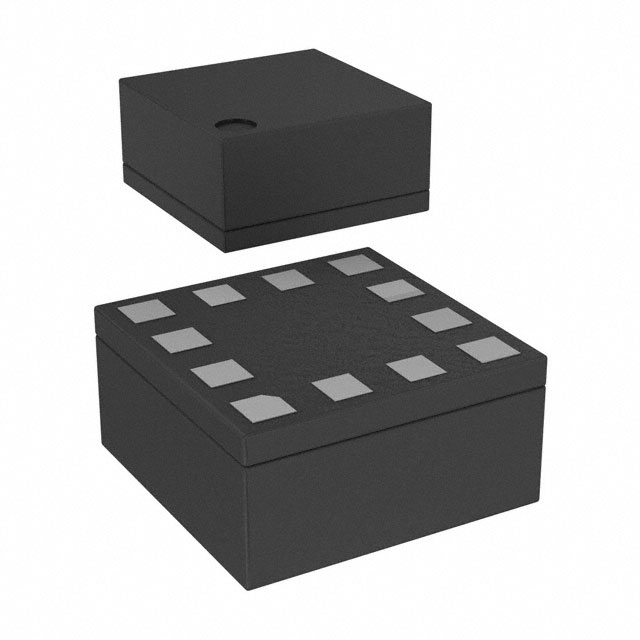
STMicroelectronics IIS2DHTR
- Part No.:
- IIS2DHTR
- Manufacturer:
- STMicroelectronics
- Category:
- Accelerometers
- Package:
- 12-VFLGA
- Datasheet:
-
 IIS2DHTR.pdf
- Description:
- ACCEL 2-16G I2C/SPI 12LGA
- Quantity:
- Payment:

- Shipping:

Inventory:9,835
Please send an inquiry. Send us your inquiry, and we will respond immediately.
Product details
Overview
IIS2DHTR from STMicroelectronics is an ultra-low-power, high-performance 3-axis digital accelerometer designed for industrial motion sensing. It supports selectable full-scale ranges (±2g/±4g/±8g/±16g), operates from 1.71 V to 3.6 V, consumes as low as 2 μA in low-power mode, and delivers output data rates up to 5.3 kHz-enabling precise tilt, impact, and vibration monitoring in factory equipment and robotics.
For engineers reviewing the IIS2DHTR datasheet, IIS2DHTR pinout, IIS2DHTR application, or IIS2DHTR equivalent, key selection criteria include its dual interrupt generators for motion/fall detection, embedded FIFO and temperature sensor, 6D/4D orientation capability, and compatibility with both I²C and SPI interfaces in space-constrained LGA-12 packaging.
Technical Context
The IIS2DHTR integrates a MEMS sensing element with a digital signal processing chain supporting three configurable operating modes: low-power (2 μA), normal, and high-resolution-each with distinct noise-performance trade-offs and turn-on timing. Its register-mapped architecture enables fine-grained control of data rate, high-pass filtering, self-test activation, and interrupt thresholds via dedicated configuration registers (e.g., CTRL_REG1–CTRL_REG6).
Interrupt logic is implemented through two independent generators (INT1/INT2) supporting free-fall, wake-up, click/double-click, and activity/inactivity events. The embedded FIFO (up to 32 samples) operates in bypass, stream, FIFO, or stream-to-FIFO modes, decoupling host read timing from sensor sampling-critical for deterministic latency in industrial control loops.
Key Specifications
| Parameter | Value and Actual Design Meaning |
|---|---|
| Supply voltage | 1.71 V to 3.6 V - supports direct integration into battery-powered or wide-input industrial power rails without external regulation. |
| Current consumption | 2 μA in low-power mode - enables multi-year operation on coin-cell batteries in remote condition-monitoring nodes. |
| Full-scale range | ±2g / ±4g / ±8g / ±16g - user-selectable via CTRL_REG4; allows optimization of resolution vs. dynamic range per application. |
| Output data rate | 1 Hz to 5.3 kHz - supports slow tilt measurement and fast impact transient capture within a single device. |
| Digital interface | I²C (standard/fast-mode) and SPI (3-/4-wire) - ensures interoperability with legacy microcontrollers and real-time systems requiring deterministic access. |
| Operating temperature | −40 °C to +85 °C - validated for deployment in harsh industrial environments including motor control cabinets and outdoor equipment enclosures. |
| Embedded features | FIFO (32-sample depth), self-test, 6D/4D orientation detection, temperature sensor - reduces host MCU firmware overhead and enables autonomous event-driven operation. |
Pinout & Package
LGA-12 package (2.0 mm × 2.0 mm × 1.0 mm), RoHS-compliant, land grid array with exposed pad for thermal and mechanical stability.
| Pin/Terminal | Circuit Role | Design Meaning |
|---|---|---|
| VDD | Main supply input | Connects to 1.71–3.6 V power rail; powers internal analog and digital blocks. |
| VDD_IO | IO supply input | Independent 1.8 V supply for digital interface pins-enables level-shifting with 1.8 V logic without external translators. |
| GND | Ground reference | Common return path for analog and digital domains; must be low-impedance and tied to exposed pad. |
| SCL/SPC | I²C clock / SPI clock | Configurable as I²C SCL or SPI SPC; requires pull-up for I²C, driven by host for SPI. |
| SDA/SDI | I²C data / SPI data in | Bidirectional I²C data line or unidirectional SPI MOSI; shares pin with SDI function. |
| SDO/SA0 | I²C address select / SPI data out | Configurable as I²C slave address bit (SA0) or SPI MISO; determines I²C address (0x18 or 0x19). |
| INT1 | Programmable interrupt 1 output | Open-drain output signaling motion, free-fall, click, or FIFO threshold events per INT1_CFG register settings. |
| INT2 | Programmable interrupt 2 output | Independent open-drain output for second set of configurable inertial or orientation events. |
| CS | SPI chip select | Active-low enable for SPI communication; must be asserted before each SPI transaction. |
| DRDY | Data ready indicator | Open-drain signal pulses when new acceleration data is available in output registers-synchronizes host reads. |
| NC | No connect | Unbonded pin; left floating or grounded per layout guidelines-no electrical function. |
| EPAD | Exposed thermal pad | Internally connected to GND; soldering improves thermal dissipation and mechanical reliability. |
Key Features
| Feature | Design Value |
|---|---|
| Ultra-low-power operation | 2 μA current draw in low-power mode enables >10-year battery life in wireless sensor nodes with infrequent wake-ups. |
| Dual independent interrupt generators | INT1 and INT2 support simultaneous configuration for motion detection and free-fall-eliminates need for host polling or additional logic. |
| 6D/4D orientation detection | Hardware-accelerated position recognition (e.g., portrait/landscape/up/down) reduces CPU load and enables instant UI response in handheld tools. |
| Embedded FIFO buffer | 32-sample depth with four operational modes offloads burst data capture from host processor-critical for jitter-sensitive industrial logging. |
| Integrated temperature sensor | On-die sensor with ±3 °C accuracy over −40 °C to +85 °C enables in-situ thermal compensation of offset and sensitivity drift. |
Applications
| Robotics | Anti-tampering devices |
|---|---|
Use Scenario: Real-time joint angle estimation and collision avoidance in collaborative robotic arms. IC Role / Device Role / Timing Role: Primary 3-axis motion sensor feeding closed-loop servo control with <5 ms latency at 1 kHz ODR. Use Value: High-resolution ±2g/±4g scaling and embedded FIFO ensure deterministic sampling during rapid arm repositioning without host bottleneck. |
Use Scenario: Detecting unauthorized physical access or enclosure opening in secure industrial gateways. IC Role / Device Role / Timing Role: Always-on inertial monitor triggering tamper alerts via INT1 on sudden displacement or impact. Use Value: 2 μA low-power mode and "sleep-to-wake" functionality sustain years of operation on backup battery while maintaining sub-100 ms wake latency. |
| Vibration monitoring | Tilt/inclination measurements |
Use Scenario: Predictive maintenance on rotating machinery using spectral analysis of high-frequency acceleration waveforms. IC Role / Device Role / Timing Role: High-bandwidth sensor capturing up to 5.3 kHz data for FFT-based fault signature extraction. Use Value: Low-noise high-resolution mode and stable ±16g range support detection of bearing defects and imbalance harmonics above 2 kHz. |
Use Scenario: Precision leveling in construction lasers and automated surveying equipment. IC Role / Device Role / Timing Role: Static tilt estimator using DC-coupled ±2g output with temperature-compensated zero-g calibration. Use Value: Factory-trimmed offset (<±50 mg) and integrated temperature sensor enable <0.1° tilt accuracy across −40 °C to +85 °C. |
Equivalent & Alternatives
The following parts are listed as comparable options for similar 3-axis accelerometer applications.
| Alternative Part | Technical Difference | Application Difference | Selection Advice |
|---|---|---|---|
| LSM6DSRTR | Higher current (1.5 mA typical in low-power mode), integrated gyroscope, supports machine learning core (ST's AI sensor hub) | Targeted at context-aware edge AI applications requiring fused motion tracking-not optimized for pure ultra-low-power static sensing | Select when gyro fusion or on-device ML inference is required; avoid if minimizing quiescent current is primary constraint |
| ADXL362ACPZ-RL7 | Lower noise density (175 μg/√Hz), true ultralow power (300 nA in wake-up mode), but no embedded FIFO or orientation engine | Best suited for long-life battery applications needing only basic motion wake-up-not for complex event sequencing or orientation state machines | Select for extreme energy-constrained deployments where interrupt-only wake-up suffices and host handles all logic |
Compared with LSM6DSRTR and ADXL362ACPZ-RL7, the IIS2DHTR uniquely balances sub-μA-level power efficiency, hardware-accelerated orientation detection, and 32-deep FIFO-making it optimal for industrial nodes requiring autonomous, low-overhead motion intelligence without gyro or AI compute.
Availability
IIS2DHTR is available at Aetrix Electronics and suitable for robotics, industrial vibration monitoring, anti-tampering security systems, and tilt-sensing instrumentation requiring stable component supply across extended temperature and long product lifecycles.
Supply support for IIS2DHTR includes scheduled delivery planning, volume procurement assistance, BOM continuity management, traceable sourcing, and lifecycle availability coordination for OEM customers, industrial embedded developers, connected-device designers, and electronics production programs.
Manufacturer
STMicroelectronics is a global semiconductor leader headquartered in Geneva, specializing in intelligent power, sensors, microcontrollers, and automotive ICs-with strong focus on industrial and IoT applications.
The IIS2DHTR belongs to ST's high-reliability industrial accelerometer portfolio, engineered specifically for robust motion sensing in factory automation, predictive maintenance, and ruggedized portable equipment.
FAQ
What is the maximum output data rate supported by the IIS2DHTR?
The IIS2DHTR supports output data rates from 1 Hz up to 5.3 kHz, selectable via CTRL_REG1 register. At 5.3 kHz, it delivers full 3-axis data with 12-bit resolution in high-resolution mode-enabling capture of high-frequency mechanical transients such as gear mesh vibrations or impact shocks in industrial assets.
Does the IIS2DHTR support both I²C and SPI simultaneously?
No-the IIS2DHTR uses shared pins (SCL/SPC, SDA/SDI, SDO/SA0) for I²C and SPI, so only one interface can be active at a time. Interface selection is determined by hardware configuration: CS pin low enables SPI; CS high with SDA/SCL pulled up enables I²C. Both protocols are fully supported, but not concurrent.
How does the embedded FIFO improve system-level performance?
The 32-sample FIFO buffers acceleration data independently of host read timing, allowing burst acquisition at high ODR while reducing I/O traffic and CPU polling overhead. In stream-to-FIFO mode, it automatically discards oldest data when full-enabling continuous background logging without host intervention, critical for deterministic data capture in PLC-linked sensors.
Can the IIS2DHTR perform self-test in-system?
Yes-the IIS2DHTR includes a hardware self-test function activated via CTRL_REG4. When triggered, it electrostatically excites the MEMS structure, producing a known differential output shift detectable in the OUT_X/Y/Z registers. This validates sensor functionality and signal chain integrity without mechanical stimulus-essential for pre-deployment verification in safety-critical industrial tools.
IIS2DHTR Specifications
- Product attributes
- Attribute value
- Manufacturer:
- STMicroelectronics
- Series:
- -
- Package/Case:
- 12-VFLGA
- Packaging:
- Tape & Reel (TR)
- Product Status:
- Active
- Type:
- Digital
- Axis:
- X, Y, Z
- Acceleration Range:
- ±2g, 4g, 8g, 16g
- Sensitivity (LSB/g):
- 255 (±2g) ~ 21 (±16g)
- Sensitivity (mV/g):
- -
- Bandwidth:
- 1Hz ~ 5.3kHz
- Output Type:
- I2C, SPI
- Voltage - Supply:
- 1.71V ~ 3.6V
- Features:
- Adjustable Bandwidth, Selectable Scale, Sleep Mode, Temperature Sensor
- Operating Temperature:
- -40°C ~ 85°C
- Grade:
- -
- Qualification:
- -
- Mounting Type:
- Surface Mount
- Supplier Device Package:
- 12-LGA (2x2)
IIS2DHTR FAQ
1.How can I place an order for IIS2DHTR through Aetrix?
Please submit a Request for Quotation (RFQ) for IIS2DHTR on Aetrix. Our sales agent will provide a competitive quotation and guide you through the order confirmation once you accept the terms.
2.Are the price and stock information for IIS2DHTR reliable?
The price and inventory of IIS2DHTR are updated periodically and may fluctuate due to market conditions. Stock and pricing data are typically refreshed every 24 hours. Quotation validity for IIS2DHTR is usually 5 days.
3.What payment methods are accepted for IIS2DHTR?
We accept Wire Transfer, PayPal, Credit Card, Western Union, MoneyGram, and Escrow for IIS2DHTR transactions.
Note: Certain payment methods may incur a processing fee.
4.How is shipping managed for IIS2DHTR?
IIS2DHTR orders can be shipped via leading logistics carriers, including DHL, UPS, FedEx, TNT, or Registered Mail.
Once your IIS2DHTR order is processed, you will receive an email with the shipment details and tracking number.
Note: Tracking information may take up to 24 hours to appear. Express delivery typically takes 3–5 business days.
5.How can I obtain technical support or documentation for IIS2DHTR?
For technical support, including IIS2DHTR datasheets, pinout diagrams, or application guidance, please contact our engineering support team. They can provide detailed documentation and assistance for your IIS2DHTR requirements.
6.How does Aetrix verify that IIS2DHTR is sourced from the original manufacturer or authorized distributors?
All IIS2DHTR products on Aetrix are procured from qualified distributors and authorized channels. Our dedicated quality assurance team conducts strict verification, including traceability checks and, if necessary, third-party testing. This ensures that IIS2DHTR meets industry standards.
7.What is the process for return or replacement of IIS2DHTR?
All IIS2DHTR units undergo pre-shipment inspection (PSI). If there is an issue with IIS2DHTR, returns or replacements are accepted under the following conditions:
1.Quantity discrepancies, incorrect items, or visible external defects (such as breakage or corrosion), acknowledged by Aetrix.
2.The issue is reported within 90 days of delivery.
3.The IIS2DHTR part is unused and in its original packaging.
Return procedure for IIS2DHTR:
1.Submit a request within 90 days.
2.Obtain a Return Material Authorization (RMA) from Aetrix.
IIS2DHTR Tags

-
MXC4005XC
Memsic Inc.
-
MC3419
Memsic Inc.
-
MC3479
Memsic Inc.
-
MXC6655XA
Memsic Inc.
-
MC3630
Memsic Inc.
.jpg)
-
LIS2HH12TR
STMicroelectronics
-
KX122-1037
Kionix Inc.
-
LIS2DE12TR
STMicroelectronics
-
LIS2DH12TR
STMicroelectronics
-
MC3635
Memsic Inc.
-
LIS2DS12TR
STMicroelectronics

-
LIS3DHTR
STMicroelectronics
Tech Hub

A practical engineering and sourcing framework covering lifecycle verification, lifetime-buy calculations, replacement qualification, supplier checks and counterfeit-risk controls.

TTL and CMOS logic families differ in thresholds, loading, output drive, power and timing. This engineering guide compares 74HC and 74HCT, calculates noise margins and checks 3.3 V/5 V compatibility.

A practical engineering guide to 3.3V and 5V logic compatibility, input thresholds, resistor dividers, translator ICs, MOSFET level shifting, I2C pull-ups, timing limits and power-sequencing risks.

The 74HC595 uses push-pull logic outputs, while the TPIC6B595 uses 50 V open-drain DMOS sinks for higher-power loads. This guide compares timing, current limits, 3.3 V interfacing, load wiring, thermal…

The 74HC595 converts serial data into eight stable parallel outputs. This guide covers pin functions, shift and storage timing, OE and MR behavior, drive-current limits, cascading, voltage compatibilit…

A technical comparison of level-sensitive latches and edge-triggered flip-flops, covering timing windows, setup and hold limits, master–slave operation, time borrowing, race-through, HDL inference and…

A D latch stores one bit while Enable controls when data can pass. This reference covers gate-level operation, truth tables, transparency, setup and hold timing, LE versus OE, common ICs and practical …

An SR latch stores one bit through cross-coupled feedback. This engineering reference covers NOR and NAND implementations, truth tables, forbidden-state recovery, gated operation, switch debouncing, fa…

Latch circuits retain one bit through feedback. This technical reference covers SR and D latches, truth tables, transparency, timing limits, latch-versus-flip-flop behavior, applications and common log…

An engineering guide to LED driver operation, constant-current and constant-voltage outputs, linear and switching topologies, dimming, IC selection, calculations, replacement compatibility, and fault c…


