
 My Inquiry
 My Account


STMicroelectronics LPY430AL
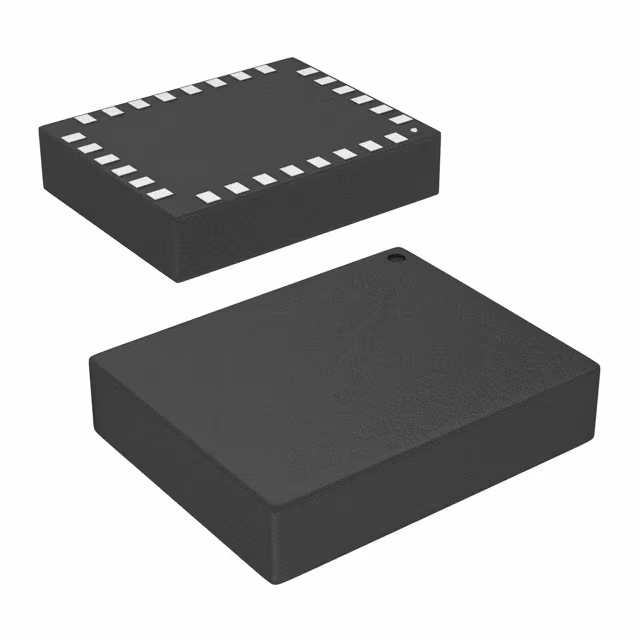
- Part No.:
- LPY430AL
- Manufacturer:
- STMicroelectronics
- Category:
- Gyroscopes
- Package:
- 28-TFLGA
- Datasheet:
-
 LPY430AL.pdf
- Description:
- GYRO 300DEG/S 3.33MV 28LGA
- Quantity:
- Payment:

- Shipping:

Inventory:4,871
Please send an inquiry. Send us your inquiry, and we will respond immediately.
Product details
Overview
LPY430AL from STMicroelectronics is a dual-axis MEMS gyroscope measuring angular rate along pitch and yaw axes with ±300 dps full-scale range, 140 Hz bandwidth, and analog outputs (amplified and non-amplified) for both axes. It operates from 2.7 V to 3.6 V, supports -40 °C to +85 °C operation, and integrates self-test, sleep mode, and embedded low-pass filtering - used in motion-sensing remote controllers and GPS navigation systems.
For engineers reviewing the LPY430AL datasheet, LPY430AL pinout, LPY430AL application, or LPY430AL equivalent, key selection considerations include its dual-axis analog output architecture, temperature-stable sensitivity (3.33 mV/dps amplified), low-power sleep mode (2.1 mA), and LGA-28 package compatibility with high-shock industrial environments.
Technical Context
The LPY430AL employs a single micromachined driving mass oscillating continuously and reacting via the Coriolis effect to applied angular rates. Its CMOS interface IC conditions and outputs analog voltage signals - two per axis (OUTX/4xOUTX and OUTZ/4xOUTZ) - with factory-trimmed sensitivity and zero-rate level referenced to 1.5 V.
It embeds a PLL-based timing system requiring external RC components on VCONT and FILTVDD pins for phase synchronization, and supports three operating modes (normal, sleep, power-down) controlled by ST and SLEEP/PD pins - enabling rapid wake-up and µA-level shutdown current.
Key Specifications
| Parameter | Value and Actual Design Meaning |
|---|---|
| Full Scale Range | ±300 dps (amplified output); enables precise motion detection within consumer-grade pointing device requirements |
| Bandwidth | 140 Hz (-3 dB); supports real-time response for game controller tilt and robotic joint feedback |
| Sensitivity | 3.33 mV/dps (4xOUT); provides 10-bit-equivalent resolution at 3.3 V supply without external ADC gain staging |
| Zero-Rate Level | 1.5 V (ratiometrically stable); simplifies DC-coupled signal chain design and reduces calibration overhead |
| Supply Current | 6.8 mA (active), 2.1 mA (sleep), 1–5 µA (power-down); enables battery-powered operation >1 year in intermittent-use remotes |
| Operating Temp | -40 °C to +85 °C; qualified for automotive cabin and industrial enclosure deployment without derating |
| Shock Survivability | 3000 g / 0.5 ms; withstands mechanical stress during handheld device drop events and robotic actuation transients |
Pinout & Package
LGA-28 (4 mm × 5 mm × 1 mm) land grid array package with exposed pad; RoHS-compliant ECOPACK® construction, JEDEC J-STD-020 soldering qualified.
| Pin/Terminal | Circuit Role | Design Meaning |
|---|---|---|
| 1, 20 | OUT Z / OUT X | Non-amplified analog angular rate outputs (0.83 mV/dps); require external amplification or ADC with ≥12-bit ENOB |
| 7, 14 | 4xOUTZ / 4xOUTX | Internally buffered 4× amplified outputs (3.33 mV/dps); drive 10 kΩ loads directly into MCU ADC inputs |
| 5, 16 | 4xIN Z / 4xIN X | Inputs to internal 4× amplifier stage; must be tied to Vref (1.5 V) when using non-amplified outputs |
| 24 | HP | High-pass filter reset control; logic high resets external HPF to clear DC offset after power-on or overload |
| 27 | ST | Self-test activation input; logic high applies electrostatic force to verify mechanical integrity and signal path functionality |
| 28 | SLEEP/PD | Mode control: GND = normal, Vdd = power-down, Vdd+ST=Vdd = sleep; enables <2.5 ms wake-up latency |
| 22 | Vref | Stable 1.5 V reference output; used to bias 4xIN pins and calibrate zero-rate drift compensation circuits |
| 9, 19, 26 | Vdd / GND | Dual Vdd pins (9, 19) and dedicated GND (26) minimize supply noise coupling into analog signal paths |
Key Features
| Feature | Design Value |
|---|---|
| Dual-axis analog outputs | Separate X/Z channels with independent amplified (4xOUT) and raw (OUT) outputs - eliminates need for multiplexed sampling or external mux |
| Embedded low-pass filtering | Fixed 140 Hz cutoff reduces aliasing risk for 250 Hz MCU sampling; avoids external RC component count and layout sensitivity |
| Factory-trimmed sensitivity & zero-rate | Calibrated at 3 V; ±0.07 %/°C sensitivity drift and ±0.05 dps/°C zero-rate drift enable <0.5° heading error over full temp range |
| Self-test with electrostatic actuation | 250 mV typical output shift confirms functional integrity of sensing mass and readout circuitry - no external test equipment required |
| Low-power operational modes | 2.1 mA sleep current allows continuous orientation tracking in portable devices; 1–5 µA power-down extends shelf life of sealed modules |
Applications
| Pointing Devices | GPS Navigation Systems |
|---|---|
Use Scenario: Tilt-based cursor control in wireless presentation remotes and smart TV pointers. IC Role / Device Role / Timing Role: Dual-axis angular rate sensor providing real-time pitch/yaw data to MCU for 2D pointer mapping. Use Value: 140 Hz bandwidth ensures sub-10 ms latency between physical motion and on-screen response; low 6.8 mA active current enables AA-battery operation >6 months. | Use Scenario: Heading correction during GPS signal loss in automotive navigation units. IC Role / Device Role / Timing Role: Angular rate source for dead-reckoning integration with accelerometer and magnetometer in AHRS fusion. Use Value: ±300 dps full scale covers typical vehicle turning rates; -40 °C to +85 °C rating ensures reliability inside dashboard enclosures. |
| Game Controllers | Industrial Robotics |
Use Scenario: Motion-responsive gameplay in console controllers and VR handsets. IC Role / Device Role / Timing Role: Primary pitch/yaw motion capture element feeding IMU algorithm for gesture recognition. Use Value: Self-test capability validates sensor health before each gaming session; 3000 g shock survivability prevents failure during aggressive controller use. | Use Scenario: Joint angle feedback in collaborative robot (cobot) end-effectors and articulated arms. IC Role / Device Role / Timing Role: Compact angular velocity monitor for closed-loop servo tuning and vibration monitoring. Use Value: LGA-28 package enables direct PCB mounting in space-constrained joints; embedded low-pass filter suppresses motor-induced mechanical noise above 140 Hz. |
Equivalent & Alternatives
The following parts are listed as comparable options for similar dual-axis analog gyroscope applications.
| Alternative Part | Technical Difference | Application Difference | Selection Advice |
|---|---|---|---|
| ADXRS645 | Single-axis, digital SPI output; higher 2000 dps range; 0.015°/√hr ARW; requires external ADC and clock | Targeted at inertial navigation grade; lacks integrated self-test and sleep mode | Select for high-precision heading hold where digital interface and lower noise outweigh dual-axis convenience |
| LPY430AH | Same dual-axis analog architecture but ±150 dps full scale; identical pinout, package, and feature set | Optimized for lower-range motion detection (e.g., UI scrolling vs. full rotation) | Select when application angular rates stay below ±150 dps to improve resolution and reduce saturation risk |
Compared with ADXRS645 and LPY430AH, the LPY430AL uniquely balances dual-axis analog simplicity, built-in power management, and ±300 dps range - making it optimal for cost-sensitive, battery-operated motion interfaces where rapid integration and minimal BOM count are critical.
Availability
LPY430AL is available at Aetrix Electronics and suitable for motion-sensing remote controllers, GPS dead-reckoning modules, and industrial robotic joint feedback systems requiring stable component supply across extended temperature ranges and long production lifecycles.
Supply support for LPY430AL includes scheduled delivery planning, volume procurement assistance, BOM continuity management, traceable sourcing, and lifecycle availability coordination for OEM customers, industrial embedded developers, connected-device designers, and electronics production programs.
Manufacturer
STMicroelectronics is a global semiconductor leader headquartered in Geneva, Switzerland, designing and manufacturing microcontrollers, sensors, power ICs, and analog/mixed-signal devices for industrial, automotive, and consumer markets.
The LPY430AL belongs to ST's MEMS motion sensor product line, engineered specifically for compact, low-power angular rate measurement in human-interface and navigation applications - leveraging ST's high-volume LGA packaging expertise and proven accelerometer manufacturing infrastructure.
FAQ
What is the function of the HP pin on the LPY430AL?
The HP (High-pass Filter Reset) pin resets an optional external high-pass filter by applying a logic high signal. This clears DC offset buildup after power-on or mechanical overload, ensuring accurate zero-rate baseline recovery. It must be driven actively - leaving it floating may cause unpredictable output drift during startup sequences.
How does the self-test feature verify sensor integrity?
The ST pin activates an electrostatic force that displaces the internal MEMS mass, generating a predictable 250 mV DC-level shift at the output pins. This confirms both mechanical mobility of the sensing element and correct operation of the analog signal chain - no external stimulus or instrumentation is needed for functional validation.
Can the LPY430AL operate with only one axis enabled?
Yes - the device supports independent use of either X or Z axis outputs. Unused axis outputs can remain unconnected, and corresponding 4xIN pins should be tied to Vref (1.5 V) if their amplified outputs are not used. Power consumption remains unchanged since internal oscillator and bias circuits operate for both axes simultaneously.
What external components are mandatory for stable LPY430AL operation?
Mandatory components include: 100 nF ceramic + 10 µF aluminum decoupling capacitors near Vdd pins; 2.2 kΩ resistor and 10 nF capacitor on VCONT; 1.7 kΩ resistor and 10 nF capacitor on FILTVDD. These implement the PLL loop filter - omission causes unstable oscillation and erratic output due to loss of driving frequency synchronization.
LPY430AL Specifications
- Product attributes
- Attribute value
- Manufacturer:
- STMicroelectronics
- Series:
- -
- Package/Case:
- 28-TFLGA
- Packaging:
- Tray
- Product Status:
- Obsolete
- Type:
- Analog
- Axis:
- X (Pitch), Y (Roll)
- Range °/s:
- ±300
- Sensitivity (LSB/(°/s)):
- -
- Sensitivity (mV/°/s):
- 33.3
- Bandwidth:
- 140Hz
- Output Type:
- Analog Voltage
- Voltage - Supply:
- 2.7V ~ 3.6V
- Current - Supply:
- 6.8 mA
- Features:
- -
- Operating Temperature:
- -40°C ~ 85°C
- Grade:
- -
- Qualification:
- -
LPY430AL FAQ
1.How can I place an order for LPY430AL through Aetrix?
Please submit a Request for Quotation (RFQ) for LPY430AL on Aetrix. Our sales agent will provide a competitive quotation and guide you through the order confirmation once you accept the terms.
2.Are the price and stock information for LPY430AL reliable?
The price and inventory of LPY430AL are updated periodically and may fluctuate due to market conditions. Stock and pricing data are typically refreshed every 24 hours. Quotation validity for LPY430AL is usually 5 days.
3.What payment methods are accepted for LPY430AL?
We accept Wire Transfer, PayPal, Credit Card, Western Union, MoneyGram, and Escrow for LPY430AL transactions.
Note: Certain payment methods may incur a processing fee.
4.How is shipping managed for LPY430AL?
LPY430AL orders can be shipped via leading logistics carriers, including DHL, UPS, FedEx, TNT, or Registered Mail.
Once your LPY430AL order is processed, you will receive an email with the shipment details and tracking number.
Note: Tracking information may take up to 24 hours to appear. Express delivery typically takes 3–5 business days.
5.How can I obtain technical support or documentation for LPY430AL?
For technical support, including LPY430AL datasheets, pinout diagrams, or application guidance, please contact our engineering support team. They can provide detailed documentation and assistance for your LPY430AL requirements.
6.How does Aetrix verify that LPY430AL is sourced from the original manufacturer or authorized distributors?
All LPY430AL products on Aetrix are procured from qualified distributors and authorized channels. Our dedicated quality assurance team conducts strict verification, including traceability checks and, if necessary, third-party testing. This ensures that LPY430AL meets industry standards.
7.What is the process for return or replacement of LPY430AL?
All LPY430AL units undergo pre-shipment inspection (PSI). If there is an issue with LPY430AL, returns or replacements are accepted under the following conditions:
1.Quantity discrepancies, incorrect items, or visible external defects (such as breakage or corrosion), acknowledged by Aetrix.
2.The issue is reported within 90 days of delivery.
3.The LPY430AL part is unused and in its original packaging.
Return procedure for LPY430AL:
1.Submit a request within 90 days.
2.Obtain a Return Material Authorization (RMA) from Aetrix.
LPY430AL Tags
-
I3G4250DTR
STMicroelectronics

-
IAM-20380HT
TDK InvenSense

-
IAM-20380
TDK InvenSense
-
A3G4250DTR
STMicroelectronics
-
SCR2100-D08-05
Murata Electronics
-
ADXRS623BBGZ-RL
Analog Devices Inc.
-
ADXRS624BBGZ-RL
Analog Devices Inc.
-
ADXRS620BBGZ-RL
Analog Devices Inc.
-
ADXRS642BBGZ-RL
Analog Devices Inc.
-
ADXRS450BEYZ
Analog Devices Inc.
-
ADXRS453BRGZ
Analog Devices Inc.
-
ADXRS649BBGZ
Analog Devices Inc.
Tech Hub

Jumper cables guide covering safe connection order, red and black clamp placement, final ground connection, cable gauge, length, clamp quality, copper vs CCA cables, jump starter comparison and battery…

LDO regulator guide covering low dropout voltage, power dissipation, thermal design, PSRR, output noise, capacitor stability, adjustable LDO circuits, LDO vs buck converter and datasheet selection chec…

Conditional Access Module guide covering CAM meaning, CI/CI+ interface, smart card authorization, DVB security workflow, TV and set-top box compatibility, internal electronics, ESD protection, connecto…

Guide to electronic component obsolescence covering EOL risk, PCN/PDN notices, last-time buy planning, replacement options, form-fit-function validation, counterfeit risk and BOM lifecycle management.

18650 battery guide covering lithium-ion cell basics, 3.6V/3.7V voltage, 4.2V charging, mAh and Wh capacity, protected cells, chargers, BMS, series-parallel packs, holders, welding and sourcing checks.…

Hall effect sensor guide covering working principle, linear and digital sensors, Arduino circuits, current sensing, speed detection, automotive applications, A3144 examples, signal filtering and datash…

Product Change Notification guide for electronic components, covering PCN meaning, PCN vs PDN/EOL, common change types, risk levels, form-fit-function review, engineering validation, BOM control, LTB/L…

A practical guide to blend door actuators, covering HVAC function, symptoms, location, AC and heater issues, reset and calibration, replacement cost, electrical diagnosis, compatibility checks, and rep…

Engineering guide to Raspberry Pi alternatives, covering chip-level differences, Orange Pi, ROCK, Jetson, Banana Pi, NanoPi, Compute Module, Pico, GPIO, camera, HAT compatibility, and replacement risks…

Engineering guide to dynamic load response testing for high-current buck converters, covering load step setup, slew rate, Vcore undershoot, overshoot, recovery time, probe location, output capacitors a…


