
 My Inquiry
 My Account


STMicroelectronics M24LR64E-RMC6T/2
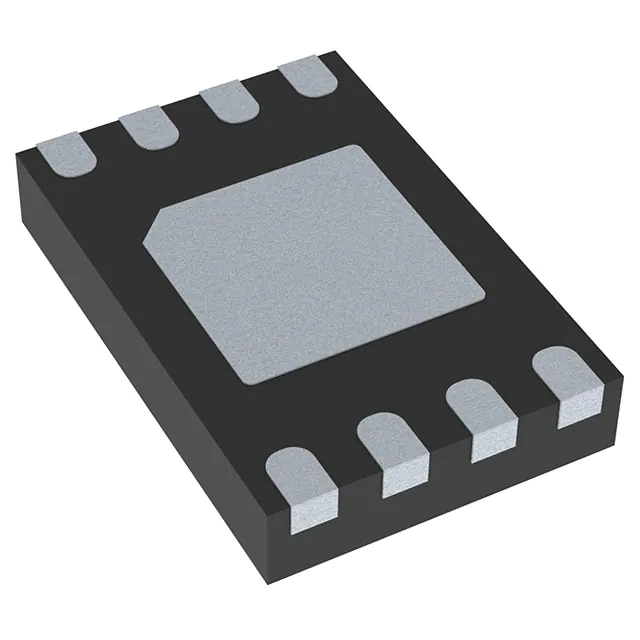
- Part No.:
- M24LR64E-RMC6T/2
- Manufacturer:
- STMicroelectronics
- Category:
- RFID, RF Access, Monitoring ICs
- Package:
- 8-UFDFN Exposed Pad
- Datasheet:
-
 M24LR64E-RMC6T/2.pdf
- Description:
- IC RFID TRANSP 13.56MHZ 8MLP
- Quantity:
- Payment:

- Shipping:

Inventory:15,930
Please send an inquiry. Send us your inquiry, and we will respond immediately.
Product details
Overview
M24LR64E-RMC6T/2 from STMicroelectronics is a dual-interface Dynamic NFC/RFID tag IC integrating 64-Kbit EEPROM, ISO 15693 RF interface, I²C bus (400 kHz), energy harvesting analog output (Vout), and RF busy indicator (RF WIP/BUSY). It operates from 1.8 V to 5.5 V and supports –40 °C to +85 °C ambient, enabling batteryless sensing in industrial asset tagging and smart packaging.
For engineers reviewing the M24LR64E-RMC6T/2 datasheet, M24LR64E-RMC6T/2 pinout, M24LR64E-RMC6T/2 application, or M24LR64E-RMC6T/2 equivalent, key selection criteria include dual-interface memory coherency, RF write-in-progress signaling, configurable energy harvesting sink current, ISO 15693 fast-command support (53 kbit/s), and sector-level password protection in both RF and I²C modes.
Technical Context
The M24LR64E-RMC6T/2 implements a true dual-port memory architecture: I²C accesses 8192 bytes linearly, while RF commands operate on 2048 × 32-bit blocks-both mapping to the same physical EEPROM array with atomic cross-interface consistency. Its RF interface complies fully with ISO 15693 and ISO 18000-3 Mode 1, supporting 10%/100% ASK modulation, Manchester load modulation, and dual subcarrier frequencies (423 kHz / 484 kHz) for low/high data rate operation.
Energy harvesting is implemented via an analog Vout pin delivering regulated DC from the RF field, with four programmable sink current ranges (10 µA to 100 µA) enabling precise power budgeting for external sensors or microcontrollers. The RF WIP/BUSY pin provides hardware-level status feedback during RF write operations, eliminating polling overhead in host systems.
Key Specifications
| Parameter | Value and Actual Design Meaning |
|---|---|
| Memory capacity | 64-Kbit EEPROM: 8192 bytes accessible via I²C; 2048 blocks of 32 bits via RF-same physical memory, coherent access. |
| I²C interface | Two-wire bus supporting 400 kHz protocol; includes I²C timeout protection and single-password lock for write protection. |
| RF interface | ISO 15693/ISO 18000-3 Mode 1 compliant; 13.56 MHz ±7 kHz carrier; supports Fast commands up to 53 kbit/s. |
| Write performance | I²C byte/page write ≤5 ms max; RF block write ≤5.75 ms including internal verify-enables deterministic timing in real-time logging. |
| Endurance & retention | 1 million write cycles at 25 °C; 150k at 85 °C; >40-year data retention-qualified for long-life industrial deployments. |
| Energy harvesting | Analog Vout pin with 4 configurable sink current ranges (10/30/60/100 µA); enables direct powering of ultra-low-power peripherals. |
| Operating temperature | –40 °C to +85 °C industrial grade-validated across full range for embedded sensor nodes and logistics tags. |
Pinout & Package
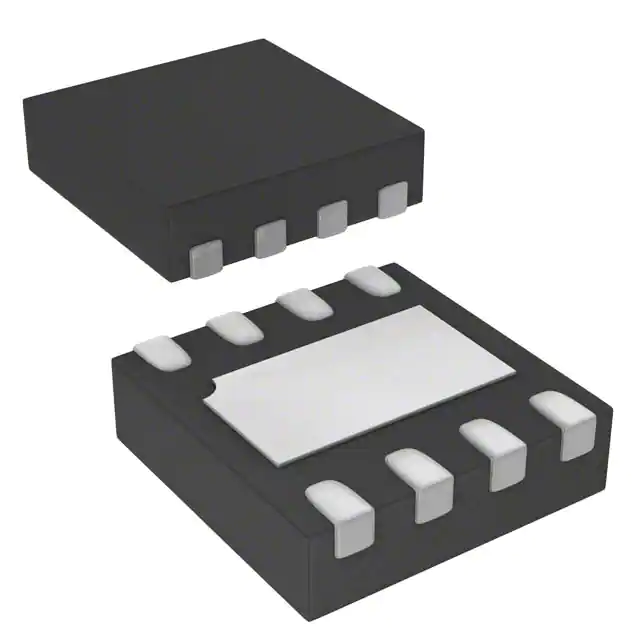
Available in SO8 (ECOPACK2®), TSSOP8 (ECOPACK2®), and UFDFPN8 (ECOPACK2®) packages. The M24LR64E-RMC6T/2 uses the UFDFPN8 (MC) variant: 2 mm × 3 mm, 0.5 mm pitch, exposed pad for thermal enhancement.
| Pin/Terminal | Circuit Role | Design Meaning |
|---|---|---|
| SCL | I²C serial clock input | Drives synchronous data transfer; supports 400 kHz max; includes built-in timeout to prevent bus lockup. |
| SDA | I²C bidirectional data line | Open-drain I/O with internal pull-up; handles byte/page read/write and password verification sequences. |
| RF WIP/BUSY | Configurable digital output | Asserts active-low during RF write or command processing-enables hardware interrupt-driven host coordination. |
| Vout | Energy harvesting analog output | DC voltage derived from RF field; sink current programmable in 4 steps for calibrated power delivery to external circuitry. |
| AC0 / AC1 | RF antenna connection terminals | Differential RF port; integrates 27.5 pF internal tuning capacitance-reduces external component count for antenna matching. |
| VSS | Ground reference | Common return for I²C, RF, and energy harvesting circuits; requires low-impedance PCB connection for noise immunity. |
| VCC | Supply voltage input | 1.8 V–5.5 V operation; powers I²C interface and internal logic; independent of RF energy harvesting path. |
Key Features
| Feature | Design Value |
|---|---|
| Dual-interface memory coherence | Single EEPROM array accessed atomically via I²C or RF-ensures data integrity when updating from either interface without software arbitration. |
| RF fast-command acceleration | Supports 53 kbit/s data rate using Fast Read Single Block and Fast Inventory Initiated-cuts tag interrogation time by >60% vs standard ISO 15693. |
| Multi-layer security model | RF mode: per-sector password protection (up to 8 sectors); I²C mode: single global write-lock bit-enables granular access control for mixed-read/write applications. |
| Hardware RF status signaling | RF WIP/BUSY pin eliminates need for repeated RF status polling-reduces reader firmware complexity and improves system throughput. |
| Integrated RF tuning capacitance | 27.5 pF internal capacitor reduces external BOM to just antenna coil-simplifies layout and improves production yield in compact tags. |
Applications
| Industrial Asset Tagging | Smart Packaging Authentication |
|---|---|
Use Scenario: Permanent attachment to metal machinery housings for maintenance history logging and calibration tracking. IC Role / Device Role / Timing Role: Dual-interface EEPROM stores firmware revision, service dates, and sensor calibration coefficients-updated via handheld reader (RF) or factory programming station (I²C). Use Value: Eliminates battery dependency via energy harvesting; RF WIP/BUSY pin ensures reliable write confirmation during field updates under variable reader field strength. |
Use Scenario: Tamper-evident pharmaceutical blister pack with serialized lot data and anti-counterfeit challenge-response. IC Role / Device Role / Timing Role: Stores encrypted DSFID, AFI, and sector passwords; performs cryptographic handshake via RF Fast commands during pharmacy scanner verification. Use Value: 53 kbit/s Fast Inventory Initiated enables sub-100 ms multi-pack scan; sector-level RF password prevents unauthorized reprogramming of authentication keys. |
| Wireless Sensor Node Memory | Reusable Logistics Pallet ID |
Use Scenario: Batteryless temperature/humidity sensor node powered solely by NFC reader field during data upload. IC Role / Device Role / Timing Role: Vout pin supplies regulated power to external sensor ASIC; I²C writes measurement data; RF reads aggregated logs during warehouse scan. Use Value: Four-step Vout sink current configuration matches exact sensor power demand-maximizes RF-to-DC conversion efficiency and extends read range. |
Use Scenario: High-cycle reusable pallet with dynamic route history, damage logs, and customs documentation. IC Role / Device Role / Timing Role: Stores 2048 × 32-bit blocks of timestamped events; RF Write Single Block updates location stamps; I²C bulk-loads new manifests at depot. Use Value: 1 million write cycles at 25 °C ensures >10-year service life with daily updates; UID + DSFID + AFI enable automated customs clearance workflows. |
Equivalent & Alternatives
The following parts are listed as comparable options for similar dual-interface NFC tag IC applications.
| Alternative Part | Technical Difference | Application Difference | Selection Advice |
|---|---|---|---|
| ST25DV64KC-IE6T | Same ST25 family; 64-Kbit EEPROM; adds I²C interrupt (INT) pin and dynamic register for real-time RF event notification. | Requires interrupt-driven host firmware; better suited for high-frequency sensor wake-up than static logging. | Select when RF-initiated host wake-up or real-time event flagging is required-M24LR64E-RMC6T/2 lacks INT pin. |
| NXH3670UK/V1 | NXP HF RFID tag IC with 2-Kbit EEPROM; no I²C interface; integrated temperature sensor and ADC; lower memory density. | Targeted at self-contained sensing (e.g., cold-chain monitoring); no wired interface for factory programming. | Select only for pure RF-only, sensor-integrated use cases-no dual-interface capability or I²C configurability. |
Compared with ST25DV64KC-IE6T, M24LR64E-RMC6T/2 offers simpler interrupt-free integration but lacks dynamic register access; versus NXH3670UK/V1, it provides full dual-interface control and higher memory density at the cost of no on-chip sensing.
Availability
M24LR64E-RMC6T/2 is available at Aetrix Electronics and suitable for industrial asset tagging, smart packaging authentication, and wireless sensor node memory requiring stable component supply across extended temperature and multi-interface operation.
Supply support for M24LR64E-RMC6T/2 includes scheduled delivery planning, volume procurement assistance, BOM continuity management, traceable sourcing, and lifecycle availability coordination for OEM customers, industrial embedded developers, connected-device designers, and electronics production programs.
Manufacturer
STMicroelectronics is a global semiconductor leader headquartered in Geneva, Switzerland, designing and manufacturing microcontrollers, power management ICs, sensors, and connectivity solutions for industrial, automotive, and consumer markets.
The M24LR64E-RMC6T/2 belongs to the ST25 NFC/RFID tag product line, engineered specifically for batteryless, dual-interface data storage in industrial IoT, supply chain traceability, and secure identification applications.
FAQ
What is the function of the RF WIP/BUSY pin?
The RF WIP/BUSY pin is a user-configurable digital output that asserts low during RF write operations or command execution. It eliminates the need for software polling by providing hardware-level status feedback-critical for deterministic timing in high-throughput reader systems. Configuration is done via the Control Register's RF_WIP_EN bit, and the pin remains functional across all supported packages.
How does energy harvesting work on the M24LR64E-RMC6T/2?
Energy harvesting is implemented through the Vout pin, which delivers regulated DC power derived from the RF carrier field. The device supports four programmable sink current ranges (10 µA, 30 µA, 60 µA, 100 µA) set via the EH_CFG bits in the Configuration Byte. This allows precise matching to external sensor or MCU power requirements without external regulators or LDOs.
Can I²C and RF interfaces access memory simultaneously?
No-simultaneous access is prohibited by hardware arbitration. The M24LR64E-RMC6T/2 implements atomic dual-port memory access: an ongoing I²C operation locks the RF interface, and vice versa. This guarantees data coherency without external software coordination. The RF WIP/BUSY pin reflects this state, and I²C timeout prevents indefinite blocking.
What security mechanisms protect memory in RF mode?
In RF mode, memory is protected by a multi-sector password system: up to eight 32-bit blocks can be individually locked with unique passwords stored in the System Memory Area. Each sector supports Read/Write protection bits, and password presentation is required before unlocking. Additionally, the AFI and DSFID fields provide application-level filtering and data format enforcement per ISO 15693.
M24LR64E-RMC6T/2 Specifications
- Product attributes
- Attribute value
- Manufacturer:
- STMicroelectronics
- Series:
- -
- Package/Case:
- 8-UFDFN Exposed Pad
- Packaging:
- Tape & Reel (TR)
- Product Status:
- Active
- Type:
- RFID Transponder
- Frequency:
- 13.56MHz
- Standards:
- ISO 15693, ISO 18000-3, NFC
- Interface:
- I2C
- Voltage - Supply:
- 1.8V ~ 5.5V
- Operating Temperature:
- -40°C ~ 85°C
- Grade:
- -
- Qualification:
- -
- Mounting Type:
- Surface Mount
- Supplier Device Package:
- 8-UFDFPN (2x3)
M24LR64E-RMC6T/2 FAQ
1.How can I place an order for M24LR64E-RMC6T/2 through Aetrix?
Please submit a Request for Quotation (RFQ) for M24LR64E-RMC6T/2 on Aetrix. Our sales agent will provide a competitive quotation and guide you through the order confirmation once you accept the terms.
2.Are the price and stock information for M24LR64E-RMC6T/2 reliable?
The price and inventory of M24LR64E-RMC6T/2 are updated periodically and may fluctuate due to market conditions. Stock and pricing data are typically refreshed every 24 hours. Quotation validity for M24LR64E-RMC6T/2 is usually 5 days.
3.What payment methods are accepted for M24LR64E-RMC6T/2?
We accept Wire Transfer, PayPal, Credit Card, Western Union, MoneyGram, and Escrow for M24LR64E-RMC6T/2 transactions.
Note: Certain payment methods may incur a processing fee.
4.How is shipping managed for M24LR64E-RMC6T/2?
M24LR64E-RMC6T/2 orders can be shipped via leading logistics carriers, including DHL, UPS, FedEx, TNT, or Registered Mail.
Once your M24LR64E-RMC6T/2 order is processed, you will receive an email with the shipment details and tracking number.
Note: Tracking information may take up to 24 hours to appear. Express delivery typically takes 3–5 business days.
5.How can I obtain technical support or documentation for M24LR64E-RMC6T/2?
For technical support, including M24LR64E-RMC6T/2 datasheets, pinout diagrams, or application guidance, please contact our engineering support team. They can provide detailed documentation and assistance for your M24LR64E-RMC6T/2 requirements.
6.How does Aetrix verify that M24LR64E-RMC6T/2 is sourced from the original manufacturer or authorized distributors?
All M24LR64E-RMC6T/2 products on Aetrix are procured from qualified distributors and authorized channels. Our dedicated quality assurance team conducts strict verification, including traceability checks and, if necessary, third-party testing. This ensures that M24LR64E-RMC6T/2 meets industry standards.
7.What is the process for return or replacement of M24LR64E-RMC6T/2?
All M24LR64E-RMC6T/2 units undergo pre-shipment inspection (PSI). If there is an issue with M24LR64E-RMC6T/2, returns or replacements are accepted under the following conditions:
1.Quantity discrepancies, incorrect items, or visible external defects (such as breakage or corrosion), acknowledged by Aetrix.
2.The issue is reported within 90 days of delivery.
3.The M24LR64E-RMC6T/2 part is unused and in its original packaging.
Return procedure for M24LR64E-RMC6T/2:
1.Submit a request within 90 days.
2.Obtain a Return Material Authorization (RMA) from Aetrix.
M24LR64E-RMC6T/2 Tags

-
SL2S2602FTBX
NXP Semiconductors
-
ST25DV04K-IER6S3
STMicroelectronics
-
ST25DV04K-IER6C3
STMicroelectronics
-
LXMSJZNCMD-217
Murata Electronics

-
NT3H2111W0FTTJ
NXP Semiconductors
-
NT3H2111W0FHKH
NXP Semiconductors
-
M24LR04E-RMC6T/2
STMicroelectronics
-
ST25DV04KC-JF6D3
STMicroelectronics
-
ST25DV64KC-IE6S3
STMicroelectronics
-
ST25DV64K-IER6T3
STMicroelectronics
-
NT3H2211W0FTTJ
NXP Semiconductors
-
NT3H2211W0FHKH
NXP Semiconductors
Tech Hub
An SR latch stores one bit through cross-coupled feedback. This engineering reference covers NOR and NAND implementations, truth tables, forbidden-state recovery, gated operation, switch debouncing, fa…

Latch circuits retain one bit through feedback. This technical reference covers SR and D latches, truth tables, transparency, timing limits, latch-versus-flip-flop behavior, applications and common log…

An engineering guide to LED driver operation, constant-current and constant-voltage outputs, linear and switching topologies, dimming, IC selection, calculations, replacement compatibility, and fault c…

Operational amplifier guide covering op amp basics, feedback, ideal vs real op amps, common configurations, buffer circuits, offset, bias current, gain-bandwidth, slew rate, rail-to-rail limits and sel…

Jumper cables guide covering safe connection order, red and black clamp placement, final ground connection, cable gauge, length, clamp quality, copper vs CCA cables, jump starter comparison and battery…

LDO regulator guide covering low dropout voltage, power dissipation, thermal design, PSRR, output noise, capacitor stability, adjustable LDO circuits, LDO vs buck converter and datasheet selection chec…

Conditional Access Module guide covering CAM meaning, CI/CI+ interface, smart card authorization, DVB security workflow, TV and set-top box compatibility, internal electronics, ESD protection, connecto…

Guide to electronic component obsolescence covering EOL risk, PCN/PDN notices, last-time buy planning, replacement options, form-fit-function validation, counterfeit risk and BOM lifecycle management.

18650 battery guide covering lithium-ion cell basics, 3.6V/3.7V voltage, 4.2V charging, mAh and Wh capacity, protected cells, chargers, BMS, series-parallel packs, holders, welding and sourcing checks.…

Hall effect sensor guide covering working principle, linear and digital sensors, Arduino circuits, current sensing, speed detection, automotive applications, A3144 examples, signal filtering and datash…


