
 My Inquiry
 My Account


Analog Devices Inc./Maxim Integrated MAX3205EATE
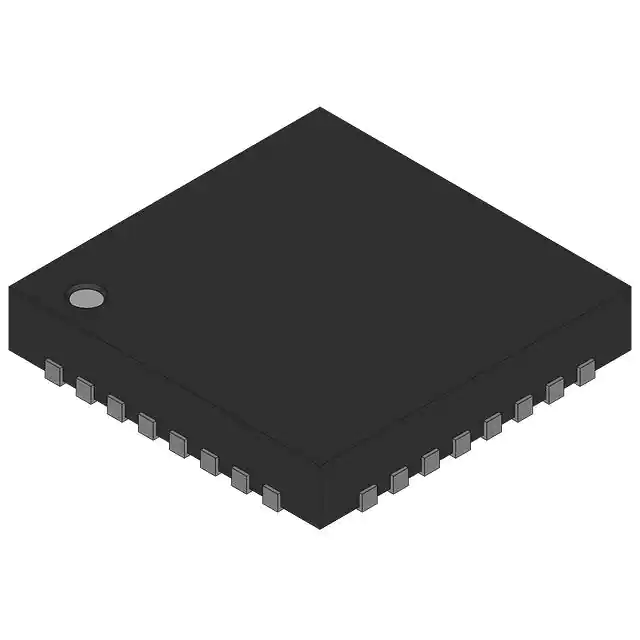
- Part No.:
- MAX3205EATE
- Manufacturer:
- Analog Devices Inc./Maxim Integrated
- Category:
- TVS Diodes
- Package:
- 16-WFQFN Exposed Pad
- Datasheet:
-
 MAX3205EATE.pdf
- Description:
- ESD PROTECTION ARRAY
- Quantity:
- Payment:

- Shipping:

Inventory:4,677
Please send an inquiry. Send us your inquiry, and we will respond immediately.
Product details
Overview
MAX3205EATE from Maxim Integrated is a six-channel, low-capacitance ESD protection diode array with integrated TVS clamp, designed for high-speed differential and single-ended signal lines in automotive-grade applications. It delivers ±15kV HBM / ±8kV IEC 61000-4-2 contact / ±15kV air-gap ESD protection, features 2.7pF typical channel capacitance (VCC = +3.3V), 0.05pF channel-to-channel capacitance variation, and operates from -40°C to +125°C. It is used for ESD protection of cell phone connectors and SVGA video interfaces.
For engineers reviewing the MAX3205EATE datasheet, MAX3205EATE pinout, MAX3205EATE application, or MAX3205EATE equivalent, key selection criteria include channel count (6), input capacitance (≤3.2pF), ESD rating compliance (IEC 61000-4-2 Level 4), automotive temperature range (-40°C to +125°C), and TQFN-EP package compatibility with controlled-impedance routing.
Technical Context
The MAX3205EATE implements a dual-diode per channel architecture that steers ESD current to VCC or GND, with an integrated TVS clamp to limit VCC rail excursion during transients. Its BiCMOS process enables low leakage (<±0.1μA) and stable clamping across temperature.
Each of its six protected I/O channels exhibits matched 2.7pF–3.2pF capacitance at 3.3V bias, with ≤0.05pF inter-channel variation-critical for preserving signal integrity on high-speed differential pairs like USB 2.0 or SVGA. Clamp voltage is specified as VCC + 100V (positive) / -100V (negative) under ±15kV IEC air-gap discharge at 45A peak.
Key Specifications
| Parameter | Value and Actual Design Meaning |
|---|---|
| ESD Protection Level | ±15kV HBM, ±8kV IEC 61000-4-2 contact, ±15kV IEC air-gap - meets Level 4 immunity for automotive and industrial end equipment. |
| Channel I/O Capacitance | 2.7pF (typ), 3.2pF (max) at VCC = +3.3V - preserves signal rise/fall times on >480Mbps USB 2.0 and SVGA links. |
| Capacitance Matching | ±0.05pF channel-to-channel variation - ensures minimal skew between differential pairs or parallel data lanes. |
| Clamp Voltage (IEC Air-Gap) | VCC + 100V / -100V at 45A - defines maximum transient overvoltage seen by downstream ICs during worst-case ESD event. |
| Operating Temperature | -40°C to +125°C - qualified for under-hood, display, and mobile accessory applications requiring AEC-Q100 alignment. |
| Supply Voltage Range | 0.9V to 5.5V - supports 1.8V, 3.3V, and 5V I/O domains without external level-shifting. |
| Leakage Current | ±0.1μA max at TA = +125°C - prevents signal degradation or false triggering in high-impedance analog/digital interfaces. |
Pinout & Package
The MAX3205EATE is housed in a 16-pin, 3mm × 3mm thin quad flat no-lead package with exposed pad (TQFN-EP), optimized for thermal dissipation and low-inductance grounding in high-speed layouts.
| Pin | Circuit Role | Design Meaning |
|---|---|---|
| 1, 3, 6, 8, 9, 11, 14, 16 | N.C. | No internal connection; pins are unconnected and may be left floating or tied to GND for mechanical stability. |
| 2 | GND | Ground reference for ESD current return path; must connect to low-impedance ground plane via exposed pad and multiple vias. |
| 4, 5, 7, 12, 13, 15 | I/O_ | Six independent ESD-protected signal channels; each pair routes transient current to VCC or GND via internal diodes. |
| 10 | VCC | Power-supply pin for TVS clamp operation; requires local 0.1μF ceramic bypass capacitor to minimize VCC rail overshoot during ESD events. |
| EP (exposed pad) | GND | Thermal and electrical ground connection; must be soldered to PCB ground plane for optimal ESD performance and thermal management. |
Key Features
| Feature | Design Value |
|---|---|
| Low channel capacitance | 2.7pF typical per I/O at 3.3V - enables use on 480Mbps USB 2.0 and SVGA video without signal integrity loss. |
| Matched capacitance tolerance | ±0.05pF channel-to-channel - maintains timing alignment across multi-lane interfaces like parallel video buses. |
| Integrated TVS clamp | Clamps VCC rail to known voltage during ESD - reduces parasitic inductance effects and protects upstream power regulators. |
| Optimized pinout layout | Alternating I/O_/N.C. pattern with central VCC/GND - minimizes stub inductance on differential traces routed beneath device. |
| Automotive temperature grade | -40°C to +125°C operation - supports deployment in infotainment displays, portable medical monitors, and industrial HMIs. |
Applications
| Cell Phone Connector Protection | SVGA Video Interface Protection |
|---|---|
Use Scenario: ESD protection for micro-USB, SIM card, and audio jack connectors in smartphones and tablets exposed to frequent human handling. IC Role / Device Role / Timing Role: Six-channel bidirectional ESD clamp placed directly at connector entry point to shunt transients before reaching baseband processor or PMIC. Use Value: Prevents latch-up or gate oxide damage in 28nm/40nm SoCs by limiting I/O overvoltage to ≤±100V under ±15kV air-gap discharge. |
Use Scenario: Protecting RGB/TTL video signals between graphics controller and LCD panel in portable projectors and docking stations. IC Role / Device Role / Timing Role: Parallel ESD suppression on 6-bit or 8-bit digital video bus, maintaining <10ps inter-pair skew via matched 0.05pF capacitance. Use Value: Eliminates visual artifacts (snow, flicker) caused by ESD-induced bit errors while preserving 60Hz+ refresh rates and color fidelity. |
| Automotive Infotainment Display | Industrial HMI Touch Interface |
Use Scenario: Shielding LVDS or TTL video lines driving center-stack displays in vehicles where ESD risk is elevated due to dry cabin air and synthetic materials. IC Role / Device Role / Timing Role: Front-end protection for display interface ICs operating at -40°C to +125°C ambient, with VCC clamping active during ignition transients. Use Value: Ensures AEC-Q200 compliance and avoids field failures from ESD-induced pixel dropouts or black-screen events during customer interaction. |
Use Scenario: Safeguarding resistive/capacitive touch controller I/Os in factory HMIs exposed to operator gloves, tools, and static-prone environments. IC Role / Device Role / Timing Role: Low-leakage (±0.1μA max) ESD guard for high-impedance touch sense lines, preventing false touches or calibration drift. Use Value: Maintains touch accuracy and response time across full industrial temperature range without requiring recalibration after ESD exposure. |
Equivalent & Alternatives
The following parts are listed as comparable options for similar ESD protection applications.
| Alternative Part | Technical Difference | Application Difference | Selection Advice |
|---|---|---|---|
| TPD6E05U06DBVR | 6-channel, 0.5pF lower capacitance (2.2pF typ), but rated only to ±12kV HBM / ±8kV IEC contact; no air-gap rating published. | Targeted at USB 2.0 and HDMI 1.4a; lacks automotive temp qualification (-40°C to +85°C only). | Select when ultra-low capacitance is critical and air-gap ESD testing is not required. |
| ESD56081D05 | 6-channel, 3.0pF capacitance, ±15kV HBM / ±8kV IEC contact, but no integrated TVS clamp - relies on system-level VCC clamping. | Used in cost-sensitive consumer electronics; requires external 0.1μF VCC bypass and careful layout to match MAX3205EATE's VCC rail control. | Select when board space allows separate TVS implementation and automotive temp range is not mandatory. |
Compared with TPD6E05U06DBVR and ESD56081D05, the MAX3205EATE uniquely combines six-channel protection, ±15kV air-gap rating, integrated TVS clamping, and full automotive temperature support in a single 3mm × 3mm TQFN package-enabling robust, layout-efficient ESD hardening for demanding embedded video and mobile interfaces.
Availability
MAX3205EATE is available at Aetrix Electronics and suitable for automotive infotainment systems, portable medical displays, and industrial HMI designs requiring stable component supply, long-term lifecycle assurance, and RoHS-compliant packaging.
Supply support for MAX3205EATE includes scheduled delivery planning, volume procurement assistance, BOM continuity management, traceable sourcing, and lifecycle availability coordination for OEM customers, industrial embedded developers, connected-device designers, and electronics production programs.
Manufacturer
Maxim Integrated (now part of Analog Devices) is a U.S.-based semiconductor company specializing in precision analog, mixed-signal, and high-reliability interface solutions.
The MAX3205EATE belongs to Maxim's high-speed ESD protection IC family, engineered specifically for automotive and industrial applications where signal integrity, ESD robustness, and extended temperature operation are non-negotiable design requirements.
FAQ
What is the maximum operating temperature for the MAX3205EATE?
The MAX3205EATE is fully specified from -40°C to +125°C, meeting automotive-grade thermal requirements. This range is validated across all electrical parameters including leakage current, clamp voltage, and input capacitance. The BiCMOS process and TQFN-EP package enable stable operation at the upper limit without derating. Engineers deploying the MAX3205EATE in under-dash displays or portable diagnostic tools can rely on consistent ESD performance across this full span.
Does the MAX3205EATE require an external bypass capacitor on VCC?
Yes-the MAX3205EATE requires a 0.1μF low-ESR ceramic capacitor placed as close as possible between VCC and GND. This capacitor absorbs charge from positive ESD transients and stabilizes the VCC rail during clamping events. Without it, parasitic inductance can cause VCC overshoot exceeding the specified clamp voltage, risking damage to downstream ICs. The MAX3205EATE datasheet explicitly recommends this capacitor for achieving guaranteed ±100V clamping under IEC 61000-4-2 air-gap discharge.
How many ESD-protected channels does the MAX3205EATE provide?
The MAX3205EATE provides six independent ESD-protected I/O channels (I/O1 through I/O6), as confirmed by its functional diagram, pin configuration, and selector guide. Each channel consists of a dual-diode structure steering transients to VCC or GND. This six-channel count makes the MAX3205EATE distinct from the two-channel MAX3207E and four-channel MAX3208E-specifically targeting dense interfaces like cell phone connectors and SVGA video buses.
What package type is used for the MAX3205EATE?
The MAX3205EATE uses a 16-pin, 3mm × 3mm thin quad flat no-lead package with exposed pad (TQFN-EP). This package is identified in the Ordering Information table and Pin Configurations section. The exposed pad (EP) must be soldered to the PCB ground plane to ensure optimal thermal performance and low-inductance ESD current return. Land pattern number 90-0031 applies, and the package is RoHS-compliant (denoted by the "+" suffix).
Is the MAX3205EATE compatible with USB 2.0 high-speed data lines?
Yes-the MAX3205EATE is explicitly cited in the Applications section for USB 2.0 (480Mbps) protection when used in multi-channel configurations. Its 2.7pF typical input capacitance and ≤0.05pF channel-to-channel variation preserve signal integrity on high-speed differential pairs. While the MAX3207E is optimized for dual-lane USB, the MAX3205EATE's six channels allow simultaneous protection of USB + auxiliary signals (e.g., ID, VBUS detect, or sideband use) in compact mobile designs.
MAX3205EATE Specifications
- Product attributes
- Attribute value
- Manufacturer:
- Analog Devices Inc./Maxim Integrated
- Package/Case:
- 16-WFQFN Exposed Pad
- Series:
- -
- Packaging:
- Bulk
- Product Status:
- Active
- Type:
- Steering (Rail to Rail)
- Unidirectional Channels:
- 6
- Bidirectional Channels:
- -
- Voltage - Reverse Standoff (Typ):
- 5.5V (Max)
- Voltage - Breakdown (Min):
- 9V (Typ)
- Voltage - Clamping (Max) @ Ipp:
- 100V
- Current - Peak Pulse (10/1000µs):
- 45A
- Power - Peak Pulse:
- -
- Power Line Protection:
- No
- Applications:
- DVI, HDMI, USB
- Capacitance @ Frequency:
- -
- Operating Temperature:
- -40°C ~ 125°C (TA)
- Grade:
- -
- Qualification:
- -
- Mounting Type:
- Surface Mount
- Supplier Device Package:
- 16-TQFN-EP (3x3)
MAX3205EATE FAQ
1.How can I place an order for MAX3205EATE through Aetrix?
Please submit a Request for Quotation (RFQ) for MAX3205EATE on Aetrix. Our sales agent will provide a competitive quotation and guide you through the order confirmation once you accept the terms.
2.Are the price and stock information for MAX3205EATE reliable?
The price and inventory of MAX3205EATE are updated periodically and may fluctuate due to market conditions. Stock and pricing data are typically refreshed every 24 hours. Quotation validity for MAX3205EATE is usually 5 days.
3.What payment methods are accepted for MAX3205EATE?
We accept Wire Transfer, PayPal, Credit Card, Western Union, MoneyGram, and Escrow for MAX3205EATE transactions.
Note: Certain payment methods may incur a processing fee.
4.How is shipping managed for MAX3205EATE?
MAX3205EATE orders can be shipped via leading logistics carriers, including DHL, UPS, FedEx, TNT, or Registered Mail.
Once your MAX3205EATE order is processed, you will receive an email with the shipment details and tracking number.
Note: Tracking information may take up to 24 hours to appear. Express delivery typically takes 3–5 business days.
5.How can I obtain technical support or documentation for MAX3205EATE?
For technical support, including MAX3205EATE datasheets, pinout diagrams, or application guidance, please contact our engineering support team. They can provide detailed documentation and assistance for your MAX3205EATE requirements.
6.How does Aetrix verify that MAX3205EATE is sourced from the original manufacturer or authorized distributors?
All MAX3205EATE products on Aetrix are procured from qualified distributors and authorized channels. Our dedicated quality assurance team conducts strict verification, including traceability checks and, if necessary, third-party testing. This ensures that MAX3205EATE meets industry standards.
7.What is the process for return or replacement of MAX3205EATE?
All MAX3205EATE units undergo pre-shipment inspection (PSI). If there is an issue with MAX3205EATE, returns or replacements are accepted under the following conditions:
1.Quantity discrepancies, incorrect items, or visible external defects (such as breakage or corrosion), acknowledged by Aetrix.
2.The issue is reported within 90 days of delivery.
3.The MAX3205EATE part is unused and in its original packaging.
Return procedure for MAX3205EATE:
1.Submit a request within 90 days.
2.Obtain a Return Material Authorization (RMA) from Aetrix.
MAX3205EATE Tags
-
ESD9B5.0ST5G
onsemi
-
DESD3V3E1BL-7B
Diodes Incorporated
-
ESD5Z3.3T1G
onsemi
-
D5V0H1B2LP-7B
Diodes Incorporated
-
D5V0P1B2LP-7B
Diodes Incorporated
-
DESD5V0U1BA-7
Diodes Incorporated
-
ESD5Z5.0T1G
onsemi
-
DESD5V0U1BB-7
Diodes Incorporated
-
D12V0L1B2LP-7B
Diodes Incorporated
-
PESD2V0Y1BSFYL
Nexperia USA Inc.
-
DF2S5M4CT,L3F
Toshiba Semiconductor and Storage
-
D5V0L1B2WS-7
Diodes Incorporated
Tech Hub

A practical engineering guide to 3.3V and 5V logic compatibility, input thresholds, resistor dividers, translator ICs, MOSFET level shifting, I2C pull-ups, timing limits and power-sequencing risks.

The 74HC595 uses push-pull logic outputs, while the TPIC6B595 uses 50 V open-drain DMOS sinks for higher-power loads. This guide compares timing, current limits, 3.3 V interfacing, load wiring, thermal…

The 74HC595 converts serial data into eight stable parallel outputs. This guide covers pin functions, shift and storage timing, OE and MR behavior, drive-current limits, cascading, voltage compatibilit…

A technical comparison of level-sensitive latches and edge-triggered flip-flops, covering timing windows, setup and hold limits, master–slave operation, time borrowing, race-through, HDL inference and…

A D latch stores one bit while Enable controls when data can pass. This reference covers gate-level operation, truth tables, transparency, setup and hold timing, LE versus OE, common ICs and practical …

An SR latch stores one bit through cross-coupled feedback. This engineering reference covers NOR and NAND implementations, truth tables, forbidden-state recovery, gated operation, switch debouncing, fa…

Latch circuits retain one bit through feedback. This technical reference covers SR and D latches, truth tables, transparency, timing limits, latch-versus-flip-flop behavior, applications and common log…

An engineering guide to LED driver operation, constant-current and constant-voltage outputs, linear and switching topologies, dimming, IC selection, calculations, replacement compatibility, and fault c…

Operational amplifier guide covering op amp basics, feedback, ideal vs real op amps, common configurations, buffer circuits, offset, bias current, gain-bandwidth, slew rate, rail-to-rail limits and sel…

Jumper cables guide covering safe connection order, red and black clamp placement, final ground connection, cable gauge, length, clamp quality, copper vs CCA cables, jump starter comparison and battery…


