
 My Inquiry
 My Account


Texas Instruments RF430CL330HIRGTR
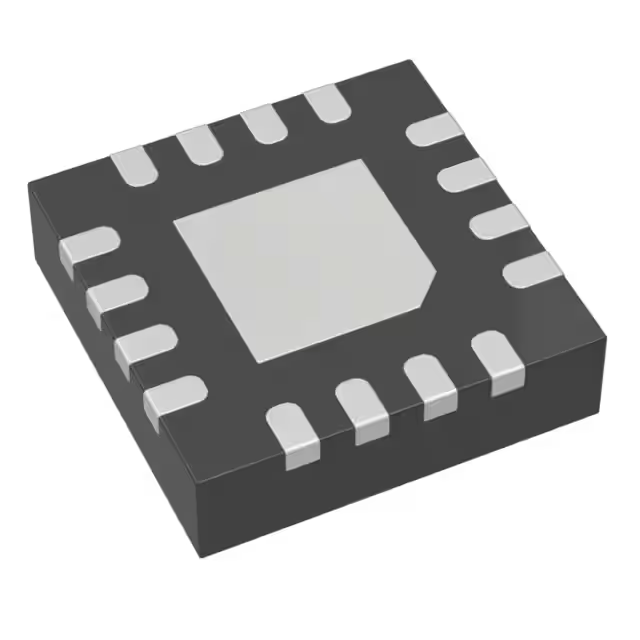
- Part No.:
- RF430CL330HIRGTR
- Manufacturer:
- Texas Instruments
- Category:
- RFID, RF Access, Monitoring ICs
- Package:
- 16-VFQFN Exposed Pad
- Datasheet:
-
 RF430CL330HIRGTR.pdf
- Description:
- IC RFID TRANSP 13.56MHZ 16VQFN
- Quantity:
- Payment:

- Shipping:

Inventory:3,230
Please send an inquiry. Send us your inquiry, and we will respond immediately.
Product details
Overview
RF430CL330HIRGTR from Texas Instruments is a Dynamic NFC Interface Transponder compliant with NFC Tag Type 4 and ISO/IEC 14443B, integrating a 13.56-MHz RF interface and dual-mode wired I²C/SPI host interface. It provides 3 KB of SRAM for NDEF message storage, automatic NDEF structure validation, and an interrupt output (INTO) signaling read/write completion. It enables tap-to-pair handover for Bluetooth and Wi-Fi in portable diagnostic and sensor devices.
For engineers reviewing the RF430CL330HIRGTR datasheet, RF430CL330HIRGTR pinout, RF430CL330HIRGTR application, or RF430CL330HIRGTR equivalent, key selection criteria include ISO14443B RF compliance up to 848 kbps, dual-protocol serial interface configurability, integrated antenna tuning support, low-power passive operation down to 2.0 V, and VQFN-16 package compatibility with space-constrained embedded designs.
Technical Context
The RF430CL330HIRGTR implements an MSP430-based processing unit managing both RF and wired communication layers. Its ISO14443B ASK demodulator supports data rates from 106 kbps to 848 kbps with 7–30% modulation depth, while its load modulator operates at 0.2–1 MHz subcarrier frequency with defined uplink voltage and field strength compliance.
Serial interface mode (I²C or SPI) is determined at power-up by the logic level on SCMS/CS, with internal pullup enabling SPI as default. I²C addressing uses hard-coded upper bits (0x50–0x57) set via E0–E2 pins; SPI mode selection (CPOL/CPHA) is configured via E0/E1 grounding or biasing per TI's Mode 0–3 mapping.
Key Specifications
| Parameter | Value and Actual Design Meaning |
|---|---|
| NFC Standard | NFC Tag Type 4, ISO/IEC 14443B-compliant RF interface |
| RF Data Rate | Up to 848 kbps - enables fast NDEF exchange during tap interactions |
| Memory | 3 KB SRAM for NDEF messages - sufficient for multi-record Bluetooth/Wi-Fi pairing payloads |
| Interface Options | I²C (up to 400 kHz) or SPI (up to 110 kHz) - selectable at boot via SCMS/CS pin |
| Supply Range | 2.0 V to 3.6 V - supports operation under weak RF field coupling without external regulator |
| Operating Temp | -40°C to +85°C - qualified for industrial and automotive cabin environments |
| Package | VQFN-16 (3 mm × 3 mm) with exposed thermal pad - optimized for compact PCB layout and thermal dissipation |
Pinout & Package
VQFN-16 (RGT) package with 3 mm × 3 mm body size and exposed thermal pad for enhanced thermal performance. Pin numbering follows TI standard top-view orientation.
| Pin/Terminal | Circuit Role | Design Meaning |
|---|---|---|
| VCC | Power supply input | 3.3-V main supply; requires 0.1 µF + 1 µF decoupling per spec |
| ANT1 / ANT2 | RF antenna terminals | Differential 13.56-MHz interface; connect to LC resonant tank (L ≈ 2.66 µH, CRES ≈ 51.8 pF) |
| RST | Active-low reset input | Asynchronous hardware reset; internally pulled up (20–50 kΩ) |
| E0 / E1 / E2 | I²C address select / SPI mode config | E0–E2 set I²C address bits (0x50–0x57); E0/E1 configure SPI CPOL/CPHA |
| INTO | Interrupt output | Open-drain signal indicating NDEF read/write completion or RF event |
| SCMS/CS | Mode select / chip select | High at power-up selects SPI; low selects I²C; functions as CS in SPI mode post-initialization |
| SCK / SO/SCL / SI/SDA | SPI clock / I²C clock / bidirectional data | Shared pins: SCK (SPI), SO/SCL (SPI out / I²C clock), SI/SDA (SPI in / I²C data) |
| VCORE | Regulated core supply | Internal LDO output; requires 0.1–1 µF low-ESR capacitor to ground |
| VSS | Ground reference | Primary digital and RF ground; connects to exposed thermal pad |
Key Features
| Feature | Design Value |
|---|---|
| Automatic NDEF structure checking | Validates NDEF message integrity on write - eliminates host-side parsing overhead and prevents malformed tag content |
| Dual-protocol serial interface | Selectable I²C or SPI at boot - enables reuse across MCU platforms without hardware redesign |
| Interrupt-driven NDEF access | INTO pin asserts on completion - allows host to enter low-power sleep between operations |
| BIP-8 error detection | Bit-interleaved parity on address/data - ensures robustness against bus noise in electrically noisy environments |
| Passive RF operation down to 2.0 V | Operates with rectified antenna voltage as low as 2.0 V - extends usable range with small antennas or low-field readers |
Applications
| Bluetooth® Pairing | Diagnostic Interface |
|---|---|
Use Scenario: Tap smartphone to medical device to initiate secure Bluetooth pairing without manual code entry. IC Role / Device Role / Timing Role: NFC transponder stores and delivers pre-configured Bluetooth MAC address and link key via NDEF record. Use Value: Eliminates user-input errors and reduces setup time from >60 seconds to <2 seconds with single tap. | Use Scenario: Technician taps NFC-enabled tablet to HVAC controller to retrieve real-time sensor logs and fault codes. IC Role / Device Role / Timing Role: Acts as wireless bridge between legacy UART-based diagnostics and modern mobile UIs. Use Value: Removes need for proprietary cables or USB adapters; enables field updates without opening enclosures. |
| Wi-Fi® Configuration | Sensor Interface |
Use Scenario: User taps phone to smart lock to provision Wi-Fi SSID/password and cloud credentials. IC Role / Device Role / Timing Role: Stores encrypted Wi-Fi provisioning payload in NDEF TLV format; serves it on RF request. Use Value: Avoids exposing credentials on screen or QR code; supports WPA3-Enterprise credential injection. | Use Scenario: Industrial vibration sensor node uses RF430CL330HIRGTR to expose calibration data and firmware version via NFC. IC Role / Device Role / Timing Role: Host MCU writes sensor metadata to SRAM; NFC reader retrieves it wirelessly. Use Value: Enables non-contact calibration verification and field firmware revision tracking without disassembly. |
Equivalent & Alternatives
The following parts are listed as comparable options for similar NFC transponder applications.
| Alternative Part | Technical Difference | Application Difference | Selection Advice |
|---|---|---|---|
| NT3H2111W0FHKH | 1 KB NDEF memory, I²C-only interface, no SPI option; supports NFC Forum Type 4B but not full ISO14443B feature set | Limited to simpler pairing use cases; lacks interrupt output and BIP-8 protection | Choose when board space is tighter (2.0 mm × 2.0 mm DFN) and only I²C host is available |
| PN5180AUHN/C1 | Full NFC controller (reader + card emulation), 32-bit ARM Cortex-M0+, supports ISO14443A/B, FeliCa, and peer-to-peer | Requires host driver stack; higher BOM cost and power; overqualified for pure tag use | Choose only if future expansion to reader mode or multi-protocol support is required |
Compared with NT3H2111W0FHKH and PN5180AUHN/C1, the RF430CL330HIRGTR uniquely balances dedicated tag functionality, dual-protocol flexibility, and robust RF performance in a compact VQFN package-making it optimal for cost-sensitive, space-constrained tap-to-pair implementations where reliability and low host overhead are critical.
Availability
RF430CL330HIRGTR is available at Aetrix Electronics and suitable for Bluetooth pairing, Wi-Fi provisioning, diagnostic interfaces, and sensor configuration requiring stable component supply across industrial, medical, and consumer electronics programs.
Supply support for RF430CL330HIRGTR includes scheduled delivery planning, volume procurement assistance, BOM continuity management, traceable sourcing, and lifecycle availability coordination for OEM customers, industrial embedded developers, connected-device designers, and electronics production programs.
Manufacturer
Texas Instruments is a global semiconductor company delivering analog and embedded processing solutions with leadership in signal chain and power management technologies.
The RF430CL330H product line delivers dynamic NFC transponders designed specifically for seamless wireless handover between NFC and short-range radio protocols in resource-constrained edge devices.
FAQ
What communication protocols does the RF430CL330HIRGTR support?
The RF430CL330HIRGTR supports both I²C and SPI serial interfaces - selected at power-up via the SCMS/CS pin level. In I²C mode, it uses a 7-bit address (0x50–0x57) configurable via E0–E2 pins; in SPI mode, it operates with CPOL/CPHA settings determined by E0/E1. The RF430CL330HIRGTR does not support UART or one-wire protocols.
How much NDEF memory does the RF430CL330HIRGTR provide, and is it persistent?
The RF430CL330HIRGTR provides 3 KB of on-chip SRAM dedicated to NDEF message storage. This memory is volatile and retains data only while powered - either from the host interface (VCC) or from energy harvested from the RF field. It is not flash-based and does not retain data after power loss, which aligns with NFC Tag Type 4 operational requirements.
Does the RF430CL330HIRGTR require external antenna matching components?
Yes, the RF430CL330HIRGTR requires external LC matching: a 2.66 µH antenna coil and total resonance capacitance of ~51.8 pF (CIN + CTune). The device integrates 31.5–38.5 pF of input capacitance (CIN), so CTune must be selected accordingly. No external balun or matching network is needed beyond this series-tuned circuit.
What is the function of the INTO pin on the RF430CL330HIRGTR?
INTO is an open-drain interrupt output that signals NDEF read/write completion, RF field detection, or error conditions. It remains low until cleared by reading the Interrupt Flags register (0xFFF8) over I²C or SPI. This pin enables event-driven host firmware design, allowing the microcontroller to sleep until an NFC interaction occurs - reducing system-level power consumption in battery-operated devices using the RF430CL330HIRGTR.
Can the RF430CL330HIRGTR operate without a host microcontroller?
No, the RF430CL330HIRGTR is not a standalone NFC tag - it requires a host microcontroller to write NDEF data into its SRAM via I²C or SPI before NFC readers can access it. While it supports passive RF operation (powered by the reader's field), all NDEF content must be pre-loaded by the host. It cannot autonomously generate or update NDEF records without host intervention.
RF430CL330HIRGTR Specifications
- Product attributes
- Attribute value
- Manufacturer:
- Texas Instruments
- Series:
- -
- Package/Case:
- 16-VFQFN Exposed Pad
- Packaging:
- Tape & Reel (TR)
- Product Status:
- Active
- Type:
- RFID Transponder
- Frequency:
- 13.56MHz
- Standards:
- ISO 14443, NFC
- Interface:
- I2C, SPI
- Voltage - Supply:
- 2V ~ 3.6V
- Operating Temperature:
- -40°C ~ 85°C
- Grade:
- -
- Qualification:
- -
- Mounting Type:
- Surface Mount
- Supplier Device Package:
- 16-VQFN (3x3)
RF430CL330HIRGTR FAQ
1.How can I place an order for RF430CL330HIRGTR through Aetrix?
Please submit a Request for Quotation (RFQ) for RF430CL330HIRGTR on Aetrix. Our sales agent will provide a competitive quotation and guide you through the order confirmation once you accept the terms.
2.Are the price and stock information for RF430CL330HIRGTR reliable?
The price and inventory of RF430CL330HIRGTR are updated periodically and may fluctuate due to market conditions. Stock and pricing data are typically refreshed every 24 hours. Quotation validity for RF430CL330HIRGTR is usually 5 days.
3.What payment methods are accepted for RF430CL330HIRGTR?
We accept Wire Transfer, PayPal, Credit Card, Western Union, MoneyGram, and Escrow for RF430CL330HIRGTR transactions.
Note: Certain payment methods may incur a processing fee.
4.How is shipping managed for RF430CL330HIRGTR?
RF430CL330HIRGTR orders can be shipped via leading logistics carriers, including DHL, UPS, FedEx, TNT, or Registered Mail.
Once your RF430CL330HIRGTR order is processed, you will receive an email with the shipment details and tracking number.
Note: Tracking information may take up to 24 hours to appear. Express delivery typically takes 3–5 business days.
5.How can I obtain technical support or documentation for RF430CL330HIRGTR?
For technical support, including RF430CL330HIRGTR datasheets, pinout diagrams, or application guidance, please contact our engineering support team. They can provide detailed documentation and assistance for your RF430CL330HIRGTR requirements.
6.How does Aetrix verify that RF430CL330HIRGTR is sourced from the original manufacturer or authorized distributors?
All RF430CL330HIRGTR products on Aetrix are procured from qualified distributors and authorized channels. Our dedicated quality assurance team conducts strict verification, including traceability checks and, if necessary, third-party testing. This ensures that RF430CL330HIRGTR meets industry standards.
7.What is the process for return or replacement of RF430CL330HIRGTR?
All RF430CL330HIRGTR units undergo pre-shipment inspection (PSI). If there is an issue with RF430CL330HIRGTR, returns or replacements are accepted under the following conditions:
1.Quantity discrepancies, incorrect items, or visible external defects (such as breakage or corrosion), acknowledged by Aetrix.
2.The issue is reported within 90 days of delivery.
3.The RF430CL330HIRGTR part is unused and in its original packaging.
Return procedure for RF430CL330HIRGTR:
1.Submit a request within 90 days.
2.Obtain a Return Material Authorization (RMA) from Aetrix.
RF430CL330HIRGTR Tags

-
SL2S2602FTBX
NXP Semiconductors
-
ST25DV04K-IER6S3
STMicroelectronics
-
ST25DV04K-IER6C3
STMicroelectronics
-
LXMSJZNCMD-217
Murata Electronics

-
NT3H2111W0FTTJ
NXP Semiconductors
-
NT3H2111W0FHKH
NXP Semiconductors
-
M24LR04E-RMC6T/2
STMicroelectronics
-
ST25DV04KC-JF6D3
STMicroelectronics
-
ST25DV64KC-IE6S3
STMicroelectronics
-
ST25DV64K-IER6T3
STMicroelectronics
-
NT3H2211W0FTTJ
NXP Semiconductors
-
NT3H2211W0FHKH
NXP Semiconductors
Tech Hub

A practical engineering guide to 3.3V and 5V logic compatibility, input thresholds, resistor dividers, translator ICs, MOSFET level shifting, I2C pull-ups, timing limits and power-sequencing risks.

The 74HC595 uses push-pull logic outputs, while the TPIC6B595 uses 50 V open-drain DMOS sinks for higher-power loads. This guide compares timing, current limits, 3.3 V interfacing, load wiring, thermal…

The 74HC595 converts serial data into eight stable parallel outputs. This guide covers pin functions, shift and storage timing, OE and MR behavior, drive-current limits, cascading, voltage compatibilit…

A technical comparison of level-sensitive latches and edge-triggered flip-flops, covering timing windows, setup and hold limits, master–slave operation, time borrowing, race-through, HDL inference and…

A D latch stores one bit while Enable controls when data can pass. This reference covers gate-level operation, truth tables, transparency, setup and hold timing, LE versus OE, common ICs and practical …

An SR latch stores one bit through cross-coupled feedback. This engineering reference covers NOR and NAND implementations, truth tables, forbidden-state recovery, gated operation, switch debouncing, fa…

Latch circuits retain one bit through feedback. This technical reference covers SR and D latches, truth tables, transparency, timing limits, latch-versus-flip-flop behavior, applications and common log…

An engineering guide to LED driver operation, constant-current and constant-voltage outputs, linear and switching topologies, dimming, IC selection, calculations, replacement compatibility, and fault c…

Operational amplifier guide covering op amp basics, feedback, ideal vs real op amps, common configurations, buffer circuits, offset, bias current, gain-bandwidth, slew rate, rail-to-rail limits and sel…

Jumper cables guide covering safe connection order, red and black clamp placement, final ground connection, cable gauge, length, clamp quality, copper vs CCA cables, jump starter comparison and battery…


