
 My Inquiry
 My Account


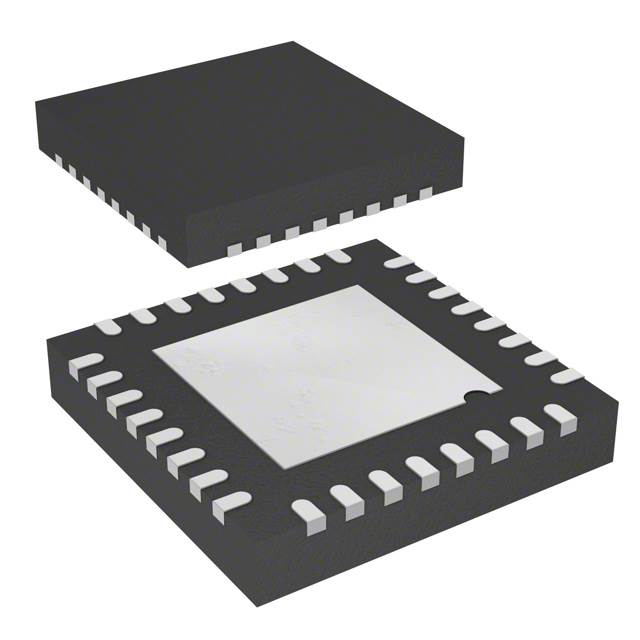
STMicroelectronics RX95HF-VMD5T
- Part No.:
- RX95HF-VMD5T
- Manufacturer:
- STMicroelectronics
- Category:
- RFID, RF Access, Monitoring ICs
- Package:
- 32-VFQFN Exposed Pad
- Datasheet:
-
 RX95HF-VMD5T.pdf
- Description:
- IC RFID RDR/TRN 13.56MZ 32VFQFPN
- Quantity:
- Payment:

- Shipping:

Inventory:2,938
Please send an inquiry. Send us your inquiry, and we will respond immediately.
Product details
Overview
RX95HF-VMD5T from STMicroelectronics is a near field communication (NFC) transceiver IC designed for ISO/IEC 14443 Type A tag emulation in passive peer-to-peer mode. It integrates a dedicated analog front end (AFE), internal frame controller, and field detection capability, operating at 13.56 MHz with SPI slave interface, 256-byte FIFO buffer, and ultra-low-power Wait-for-Event (WFE) mode - deployed in consumer electronics such as laptops, printers, and smart TVs for secure item pairing and data exchange.
For engineers reviewing the RX95HF-VMD5T datasheet, RX95HF-VMD5T pinout, RX95HF-VMD5T application, or RX95HF-VMD5T equivalent, key selection considerations include its SPI-based host control architecture, ISO/IEC 14443-A compliance in tag emulation, field-detection wake-up capability, and VFQFPN32 5×5 mm package suitability for space-constrained NFC-enabled peripherals.
Technical Context
The RX95HF operates in two primary states: Active (Ready and Tag Emulation) and Wait-for-Event (WFE), with configurable low-power modes including Hibernate and Sleep/Field Detector. Wake-up is triggered exclusively by a ≥10 μs low pulse on IRQ_IN, and the LFO remains active in all low-power states to maintain timing integrity.
Its RF subsystem supports full ISO/IEC 14443 Type A tag emulation via an integrated AFE with dual receiver inputs (RX1/RX2), RF field detection logic, and programmable transmission/reception chains. Communication with the host MCU occurs exclusively over SPI - with polling or interrupt-driven operation - using a fixed 8-bit command protocol (e.g., PROTOCOLSELECT 0x02, LISTEN 0x05, IDLE 0x07) and register-level configuration of analog parameters via WRREG/RDREG commands.
Key Specifications
| Parameter | Value and Actual Design Meaning |
|---|---|
| RF Frequency | 13.56 MHz - precisely matches ISO/IEC 14443 standard for interoperability with commercial NFC readers. |
| Communication Interface | SPI slave only - requires external MCU host; no I²C or UART support; supports up to 256-byte FIFO for command/response buffering. |
| Operating Mode | Tag Emulation (ISO/IEC 14443-A) - enables device to behave as a passive NFC tag without external power during reader interaction. |
| Power Management | Wait-for-Event (WFE) mode with IRQ_IN wake-up - achieves lowest active standby current; LFO remains running to enable sub-100 μs wake latency. |
| Package | VFQFPN32, 5×5 mm, 0.5 mm pitch - surface-mount, thermally enhanced with exposed dissipation pad tied to GND for RF stability. |
| Protocol Support | ISO/IEC 14443-3 Type A only - no Type B, FeliCa, or NFC Forum LLCP; anti-collision filter configurable via ACFILTER command (0x0D). |
| Crystal Requirement | External 13.56 MHz crystal (XIN/XOUT) - required for precise RF carrier generation and timing synchronization in tag emulation. |
Pinout & Package
VFQFPN32 (5×5 mm, 0.5 mm pitch) with exposed thermal pad (shaded area in pinout diagram) requiring direct connection to GND for RF performance and thermal management.
| Pin/Terminal | Circuit Role | Design Meaning |
|---|---|---|
| IRQ_IN | Interrupt input | Only wake-up source for WFE modes; ≥10 μs low pulse required; internally weak-pulled up to VPS. |
| IRQ_OUT | Interrupt output | Active-low flag indicating RX95HF readiness to transmit response; replaces polling in SPI interrupt mode. |
| SPI_SS, SPI_SCK, SPI_MOSI, SPI_MISO | SPI slave interface | Full-duplex serial interface; SS active-low; SCK uses weak pull-down; MOSI/MISO require termination to avoid floating. |
| RX1 / RX2 | RF receiver inputs | Differential analog inputs for 13.56 MHz signal demodulation; connected to external antenna matching network. |
| XIN / XOUT | Crystal oscillator terminals | Drive external 13.56 MHz crystal; critical for RF carrier accuracy and ISO/IEC 14443 timing compliance. |
| GND_RX / GND_TX / GND | Ground domains | Separate analog (GND_RX), RF (GND_TX), and digital (GND) grounds - must be star-connected at PCB level to minimize noise coupling. |
Key Features
| Feature | Design Value |
|---|---|
| Dedicated frame controller | Hardware-accelerated ISO/IEC 14443-A framing - offloads CRC, bit stuffing, and protocol timing from host MCU, reducing firmware overhead. |
| Field Detection mode | On-chip RF field sensing - enables autonomous wake-up without continuous polling; eliminates need for external field detector IC. |
| Optimized power management | Hibernate mode draws <1 μA - extends battery life in portable devices; WFE startup delay ≤100 μs ensures responsive user interaction. |
| Highly integrated AFE | Single-chip RF transceiver - integrates TX drivers, RX amplifiers, demodulator, and analog filters; eliminates discrete matching components. |
| Configurable anti-collision | ACFILTER command (0x0D) enables/disables ISO/IEC 14443-A anti-collision - allows dynamic tuning for multi-tag environments or simplified single-tag use cases. |
Applications
| Smart Peripheral Pairing | NFC-Enabled Printer Setup |
|---|---|
|
Use Scenario: User taps smartphone against laptop to initiate Bluetooth pairing or share Wi-Fi credentials. IC Role / Device Role / Timing Role: RX95HF acts as ISO/IEC 14443-A tag emulator; receives reader-initiated commands and relays data to host MCU via SPI. Use Value: Enables zero-configuration, tap-to-pair UX without requiring user to navigate OS settings or enter passcodes. |
Use Scenario: Technician taps NFC-enabled service tablet on printer to auto-load firmware update or diagnostic profile. IC Role / Device Role / Timing Role: RX95HF emulates static NDEF tag; delivers pre-configured URI or binary payload to host MCU upon field detection. Use Value: Eliminates manual USB cable connection or web portal login; reduces field service time by >70%. |
| Laptop Secure Login Token | Set-Top Box Content Authorization |
|
Use Scenario: User places NFC-enabled security token near laptop to unlock Windows session via Windows Hello. IC Role / Device Role / Timing Role: RX95HF operates in Tag Emulation mode; responds to reader's RATS/PPS sequence and exchanges challenge-response tokens. Use Value: Provides phishing-resistant 2FA without batteries or Bluetooth; leverages existing PC NFC reader infrastructure. |
Use Scenario: Subscriber taps NFC-enabled subscription card on set-top box to activate premium channel access. IC Role / Device Role / Timing Role: RX95HF emulates encrypted MIFARE Classic-compatible tag; hosts encrypted entitlement keys readable only after mutual authentication. Use Value: Enables physical, revocable, offline authorization - avoids cloud dependency and protects subscriber privacy. |
Equivalent & Alternatives
The following parts are listed as comparable options for similar NFC tag emulation applications.
| Alternative Part | Technical Difference | Application Difference | Selection Advice |
|---|---|---|---|
| NXP PN7150 | Integrated NFC controller + firmware stack; supports ISO/IEC 14443-A/B/F, Felica, and reader/writer modes - not pure tag emulator. | Requires host-side NFC stack integration; supports active reader mode for card emulation, but adds software complexity. | Choose if system needs dual-role (reader + tag) or Android compatibility; avoid if only passive tag emulation is required. |
| ST25DV04K | Dynamic NFC tag IC with EEPROM; no RF transceiver - relies on external reader field for power and communication. | No host MCU interface; purely passive; limited to 4-Kbit memory storage and basic NDEF messaging. | Choose for ultra-low-cost, battery-free tagging; unsuitable where host-controlled tag behavior or field detection is needed. |
Compared with PN7150 and ST25DV04K, RX95HF-VMD5T uniquely balances hardware-level ISO/IEC 14443-A tag emulation with host-controlled flexibility and field-sensing wake-up - making it optimal for embedded systems requiring deterministic, low-latency, MCU-managed NFC interactions without firmware stack overhead.
Availability
RX95HF-VMD5T is available at Aetrix Electronics and suitable for smart peripheral pairing, NFC-enabled printer setup, laptop secure login token, and set-top box content authorization requiring stable component supply across industrial and consumer OEM programs.
Supply support for RX95HF-VMD5T includes scheduled delivery planning, volume procurement assistance, BOM continuity management, traceable sourcing, and lifecycle availability coordination for OEM customers, industrial embedded developers, connected-device designers, and electronics production programs.
Manufacturer
STMicroelectronics is a global semiconductor leader headquartered in Geneva, Switzerland, specializing in microcontrollers, power management, sensors, and connectivity solutions for automotive, industrial, and consumer markets.
RX95HF belongs to ST's NFC transceiver product line, engineered specifically for host-controlled tag emulation in resource-constrained embedded systems - prioritizing RF reliability, ultra-low-power wake-up, and seamless SPI integration with MCUs.
FAQ
Does RX95HF-VMD5T support ISO/IEC 14443 Type B or FeliCa protocols?
No. The RX95HF-VMD5T supports ISO/IEC 14443 Type A tag emulation only, as confirmed in Section 1 (Description) and Table 9 of the datasheet. It lacks hardware blocks and firmware support for Type B, FeliCa, or NFC Forum Logical Link Control Protocol (LLCP). Its RF front-end and frame controller are optimized exclusively for Type A modulation and timing.
What is the minimum wake-up time from Hibernate mode?
The wake-up time from Hibernate mode is ≤100 μs, as specified in Figure 5 (Power-up sequence) and Section 3.1 (Operating modes). This includes t0 (initial wake-up delay, min 100 μs) and assumes IRQ_IN is asserted low for ≥10 μs. The LFO remains active during Hibernate, enabling rapid HFO restart and SPI interface reactivation.
Can RX95HF-VMD5T operate without an external crystal?
No. An external 13.56 MHz crystal connected between XIN and XOUT is mandatory. Section 6.6 (Oscillator characteristics) and Figure 2 (block diagram) confirm the absence of internal RC oscillator for RF carrier generation. Omitting the crystal prevents RF communication and causes failure during PROTOCOLSELECT command execution.
Is IRQ_OUT polarity active-high or active-low?
IRQ_OUT is active-low, as explicitly stated in Table 2 (Pin descriptions): "Pad internally connected to a Weak Pull-up to VPS" and Section 4.1.2 ("sets a low level on pin IRQ_OUT"). It remains low until the host reads the pending response via SPI, then returns high automatically - serving as a hardware handshake to replace polling.
RX95HF-VMD5T Specifications
- Product attributes
- Attribute value
- Manufacturer:
- STMicroelectronics
- Series:
- -
- Package/Case:
- 32-VFQFN Exposed Pad
- Packaging:
- Tape & Reel (TR)
- Product Status:
- Obsolete
- Type:
- RFID Reader/Transponder
- Frequency:
- 13.56MHz
- Standards:
- ISO 14443
- Interface:
- -
- Voltage - Supply:
- 2.7V ~ 5.5V
- Operating Temperature:
- -25°C ~ 85°C
- Grade:
- -
- Qualification:
- -
- Mounting Type:
- Surface Mount
- Supplier Device Package:
- 32-VFQFPN (5x5)
RX95HF-VMD5T FAQ
1.How can I place an order for RX95HF-VMD5T through Aetrix?
Please submit a Request for Quotation (RFQ) for RX95HF-VMD5T on Aetrix. Our sales agent will provide a competitive quotation and guide you through the order confirmation once you accept the terms.
2.Are the price and stock information for RX95HF-VMD5T reliable?
The price and inventory of RX95HF-VMD5T are updated periodically and may fluctuate due to market conditions. Stock and pricing data are typically refreshed every 24 hours. Quotation validity for RX95HF-VMD5T is usually 5 days.
3.What payment methods are accepted for RX95HF-VMD5T?
We accept Wire Transfer, PayPal, Credit Card, Western Union, MoneyGram, and Escrow for RX95HF-VMD5T transactions.
Note: Certain payment methods may incur a processing fee.
4.How is shipping managed for RX95HF-VMD5T?
RX95HF-VMD5T orders can be shipped via leading logistics carriers, including DHL, UPS, FedEx, TNT, or Registered Mail.
Once your RX95HF-VMD5T order is processed, you will receive an email with the shipment details and tracking number.
Note: Tracking information may take up to 24 hours to appear. Express delivery typically takes 3–5 business days.
5.How can I obtain technical support or documentation for RX95HF-VMD5T?
For technical support, including RX95HF-VMD5T datasheets, pinout diagrams, or application guidance, please contact our engineering support team. They can provide detailed documentation and assistance for your RX95HF-VMD5T requirements.
6.How does Aetrix verify that RX95HF-VMD5T is sourced from the original manufacturer or authorized distributors?
All RX95HF-VMD5T products on Aetrix are procured from qualified distributors and authorized channels. Our dedicated quality assurance team conducts strict verification, including traceability checks and, if necessary, third-party testing. This ensures that RX95HF-VMD5T meets industry standards.
7.What is the process for return or replacement of RX95HF-VMD5T?
All RX95HF-VMD5T units undergo pre-shipment inspection (PSI). If there is an issue with RX95HF-VMD5T, returns or replacements are accepted under the following conditions:
1.Quantity discrepancies, incorrect items, or visible external defects (such as breakage or corrosion), acknowledged by Aetrix.
2.The issue is reported within 90 days of delivery.
3.The RX95HF-VMD5T part is unused and in its original packaging.
Return procedure for RX95HF-VMD5T:
1.Submit a request within 90 days.
2.Obtain a Return Material Authorization (RMA) from Aetrix.
RX95HF-VMD5T Tags

-
SL2S2602FTBX
NXP Semiconductors
-
ST25DV04K-IER6S3
STMicroelectronics
-
ST25DV04K-IER6C3
STMicroelectronics
-
LXMSJZNCMD-217
Murata Electronics

-
NT3H2111W0FTTJ
NXP Semiconductors
-
NT3H2111W0FHKH
NXP Semiconductors
-
M24LR04E-RMC6T/2
STMicroelectronics
-
ST25DV04KC-JF6D3
STMicroelectronics
-
ST25DV64KC-IE6S3
STMicroelectronics
-
ST25DV64K-IER6T3
STMicroelectronics
-
NT3H2211W0FTTJ
NXP Semiconductors
-
NT3H2211W0FHKH
NXP Semiconductors
Tech Hub

A practical engineering guide to 3.3V and 5V logic compatibility, input thresholds, resistor dividers, translator ICs, MOSFET level shifting, I2C pull-ups, timing limits and power-sequencing risks.

The 74HC595 uses push-pull logic outputs, while the TPIC6B595 uses 50 V open-drain DMOS sinks for higher-power loads. This guide compares timing, current limits, 3.3 V interfacing, load wiring, thermal…

The 74HC595 converts serial data into eight stable parallel outputs. This guide covers pin functions, shift and storage timing, OE and MR behavior, drive-current limits, cascading, voltage compatibilit…

A technical comparison of level-sensitive latches and edge-triggered flip-flops, covering timing windows, setup and hold limits, master–slave operation, time borrowing, race-through, HDL inference and…

A D latch stores one bit while Enable controls when data can pass. This reference covers gate-level operation, truth tables, transparency, setup and hold timing, LE versus OE, common ICs and practical …

An SR latch stores one bit through cross-coupled feedback. This engineering reference covers NOR and NAND implementations, truth tables, forbidden-state recovery, gated operation, switch debouncing, fa…

Latch circuits retain one bit through feedback. This technical reference covers SR and D latches, truth tables, transparency, timing limits, latch-versus-flip-flop behavior, applications and common log…

An engineering guide to LED driver operation, constant-current and constant-voltage outputs, linear and switching topologies, dimming, IC selection, calculations, replacement compatibility, and fault c…

Operational amplifier guide covering op amp basics, feedback, ideal vs real op amps, common configurations, buffer circuits, offset, bias current, gain-bandwidth, slew rate, rail-to-rail limits and sel…

Jumper cables guide covering safe connection order, red and black clamp placement, final ground connection, cable gauge, length, clamp quality, copper vs CCA cables, jump starter comparison and battery…


