
 My Inquiry
 My Account


NXP Semiconductors SL3S1202FTB1,115
- Part No.:
- SL3S1202FTB1,115
- Manufacturer:
- NXP Semiconductors
- Category:
- RFID, RF Access, Monitoring ICs
- Package:
- 3-XDFN
- Datasheet:
-
 SL3S1202FTB1,115.pdf
- Description:
- IC RFID TRANSP 840-960MHZ 3XSON
- Quantity:
- Payment:

- Shipping:

Inventory:3,399
Please send an inquiry. Send us your inquiry, and we will respond immediately.
Product details
Overview
SL3S1202FTB1,115 from NXP Semiconductors is a passive UHF RFID tag IC compliant with EPCglobal Class 1 Generation 2 (Gen2) standard, designed for high-speed anti-collision inventory in supply chain and logistics applications. It features 240-bit EPC memory, 64-bit TID with unique 32-bit serial number, 840–960 MHz operating frequency, -15 dBm minimum operating power, and XSON3 (SOT1122) package with 3 terminals.
For engineers reviewing the SL3S1202FTB1,115 datasheet, SL3S1202FTB1,115 pinout, SL3S1202FTB1,115 application, or SL3S1202FTB1,115 equivalent, this page delivers verified technical context, Gen2 air interface timing constraints, calibrated backscatter performance, EAS and memory protection functionality, and real-world deployment guidance for item-level tagging and asset tracking systems.
Technical Context
The SL3S1202FTB1,115 implements a fully integrated analog RF interface with on-chip voltage regulator and charge pump, enabling operation from propagative RF energy without external power. Its digital controller executes EPC Gen2 protocol state machines-including Query, ACK, Req_RN, Read, Write, Kill, and Calibrate-while managing EEPROM access and session-based anti-collision arbitration across S0–S3 sessions.
It supports dual modulation schemes: DSB-ASK/SSB-ASK/PR-ASK with PIE encoding for reader-to-tag (R→T) at 40–160 kbit/s, and ASK/PSK backscatter with FM0 or Miller subcarrier for tag-to-reader (T→R) at 40–640 kbit/s. The chip integrates CRC-5 for Query command integrity and CRC-16 for EPC/PC/TID data protection, with built-in EAS alarm and read-protect commands for retail security and data confidentiality.
Key Specifications
| Parameter | Value and Actual Design Meaning |
|---|---|
| EPC Memory | 240-bit storage for Electronic Product Code; enables standardized item identification per EPCglobal spec |
| TID Memory | 64-bit tag identifier including 32-bit factory-programmed unique serial number; ensures global uniqueness and traceability |
| Operating Frequency | 840–960 MHz; supports CEPT/ETSI (Europe), FCC (US), and SRRC (China) regulatory bands for worldwide deployment |
| Min Operating Power | -15 dBm; enables reliable operation at long range with low-power readers and compact antennas |
| Forward Link Rate | 40–160 kbit/s (R→T); supports fast command delivery during dense-tag inventory rounds |
| Return Link Rate | 40–640 kbit/s (T→R); allows high-throughput EPC and user data transmission via backscatter modulation |
| Input Capacitance | 1.02 pF (typical, SOT1122 package); simplifies antenna matching and improves yield in label assembly |
| EEPROM Endurance | 100,000 write cycles; supports repeated reprogramming in reusable asset tracking applications |
Pinout & Package
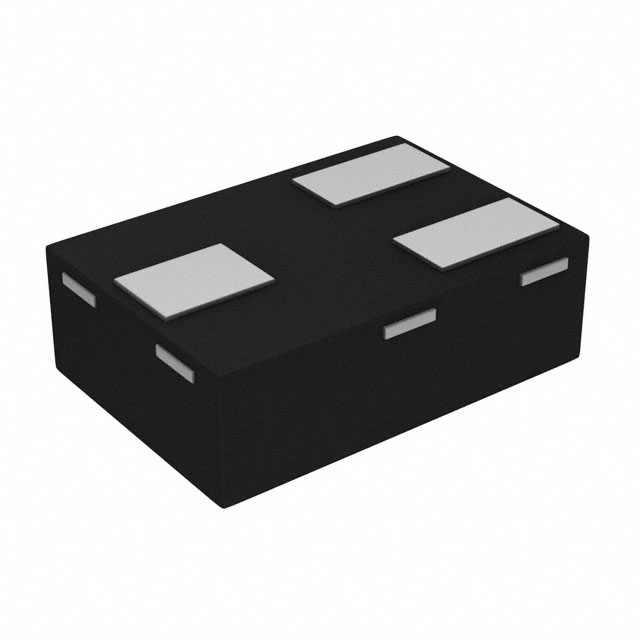
XSON3 (SOT1122) plastic extremely thin small outline package; 3-terminal no-lead surface-mount device; body dimensions 1.0 × 1.45 × 0.5 mm; designed for direct die attach to printed antennas in inlay manufacturing.
| Pin/Terminal | Circuit Role | Design Meaning |
|---|---|---|
| RFP | Ungrounded antenna connector | RF input port for unbalanced antenna connection; requires external matching network for optimal power transfer |
| RFN | Grounded antenna connector | RF return path and substrate reference; forms differential pair with RFP for loop or dipole antenna integration |
| n.c. | Not connected | No internal bond; electrically isolated terminal; must remain unconnected in PCB layout |
Key Features
| Feature | Design Value |
|---|---|
| EAS (Electronic Article Surveillance) | Standalone alarm mode enabled via EAS command; eliminates need for backend database in retail loss prevention |
| Memory Read Protection | Hardware-enforced lock on all memory banks (EPC, TID, User); prevents unauthorized scanning of sensitive data |
| Calibrate Command | Activates permanent backscatter for lab-grade tag-to-reader performance evaluation and antenna tuning |
| Kill & Access Passwords | 32-bit kill password permanently disables tag; 32-bit access password enables secure transition to protected state |
| Advanced Anti-Collision | Session-based (S0–S3) flag management with symmetric A/B inventories; enables simultaneous multi-reader operation |
| Low-Q Antenna Interface | Optimized impedance (18.6 – j171.2 Ω @ 915 MHz) and high input capacitance reduce sensitivity to material detuning |
Applications
| Supply Chain Management | Item-Level Tagging |
|---|---|
Use Scenario: High-volume pallet/case tracking across distribution centers using fixed-mount UHF readers. IC Role / Device Role / Timing Role: Passive Gen2 tag IC providing EPC-encoded product identity and session-managed anti-collision during rapid inventory sweeps. Use Value: Achieves >7 m read range under ETSI 2 W ERP in Europe, enabling single-reader coverage of entire pallet lanes without line-of-sight. |
Use Scenario: Individual apparel or pharmaceutical unit tagging for automated checkout and recall traceability. IC Role / Device Role / Timing Role: Secure, password-protected RFID tag supporting EAS alarm and read-protected TID/EPC to prevent counterfeiting. Use Value: Integrated 32-bit kill password and EAS command allow irreversible deactivation and retail theft deterrence without cloud dependency. |
| Asset Management | Container Identification |
Use Scenario: Reusable IT equipment or medical device tracking across hospital or enterprise campuses. IC Role / Device Role / Timing Role: Long-life EEPROM (50-year data retention) and 100k write cycles enable repeated reassignment and firmware update logging. Use Value: Supports field reprogramming of user memory for maintenance history, calibration dates, and ownership records over multi-year service life. |
Use Scenario: Seaport container ID verification using handheld readers in metallic, high-interference environments. IC Role / Device Role / Timing Role: Robust backscatter modulation (FM0/Miller) and jammer suppression (>−4 dB at ≥1 MHz) ensure reliable reads near RF-noisy infrastructure. Use Value: Low Q-factor and stable impedance maintain link budget on metal-mount inlays, reducing false negatives in dense container yards. |
Equivalent & Alternatives
The following parts are listed as comparable options for similar UHF RFID tag IC applications.
| Alternative Part | Technical Difference | Application Difference | Selection Advice |
|---|---|---|---|
| SL3S1002FTB1 | G2XM variant with 512-bit user memory vs. G2XL's 0-bit user memory; identical EPC/TID, package, and Gen2 compliance | Suitable where field-updatable user data (e.g., batch lot, calibration logs) is required beyond EPC/TID | Select SL3S1002FTB1 only if >0 user memory is needed; SL3S1202FTB1,115 optimizes cost and size for pure EPC/TID use cases |
| SL900A | Temperature-sensing SoC with integrated ADC, sensor interface, and 2 kB EEPROM; operates at same 860–960 MHz band but adds sensing capability | Targeted at cold-chain monitoring, predictive maintenance, and environmental compliance-not pure identification | Choose SL900A when ambient temperature logging or sensor-triggered alerts are mandatory; SL3S1202FTB1,115 remains optimal for cost-sensitive, high-volume identification-only deployments |
Compared with SL3S1002FTB1, SL3S1202FTB1,115 reduces die area and BOM cost by omitting user memory while retaining full Gen2 feature set and EAS/read-protection; versus SL900A, it delivers higher read sensitivity and lower power threshold for maximum range in static identification roles.
Availability
SL3S1202FTB1,115 is available at Aetrix Electronics and suitable for supply chain management, item-level tagging, and asset management applications requiring stable component supply, long-term lifecycle support, and consistent wafer-level sourcing from NXP's qualified production lines.
Supply support for SL3S1202FTB1,115 includes scheduled delivery planning, volume procurement assistance, BOM continuity management, traceable sourcing, and lifecycle availability coordination for OEM customers, industrial embedded developers, connected-device designers, and electronics production programs.
Manufacturer
NXP Semiconductors is a global semiconductor leader specializing in secure connectivity solutions, with core expertise in RFID, NFC, automotive radar, and secure microcontrollers.
The UCODE product family-including SL3S1202FTB1,115-is engineered specifically for high-performance, ultra-low-power passive UHF RFID tags targeting global logistics, retail, and industrial asset tracking systems.
FAQ
What is the primary function of the SL3S1202FTB1,115 in an RFID system?
The SL3S1202FTB1,115 serves as a passive UHF RFID tag IC compliant with EPCglobal Gen2 standard. It receives operating power and commands wirelessly from an interrogator, stores EPC and TID data in on-chip EEPROM, executes anti-collision protocols, and backscatters responses. Its role is strictly identification and secure data exchange-not sensing, processing, or active transmission.
Does the SL3S1202FTB1,115 support user memory, and how does it differ from SL3S1002FTB1?
No, the SL3S1202FTB1,115 is the G2XL variant and provides zero user memory. In contrast, SL3S1002FTB1 is the G2XM variant with 512-bit user memory. Both share identical EPC (240-bit), TID (64-bit), package (XSON3/SOT1122), and Gen2 feature set-including EAS, read protection, and kill/access passwords-but differ solely in user memory allocation.
What antenna configurations are supported by the SL3S1202FTB1,115?
The SL3S1202FTB1,115 supports both dipole and loop antenna topologies via its RFP (ungrounded) and RFN (grounded) terminals. Its low Q-factor and 1.02 pF input capacitance simplify matching to printed antennas on diverse substrates-including paper, PET, and on-metal inlays-without requiring discrete matching components in most designs.
How does the EAS feature of the SL3S1202FTB1,115 operate without backend infrastructure?
The SL3S1202FTB1,115 implements standalone EAS alarm mode via the EAS command. When activated, the tag responds to a specific EAS interrogation signal with a predefined backscatter pattern-triggering local alarms at store exits. No database lookup, network connection, or cloud service is required, making it ideal for retail loss prevention with minimal infrastructure.
What is the significance of the "115" suffix in SL3S1202FTB1,115?
The "115" suffix denotes the tape-and-reel packaging option per NXP's ordering convention: SL3S1202FTB1,115 indicates the XSON3 device supplied in 7-inch reel format with standard orientation (T1), moisture sensitivity level (MSL) 3, and dry pack per J-STD-033. It does not indicate a functional or revision difference from SL3S1202FTB1.
SL3S1202FTB1,115 Specifications
- Product attributes
- Attribute value
- Manufacturer:
- NXP Semiconductors
- Series:
- U-Code
- Package/Case:
- 3-XDFN
- Packaging:
- Tape & Reel (TR)
- Product Status:
- Obsolete
- Type:
- RFID Transponder
- Frequency:
- 840MHz ~ 960MHz
- Standards:
- EPC, ISO 15693, ISO 18000-6
- Interface:
- -
- Voltage - Supply:
- -
- Operating Temperature:
- -40°C ~ 85°C
- Grade:
- -
- Qualification:
- -
- Mounting Type:
- Surface Mount
- Supplier Device Package:
- 3-XSON (1x1.45)
SL3S1202FTB1,115 FAQ
1.How can I place an order for SL3S1202FTB1,115 through Aetrix?
Please submit a Request for Quotation (RFQ) for SL3S1202FTB1,115 on Aetrix. Our sales agent will provide a competitive quotation and guide you through the order confirmation once you accept the terms.
2.Are the price and stock information for SL3S1202FTB1,115 reliable?
The price and inventory of SL3S1202FTB1,115 are updated periodically and may fluctuate due to market conditions. Stock and pricing data are typically refreshed every 24 hours. Quotation validity for SL3S1202FTB1,115 is usually 5 days.
3.What payment methods are accepted for SL3S1202FTB1,115?
We accept Wire Transfer, PayPal, Credit Card, Western Union, MoneyGram, and Escrow for SL3S1202FTB1,115 transactions.
Note: Certain payment methods may incur a processing fee.
4.How is shipping managed for SL3S1202FTB1,115?
SL3S1202FTB1,115 orders can be shipped via leading logistics carriers, including DHL, UPS, FedEx, TNT, or Registered Mail.
Once your SL3S1202FTB1,115 order is processed, you will receive an email with the shipment details and tracking number.
Note: Tracking information may take up to 24 hours to appear. Express delivery typically takes 3–5 business days.
5.How can I obtain technical support or documentation for SL3S1202FTB1,115?
For technical support, including SL3S1202FTB1,115 datasheets, pinout diagrams, or application guidance, please contact our engineering support team. They can provide detailed documentation and assistance for your SL3S1202FTB1,115 requirements.
6.How does Aetrix verify that SL3S1202FTB1,115 is sourced from the original manufacturer or authorized distributors?
All SL3S1202FTB1,115 products on Aetrix are procured from qualified distributors and authorized channels. Our dedicated quality assurance team conducts strict verification, including traceability checks and, if necessary, third-party testing. This ensures that SL3S1202FTB1,115 meets industry standards.
7.What is the process for return or replacement of SL3S1202FTB1,115?
All SL3S1202FTB1,115 units undergo pre-shipment inspection (PSI). If there is an issue with SL3S1202FTB1,115, returns or replacements are accepted under the following conditions:
1.Quantity discrepancies, incorrect items, or visible external defects (such as breakage or corrosion), acknowledged by Aetrix.
2.The issue is reported within 90 days of delivery.
3.The SL3S1202FTB1,115 part is unused and in its original packaging.
Return procedure for SL3S1202FTB1,115:
1.Submit a request within 90 days.
2.Obtain a Return Material Authorization (RMA) from Aetrix.
SL3S1202FTB1,115 Tags

-
SL2S2602FTBX
NXP Semiconductors
-
ST25DV04K-IER6S3
STMicroelectronics
-
ST25DV04K-IER6C3
STMicroelectronics
-
LXMSJZNCMD-217
Murata Electronics

-
NT3H2111W0FTTJ
NXP Semiconductors
-
NT3H2111W0FHKH
NXP Semiconductors
-
M24LR04E-RMC6T/2
STMicroelectronics
-
ST25DV04KC-JF6D3
STMicroelectronics
-
ST25DV64KC-IE6S3
STMicroelectronics
-
ST25DV64K-IER6T3
STMicroelectronics
-
NT3H2211W0FTTJ
NXP Semiconductors
-
NT3H2211W0FHKH
NXP Semiconductors
Tech Hub

A practical engineering guide to 3.3V and 5V logic compatibility, input thresholds, resistor dividers, translator ICs, MOSFET level shifting, I2C pull-ups, timing limits and power-sequencing risks.

The 74HC595 uses push-pull logic outputs, while the TPIC6B595 uses 50 V open-drain DMOS sinks for higher-power loads. This guide compares timing, current limits, 3.3 V interfacing, load wiring, thermal…

The 74HC595 converts serial data into eight stable parallel outputs. This guide covers pin functions, shift and storage timing, OE and MR behavior, drive-current limits, cascading, voltage compatibilit…

A technical comparison of level-sensitive latches and edge-triggered flip-flops, covering timing windows, setup and hold limits, master–slave operation, time borrowing, race-through, HDL inference and…

A D latch stores one bit while Enable controls when data can pass. This reference covers gate-level operation, truth tables, transparency, setup and hold timing, LE versus OE, common ICs and practical …

An SR latch stores one bit through cross-coupled feedback. This engineering reference covers NOR and NAND implementations, truth tables, forbidden-state recovery, gated operation, switch debouncing, fa…

Latch circuits retain one bit through feedback. This technical reference covers SR and D latches, truth tables, transparency, timing limits, latch-versus-flip-flop behavior, applications and common log…

An engineering guide to LED driver operation, constant-current and constant-voltage outputs, linear and switching topologies, dimming, IC selection, calculations, replacement compatibility, and fault c…

Operational amplifier guide covering op amp basics, feedback, ideal vs real op amps, common configurations, buffer circuits, offset, bias current, gain-bandwidth, slew rate, rail-to-rail limits and sel…

Jumper cables guide covering safe connection order, red and black clamp placement, final ground connection, cable gauge, length, clamp quality, copper vs CCA cables, jump starter comparison and battery…


