
 My Inquiry
 My Account


NXP Semiconductors SL3S1214FTB0/1X
- Part No.:
- SL3S1214FTB0/1X
- Manufacturer:
- NXP Semiconductors
- Category:
- RFID, RF Access, Monitoring ICs
- Package:
- 6-XFDFN
- Datasheet:
-
 SL3S1214FTB0/1X.pdf
- Description:
- IC RFID TRANSP 860-960MHZ 6XSON
- Quantity:
- Payment:

- Shipping:

Inventory:2,469
Please send an inquiry. Send us your inquiry, and we will respond immediately.
Product details
Overview
SL3S1214FTB0/1X from NXP Semiconductors is an EPC Gen2 v2.0–compliant UHF RFID IC in XSON6 (SOT886F1) package, featuring 32-bit User Memory, pre-serialized 96-bit EPC, 96-bit factory-locked TID with 48-bit unique serial number, and Tag Power Indicator for optimized encoding in dense tag environments. It delivers -21 dBm read sensitivity and -16 dBm write sensitivity for retail inventory and apparel tagging.
For engineers reviewing the SL3S1214FTB0/1X datasheet, SL3S1214FTB0/1X pinout, SL3S1214FTB0/1X application, or SL3S1214FTB0/1X equivalent, this page provides verified technical context, memory architecture details, EPC Gen2 v2.0 command support, parallel encoding timing (100 items in 60 ms), and real-world deployment guidance for high-density UHF RFID label manufacturing.
Technical Context
The SL3S1214FTB0/1X implements a fully compliant EPCglobal Class-1 Generation-2 UHF RFID air interface (860–960 MHz), with analog RF front-end supporting rectification, voltage regulation, and backscatter modulation. Its digital control block handles anticollision, protocol state machines, EEPROM interface, and configuration word access at EPC bank address 200h.
Memory organization follows EPC Gen2 v1.2.0: four banks (Reserved, EPC, TID, User Memory), with 16-bit Configuration Word enabling Tag Power Indicator (204h), Parallel Encoding (202h), and Product Status Flag (20Fh) via standard SELECT commands-no custom firmware required for basic operation.
Key Specifications
| Parameter | Value and Actual Design Meaning |
|---|---|
| Read sensitivity | -21 dBm - enables long-range detection with low-power readers and compact antennas |
| Write sensitivity | -16 dBm - supports reliable encoding at greater distances or through materials |
| Parallel encoding speed | 100 tags in 60 ms - reduces bulk initialization time in printer-based label encoding |
| EPC memory size | Up to 128 bits - accommodates full EPC-96 plus extended headers or custom data |
| TID structure | 96-bit factory-locked, including 48-bit unique serial number - ensures unalterable device identity for traceability |
| User Memory | 32-bit - provides writable space for SKU variants, batch codes, or calibration data |
| Operating temperature | -40 °C to +85 °C - suitable for warehouse, retail, and logistics environments |
| Write endurance | 100,000 cycles - supports repeated reprogramming in reusable asset tracking applications |
Pinout & Package
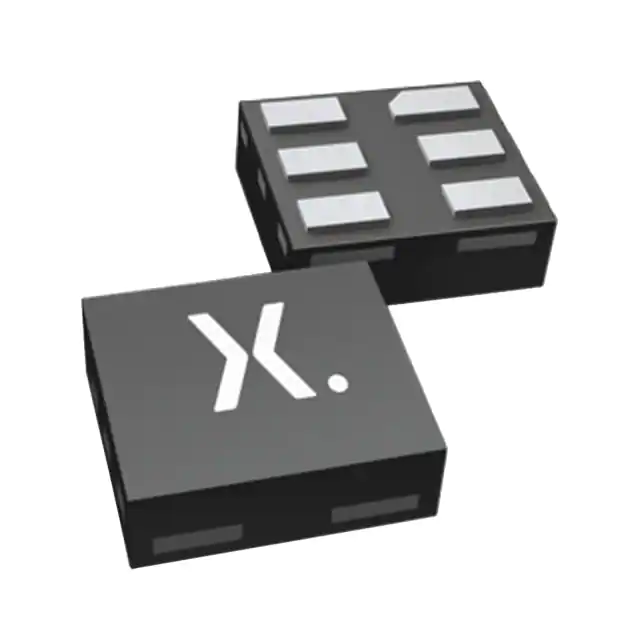
SL3S1214FTB0/1X is packaged in plastic extremely thin small outline package (XSON6, SOT886F1), 1.0 × 1.45 × 0.5 mm body, with two RF antenna terminals and four no-connect pins.
| Pin | Circuit Role | Design Meaning |
|---|---|---|
| 1 | RF2 | Antenna connector terminal - bidirectional RF interface for power harvesting and backscatter communication |
| 2 | n.c. | No connection - electrically isolated; no routing or bonding required |
| 3 | n.c. | No connection - electrically isolated; no routing or bonding required |
| 4 | n.c. | No connection - electrically isolated; no routing or bonding required |
| 5 | n.c. | No connection - electrically isolated; no routing or bonding required |
| 6 | RF1 | Antenna connector terminal - completes differential RF path with RF2; supports single-slit antenna design |
Key Features
| Feature | Design Value |
|---|---|
| Tag Power Indicator | Enables selective encoding of only sufficiently powered tags during high-density roll-fed printing, reducing cross-talk and failed writes |
| Pre-serialized 96-bit EPC | Factory-programmed EPC containing 48-bit TID serial number - cuts SKU-only encoding time by eliminating full EPC rewrite |
| Parallel encoding mode | Brings multiple tags to OPEN state simultaneously using SELECT on bit 202h - accelerates bulk write operations without reader-side protocol changes |
| Product Status Flag (PSF) | Configurable 1-bit flag at EPC address 20Fh - supports EAS alarm, quality pass/fail, or tamper indication without backend database dependency |
| Single-slit antenna compatibility | TP1/TP2 pads electrically disconnected - allows mechanical shorting to RF1/RF2 for simplified, mechanically robust antenna assembly |
| EPC Gen2 v2.0 readiness | Full support for mandatory (Perma)LOCK, ACCESS, and BlockWrite (32-bit) commands - ensures interoperability with next-gen readers and middleware |
Applications
| Retail Inventory Management | Supply Chain Visibility |
|---|---|
Use Scenario: High-speed scanning of apparel hangtags on moving conveyor belts in distribution centers. IC Role / Device Role / Timing Role: Passive UHF RFID transponder providing EPC-96 identification and TID-based authentication. Use Value: -21 dBm read sensitivity enables >7 m detection range with fixed-mount readers, while parallel encoding cuts tag commissioning time by 85% versus sequential methods. | Use Scenario: Real-time pallet-level tracking across multi-tier logistics hubs with mixed-reader environments. IC Role / Device Role / Timing Role: Gen2-compliant endpoint storing serialized EPC and PSF-enabled status flags for automated gate check-in. Use Value: Pre-serialized EPC and 48-bit locked TID eliminate post-manufacturing serialization bottlenecks, ensuring consistent EPC structure across global SKUs. |
| Electronic Article Surveillance (EAS) | Asset Lifecycle Tracking |
Use Scenario: Self-contained anti-theft tagging for luxury goods without centralized database lookup. IC Role / Device Role / Timing Role: RFID tag with PSF bit toggled to indicate active alarm state during exit-zone interrogation. Use Value: PSF bit at EPC address 20Fh allows immediate EAS response using standard SELECT/INVENTORY - no network latency or cloud dependency. | Use Scenario: Reusable tool tracking in automotive assembly plants with repeated wash-down and thermal cycling. IC Role / Device Role / Timing Role: Durable UHF tag storing maintenance history in User Memory and calibrated TID for lifetime traceability. Use Value: 100,000 write cycles and -40 °C to +85 °C operation ensure reliable data retention across 5+ years of industrial reuse. |
Equivalent & Alternatives
The following parts are listed as comparable options for similar UHF RFID IC applications.
| Alternative Part | Technical Difference | Application Difference | Selection Advice |
|---|---|---|---|
| SL3S1213FTB0/1X | Omits Tag Power Indicator and Parallel Encoding features; identical pinout and memory map except missing action bits at 202h/204h | Lacks dense-roll encoding optimization and selective power-aware singulation - limited to low-density or single-tag encoding workflows | Select when cost sensitivity outweighs need for high-throughput initialization or EAS functionality |
| SL900A1TTB0/1X | Includes integrated temperature sensor and 2 kbit EEPROM; requires external crystal; larger SOT886 footprint (1.2 × 1.6 mm); different command set | Supports sensor-augmented applications (e.g., cold-chain monitoring) but adds complexity in antenna tuning and firmware integration | Choose when environmental sensing or extended data logging is required beyond pure ID/encoding use cases |
Compared with SL3S1213FTB0/1X, SL3S1214FTB0/1X adds production-grade encoding acceleration and power-aware tag selection; versus SL900A1TTB0/1X, it offers simpler integration, lower BOM cost, and optimized performance for pure EPC-96 retail tagging without sensor overhead.
Availability
SL3S1214FTB0/1X is available at Aetrix Electronics and suitable for retail inventory management, supply chain visibility, and electronic article surveillance requiring stable component supply and consistent wafer-to-wafer parametric performance.
Supply support for SL3S1214FTB0/1X includes scheduled delivery planning, volume procurement assistance, BOM continuity management, traceable sourcing, and lifecycle availability coordination for OEM customers, industrial embedded developers, connected-device designers, and electronics production programs.
Manufacturer
NXP Semiconductors is a global semiconductor leader specializing in secure connectivity solutions for automotive, industrial, and IoT markets, with deep expertise in RFID, NFC, and wireless identification technologies.
The UCODE product line was designed specifically for high-performance, globally deployable UHF RFID tagging-prioritizing read/write sensitivity, memory flexibility, and manufacturability in ultra-thin label formats for retail, fashion, and FMCG sectors.
FAQ
What is the primary function of the SL3S1214FTB0/1X in an RFID system?
The SL3S1214FTB0/1X serves as a passive UHF RFID transponder IC compliant with EPC Gen2 v2.0 standards. It harvests RF energy from a reader, stores and transmits EPC-96, TID, and user data, and supports advanced features like parallel encoding and Tag Power Indicator. Its core role is reliable, high-sensitivity identification and data exchange in retail, logistics, and EAS applications - all implemented within the SL3S1214FTB0/1X die in XSON6 packaging.
Does the SL3S1214FTB0/1X support EPC Gen2 v2.0 commands out of the box?
Yes, the SL3S1214FTB0/1X natively supports all mandatory EPCglobal Gen2 v1.2.0 commands (including PermaLOCK) and optional commands (ACCESS, BlockWrite) as defined in the specification. It is also explicitly documented as "EPC Gen2 v2.0 ready," confirming forward compatibility with updated reader firmware and protocol extensions - no hardware modification or reconfiguration of the SL3S1214FTB0/1X is required.
How does the Tag Power Indicator feature work in the SL3S1214FTB0/1X?
The Tag Power Indicator in the SL3S1214FTB0/1X is activated by issuing a SELECT command to bit 204h in the EPC configuration word. Upon receipt, the IC performs an internal power check against its nominal write sensitivity (-16 dBm) minus 1 dB. If sufficient power is present, the SELECT matches; otherwise, it fails - enabling readers to isolate only well-powered tags during dense-roll encoding. This behavior is intrinsic to the SL3S1214FTB0/1X silicon design and requires no external components.
Can the SL3S1214FTB0/1X be used with a single-slit antenna design?
Yes, the SL3S1214FTB0/1X supports single-slit antenna implementation because its TP1 and TP2 test pads are electrically disconnected from the RF path. This allows them to be safely shorted to RF1 and RF2 during assembly, simplifying mechanical bonding and improving antenna stability. The resulting input capacitance shift (13.5-j195 Ω at 915 MHz) is characterized in the datasheet and enables fine-tuned impedance matching - a validated capability of the SL3S1214FTB0/1X.
What memory resources are available on the SL3S1214FTB0/1X?
The SL3S1214FTB0/1X provides four memory banks: 64-bit Reserved (Kill/Access passwords), up to 128-bit EPC, 96-bit factory-locked TID (with 48-bit unique serial number), and 32-bit User Memory. The EPC bank also contains a 16-bit Configuration Word at address 200h for controlling Tag Power Indicator, Parallel Encoding, and PSF. All memory is accessed via standard EPC Gen2 READ/WRITE/ACCESS commands - no proprietary interfaces are needed to utilize any memory resource on the SL3S1214FTB0/1X.
SL3S1214FTB0/1X Specifications
- Product attributes
- Attribute value
- Manufacturer:
- NXP Semiconductors
- Series:
- U-Code
- Package/Case:
- 6-XFDFN
- Packaging:
- Tape & Reel (TR)
- Product Status:
- Obsolete
- Type:
- RFID Transponder
- Frequency:
- 860MHz ~ 960MHz
- Standards:
- EPC
- Interface:
- -
- Voltage - Supply:
- -
- Operating Temperature:
- -40°C ~ 85°C (TA)
- Grade:
- -
- Qualification:
- -
- Mounting Type:
- Surface Mount
- Supplier Device Package:
- 6-XSON, SOT886 (1.45x1)
SL3S1214FTB0/1X FAQ
1.How can I place an order for SL3S1214FTB0/1X through Aetrix?
Please submit a Request for Quotation (RFQ) for SL3S1214FTB0/1X on Aetrix. Our sales agent will provide a competitive quotation and guide you through the order confirmation once you accept the terms.
2.Are the price and stock information for SL3S1214FTB0/1X reliable?
The price and inventory of SL3S1214FTB0/1X are updated periodically and may fluctuate due to market conditions. Stock and pricing data are typically refreshed every 24 hours. Quotation validity for SL3S1214FTB0/1X is usually 5 days.
3.What payment methods are accepted for SL3S1214FTB0/1X?
We accept Wire Transfer, PayPal, Credit Card, Western Union, MoneyGram, and Escrow for SL3S1214FTB0/1X transactions.
Note: Certain payment methods may incur a processing fee.
4.How is shipping managed for SL3S1214FTB0/1X?
SL3S1214FTB0/1X orders can be shipped via leading logistics carriers, including DHL, UPS, FedEx, TNT, or Registered Mail.
Once your SL3S1214FTB0/1X order is processed, you will receive an email with the shipment details and tracking number.
Note: Tracking information may take up to 24 hours to appear. Express delivery typically takes 3–5 business days.
5.How can I obtain technical support or documentation for SL3S1214FTB0/1X?
For technical support, including SL3S1214FTB0/1X datasheets, pinout diagrams, or application guidance, please contact our engineering support team. They can provide detailed documentation and assistance for your SL3S1214FTB0/1X requirements.
6.How does Aetrix verify that SL3S1214FTB0/1X is sourced from the original manufacturer or authorized distributors?
All SL3S1214FTB0/1X products on Aetrix are procured from qualified distributors and authorized channels. Our dedicated quality assurance team conducts strict verification, including traceability checks and, if necessary, third-party testing. This ensures that SL3S1214FTB0/1X meets industry standards.
7.What is the process for return or replacement of SL3S1214FTB0/1X?
All SL3S1214FTB0/1X units undergo pre-shipment inspection (PSI). If there is an issue with SL3S1214FTB0/1X, returns or replacements are accepted under the following conditions:
1.Quantity discrepancies, incorrect items, or visible external defects (such as breakage or corrosion), acknowledged by Aetrix.
2.The issue is reported within 90 days of delivery.
3.The SL3S1214FTB0/1X part is unused and in its original packaging.
Return procedure for SL3S1214FTB0/1X:
1.Submit a request within 90 days.
2.Obtain a Return Material Authorization (RMA) from Aetrix.
SL3S1214FTB0/1X Tags

-
SL2S2602FTBX
NXP Semiconductors
-
ST25DV04K-IER6S3
STMicroelectronics
-
ST25DV04K-IER6C3
STMicroelectronics
-
LXMSJZNCMD-217
Murata Electronics

-
NT3H2111W0FTTJ
NXP Semiconductors
-
NT3H2111W0FHKH
NXP Semiconductors
-
M24LR04E-RMC6T/2
STMicroelectronics
-
ST25DV04KC-JF6D3
STMicroelectronics
-
ST25DV64KC-IE6S3
STMicroelectronics
-
ST25DV64K-IER6T3
STMicroelectronics
-
NT3H2211W0FTTJ
NXP Semiconductors
-
NT3H2211W0FHKH
NXP Semiconductors
Tech Hub

A practical engineering guide to 3.3V and 5V logic compatibility, input thresholds, resistor dividers, translator ICs, MOSFET level shifting, I2C pull-ups, timing limits and power-sequencing risks.

The 74HC595 uses push-pull logic outputs, while the TPIC6B595 uses 50 V open-drain DMOS sinks for higher-power loads. This guide compares timing, current limits, 3.3 V interfacing, load wiring, thermal…

The 74HC595 converts serial data into eight stable parallel outputs. This guide covers pin functions, shift and storage timing, OE and MR behavior, drive-current limits, cascading, voltage compatibilit…

A technical comparison of level-sensitive latches and edge-triggered flip-flops, covering timing windows, setup and hold limits, master–slave operation, time borrowing, race-through, HDL inference and…

A D latch stores one bit while Enable controls when data can pass. This reference covers gate-level operation, truth tables, transparency, setup and hold timing, LE versus OE, common ICs and practical …

An SR latch stores one bit through cross-coupled feedback. This engineering reference covers NOR and NAND implementations, truth tables, forbidden-state recovery, gated operation, switch debouncing, fa…

Latch circuits retain one bit through feedback. This technical reference covers SR and D latches, truth tables, transparency, timing limits, latch-versus-flip-flop behavior, applications and common log…

An engineering guide to LED driver operation, constant-current and constant-voltage outputs, linear and switching topologies, dimming, IC selection, calculations, replacement compatibility, and fault c…

Operational amplifier guide covering op amp basics, feedback, ideal vs real op amps, common configurations, buffer circuits, offset, bias current, gain-bandwidth, slew rate, rail-to-rail limits and sel…

Jumper cables guide covering safe connection order, red and black clamp placement, final ground connection, cable gauge, length, clamp quality, copper vs CCA cables, jump starter comparison and battery…


