
 My Inquiry
 My Account


Alpha & Omega Semiconductor Inc. SMDJ60CA
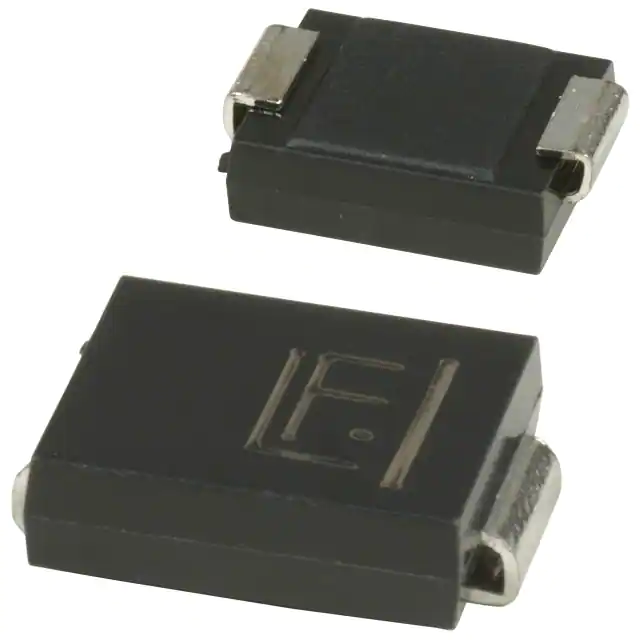
- Part No.:
- SMDJ60CA
- Manufacturer:
- Alpha & Omega Semiconductor Inc.
- Category:
- TVS Diodes
- Package:
- DO-214AB, SMC
- Datasheet:
-
 SMDJ60CA.pdf
- Description:
- 1CH 60V BIDIRECTIONAL 3000W SMD
- Quantity:
- Payment:

- Shipping:

Inventory:8,841
Please send an inquiry. Send us your inquiry, and we will respond immediately.
Product details
Overview
SMDJ60CA from Alpha & Omega Semiconductor is a bi-directional transient voltage suppressor (TVS) diode in DO-214AB (SMC) package, designed for high-energy surge protection in DC power lines and data interfaces. It features 60 V reverse stand-off voltage (VRWM), 66.7–73.7 V breakdown voltage (VBR), 96.8 A peak pulse current (IPP), 3000 W peak pulse power (PPPM) on 10/1000 µs waveform, and operates from –55 °C to +150 °C junction temperature.
For engineers reviewing the SMDJ60CA datasheet, pinout, applications, or equivalent options, this device is selected for robust overvoltage clamping in industrial power supplies, automotive ECUs, PoE injectors, and telecom line cards where bidirectional surge immunity and low clamping voltage are critical.
Technical Context
The SMDJ60CA employs a glass-passivated silicon junction optimized for fast response (<1.0 ps rise time from 0 V to VBR) and stable clamping under repetitive transients at 0.01% duty cycle. Its bi-directional polarity enables symmetrical suppression of positive and negative surges without external polarity management.
Thermal performance is defined by 15 °C/W junction-to-lead (RθJL) and 75 °C/W junction-to-ambient (RθJA) resistance when mounted on 8.0 mm × 8.0 mm copper pads - enabling reliable power derating up to 150 °C TJ max with proper PCB layout.
Key Specifications
| Parameter | Value and Actual Design Meaning |
|---|---|
| VRWM | 60.0 V - Maximum continuous reverse operating voltage before clamping begins; defines safe DC bias margin. |
| VBR @ IT=1A | 66.7–73.7 V - Measured breakdown range at 1 mA test current; ensures predictable turn-on threshold. |
| Vc @ IPP=96.8A | 96.8 V - Clamped voltage during 10/1000 µs surge; determines protected circuit's maximum transient exposure. |
| PPPM | 3000 W - Peak pulse power handling on standard 10/1000 µs waveform; supports IEC 61000-4-5 Level 4 compliance. |
| IR @ VRWM | 2.0 µA - Reverse leakage at rated stand-off voltage; minimizes standby power loss in high-impedance circuits. |
| TJ Range | –55 °C to +150 °C - Extended thermal operating envelope suitable for under-hood automotive and industrial environments. |
| Package | DO-214AB (SMC J-Bend) - Surface-mount, low-profile package with matte tin lead-free plating and MSL1 rating (260 °C reflow). |
Pinout & Package
DO-214AB (SMC) package: molded plastic case with J-bend leads; cathode identified by color band (not applicable for bi-directional SMDJ60CA - no polarity marking required).
| Pin/Terminal | Circuit Role | Design Meaning |
|---|---|---|
| Anode / Cathode (symmetrical) | Bi-directional surge path | Both terminals function identically; no fixed anode/cathode - enables single-component protection of AC or differential signals. |
| Case / Body | Non-conductive housing | Plastic encapsulation rated UL 94V-0; provides electrical isolation and mechanical strain relief per JEDEC DO-214AB spec. |
Key Features
| Feature | Design Value |
|---|---|
| Bi-directional clamping | Enables single-device protection of AC-coupled or floating bus lines (e.g., RS-485, CAN FD, Ethernet PHY) without polarity constraints. |
| 3000 W peak pulse power | Withstands 4 kV/2 kA IEC 61000-4-5 combined wave surges when properly laid out - reduces need for cascaded protection stages. |
| Fast response time <1.0 ps | Clamps transients before downstream ICs experience damaging overvoltage - critical for protecting high-speed interface receivers. |
| Glass-passivated junction | Ensures long-term reliability and stable VBR over temperature and lifetime; eliminates risk of junction corrosion in humid environments. |
| MSL1 reflow compatibility | Supports standard lead-free reflow profiles (peak 260 °C) without preconditioning - simplifies manufacturing and avoids moisture-related popcorning. |
Applications
| Industrial Power Supply Input Protection | Automotive Body Control Module (BCM) ECU |
|---|---|
Use Scenario: Protecting 24 V DC input rails in programmable logic controllers (PLCs) against load dump and inductive switching surges. IC Role / Device Role: Primary clamping element placed upstream of DC-DC converters and microcontrollers. Use Value: Limits transient voltage to ≤96.8 V during 3000 W surges, preventing latch-up or gate oxide damage in downstream SiC MOSFET drivers and PMICs. |
Use Scenario: Safeguarding LIN/CAN transceiver power pins and I/O lines in BCMs exposed to ISO 7637-2 Pulse 1, 2a, and 5a. IC Role / Device Role: Bi-directional TVS placed at connector entry point to shunt coupled transients before signal conditioning circuitry. Use Value: Symmetrical clamping ensures equal protection for both positive and negative pulses - eliminating need for dual unidirectional devices. |
| PoE++ (IEEE 802.3bt) PSE Port Protection | Telecom DSL Line Interface |
Use Scenario: Surge protection on 57 V DC power pairs of IEEE 802.3bt Type 4 PSE ports subject to lightning-induced common-mode surges. IC Role / Device Role: Secondary-level TVS after primary gas discharge tube (GDT), providing low-clamp refinement. Use Value: 96.8 V clamping voltage ensures powered devices remain within absolute maximum ratings even during worst-case 10/1000 µs surges. |
Use Scenario: Protecting ADSL/VDSL line drivers and SLIC interfaces from induced surges on twisted-pair copper loops. IC Role / Device Role: Bidirectional clamp across differential line pair (tip/ring) to suppress longitudinal surges. Use Value: Low 2.0 µA IR at 60 V VRWM prevents DC bias shift in high-impedance analog front-end circuits. |
Equivalent & Alternatives
The following parts are listed as comparable options for similar transient voltage suppression applications.
| Alternative Part | Technical Difference | Application Difference | Selection Advice |
|---|---|---|---|
| SAC60CA (Littelfuse) | Same VRWM (60 V), identical DO-214AB package, but lower PPPM (1500 W) and higher Vc (103 V @ 96.8 A). | Less suitable for IEC 61000-4-5 Level 4; requires higher layout margin due to 6.2 V higher clamping voltage. | Select only if system-level surge energy is limited to ≤1500 W and clamping margin allows 103 V peak exposure. |
| SMCJ60CA (ON Semiconductor) | Identical VRWM (60 V), DO-214AB package, and 3000 W PPPM, but wider VBR tolerance (60–73.3 V) and higher IR (5.0 µA @ VRWM). | Higher leakage may affect ultra-low-power monitoring circuits; broader VBR affects consistency in tightly regulated systems. | Acceptable for general-purpose protection where ±10% VBR variation and 2.5× higher IR are tolerable. |
Compared with SAC60CA and SMCJ60CA, the SMDJ60CA delivers tighter VBR (66.7–73.7 V), lower clamping (96.8 V), and lowest IR (2.0 µA), making it optimal for high-reliability industrial and automotive designs demanding precise, low-leakage surge response.
Availability
SMDJ60CA is available at Aetrix Electronics and suitable for industrial power supply input protection, automotive body control modules, PoE++ PSE port hardening, and telecom DSL line interface applications requiring stable component supply and full traceability.
Supply support for SMDJ60CA includes scheduled delivery planning, volume procurement assistance, BOM continuity management, traceable sourcing, and lifecycle availability coordination for OEM customers, industrial embedded developers, connected-device designers, and electronics production programs.
Manufacturer
Alpha & Omega Semiconductor (AOS) is a fabless power semiconductor company specializing in high-efficiency MOSFETs, TVS diodes, and power ICs for industrial, computing, and automotive markets.
The SMDJ series is engineered specifically for high-power, surface-mount transient suppression in harsh environments - emphasizing low clamping, tight VBR tolerance, and robust thermal performance in DO-214AB packaging.
FAQ
What is the clamping voltage of the SMDJ60CA under a 10/1000 µs surge?
The SMDJ60CA clamps to a maximum of 96.8 V when subjected to its rated peak pulse current of 96.8 A on the standardized 10/1000 µs waveform. This value is measured per JEDEC test conditions and defines the upper voltage limit imposed on protected circuitry during surge events - critical for ensuring downstream components remain within their absolute maximum ratings.
Is the SMDJ60CA unidirectional or bidirectional?
The SMDJ60CA is a bi-directional TVS diode, indicated by the "CA" suffix. It provides symmetrical clamping for both positive- and negative-going transients without polarity orientation requirements - making it ideal for AC-coupled interfaces like RS-485, CAN, or Ethernet PHY lines where signal polarity is undefined or alternating.
What is the maximum operating junction temperature for the SMDJ60CA?
The SMDJ60CA has a maximum junction temperature (TJ max) of +150 °C, with a specified operating range from –55 °C to +150 °C. This wide thermal envelope supports deployment in under-hood automotive locations, industrial motor drives, and outdoor telecom equipment where ambient temperatures exceed 85 °C.
Does the SMDJ60CA meet RoHS and halogen-free requirements?
Yes, the SMDJ60CA is an AOS Green Product: fully RoHS compliant, lead-free, and halogen-free per AOS' environmental policy. It carries matte tin lead-free plating and conforms to UL 94V-0 flammability standards - satisfying regulatory requirements for consumer, industrial, and automotive end equipment.
How does the SMDJ60CA compare to the SMDJ60A in terms of functionality?
The SMDJ60CA is bi-directional, while the SMDJ60A is unidirectional. Both share identical VRWM (60 V), VBR (66.7–73.7 V), and PPPM (3000 W), but the SMDJ60CA clamps symmetrically across both polarities - eliminating the need for polarity-aware placement and enabling use in differential or AC signal paths where the SMDJ60A would require additional design considerations.
SMDJ60CA Specifications
- Product attributes
- Attribute value
- Manufacturer:
- Alpha & Omega Semiconductor Inc.
- Package/Case:
- DO-214AB, SMC
- Series:
- -
- Packaging:
- Tape & Reel (TR)
- Product Status:
- Active
- Type:
- Zener
- Unidirectional Channels:
- -
- Bidirectional Channels:
- 1
- Voltage - Reverse Standoff (Typ):
- 60V
- Voltage - Breakdown (Min):
- 66.7V
- Voltage - Clamping (Max) @ Ipp:
- 96.8V
- Current - Peak Pulse (10/1000µs):
- 31A
- Power - Peak Pulse:
- 3000W (3kW)
- Power Line Protection:
- No
- Applications:
- General Purpose
- Capacitance @ Frequency:
- -
- Operating Temperature:
- -55°C ~ 150°C (TJ)
- Grade:
- -
- Qualification:
- -
- Mounting Type:
- Surface Mount
- Supplier Device Package:
- DO-214AB
SMDJ60CA FAQ
1.How can I place an order for SMDJ60CA through Aetrix?
Please submit a Request for Quotation (RFQ) for SMDJ60CA on Aetrix. Our sales agent will provide a competitive quotation and guide you through the order confirmation once you accept the terms.
2.Are the price and stock information for SMDJ60CA reliable?
The price and inventory of SMDJ60CA are updated periodically and may fluctuate due to market conditions. Stock and pricing data are typically refreshed every 24 hours. Quotation validity for SMDJ60CA is usually 5 days.
3.What payment methods are accepted for SMDJ60CA?
We accept Wire Transfer, PayPal, Credit Card, Western Union, MoneyGram, and Escrow for SMDJ60CA transactions.
Note: Certain payment methods may incur a processing fee.
4.How is shipping managed for SMDJ60CA?
SMDJ60CA orders can be shipped via leading logistics carriers, including DHL, UPS, FedEx, TNT, or Registered Mail.
Once your SMDJ60CA order is processed, you will receive an email with the shipment details and tracking number.
Note: Tracking information may take up to 24 hours to appear. Express delivery typically takes 3–5 business days.
5.How can I obtain technical support or documentation for SMDJ60CA?
For technical support, including SMDJ60CA datasheets, pinout diagrams, or application guidance, please contact our engineering support team. They can provide detailed documentation and assistance for your SMDJ60CA requirements.
6.How does Aetrix verify that SMDJ60CA is sourced from the original manufacturer or authorized distributors?
All SMDJ60CA products on Aetrix are procured from qualified distributors and authorized channels. Our dedicated quality assurance team conducts strict verification, including traceability checks and, if necessary, third-party testing. This ensures that SMDJ60CA meets industry standards.
7.What is the process for return or replacement of SMDJ60CA?
All SMDJ60CA units undergo pre-shipment inspection (PSI). If there is an issue with SMDJ60CA, returns or replacements are accepted under the following conditions:
1.Quantity discrepancies, incorrect items, or visible external defects (such as breakage or corrosion), acknowledged by Aetrix.
2.The issue is reported within 90 days of delivery.
3.The SMDJ60CA part is unused and in its original packaging.
Return procedure for SMDJ60CA:
1.Submit a request within 90 days.
2.Obtain a Return Material Authorization (RMA) from Aetrix.
SMDJ60CA Tags
-
ESD9B5.0ST5G
onsemi
-
DESD3V3E1BL-7B
Diodes Incorporated
-
ESD5Z3.3T1G
onsemi
-
D5V0H1B2LP-7B
Diodes Incorporated
-
D5V0P1B2LP-7B
Diodes Incorporated
-
DESD5V0U1BA-7
Diodes Incorporated
-
ESD5Z5.0T1G
onsemi
-
DESD5V0U1BB-7
Diodes Incorporated
-
D12V0L1B2LP-7B
Diodes Incorporated
-
PESD2V0Y1BSFYL
Nexperia USA Inc.
-
DF2S5M4CT,L3F
Toshiba Semiconductor and Storage
-
D5V0L1B2WS-7
Diodes Incorporated
Tech Hub

A practical engineering and sourcing framework covering lifecycle verification, lifetime-buy calculations, replacement qualification, supplier checks and counterfeit-risk controls.

TTL and CMOS logic families differ in thresholds, loading, output drive, power and timing. This engineering guide compares 74HC and 74HCT, calculates noise margins and checks 3.3 V/5 V compatibility.

A practical engineering guide to 3.3V and 5V logic compatibility, input thresholds, resistor dividers, translator ICs, MOSFET level shifting, I2C pull-ups, timing limits and power-sequencing risks.

The 74HC595 uses push-pull logic outputs, while the TPIC6B595 uses 50 V open-drain DMOS sinks for higher-power loads. This guide compares timing, current limits, 3.3 V interfacing, load wiring, thermal…

The 74HC595 converts serial data into eight stable parallel outputs. This guide covers pin functions, shift and storage timing, OE and MR behavior, drive-current limits, cascading, voltage compatibilit…

A technical comparison of level-sensitive latches and edge-triggered flip-flops, covering timing windows, setup and hold limits, master–slave operation, time borrowing, race-through, HDL inference and…

A D latch stores one bit while Enable controls when data can pass. This reference covers gate-level operation, truth tables, transparency, setup and hold timing, LE versus OE, common ICs and practical …

An SR latch stores one bit through cross-coupled feedback. This engineering reference covers NOR and NAND implementations, truth tables, forbidden-state recovery, gated operation, switch debouncing, fa…

Latch circuits retain one bit through feedback. This technical reference covers SR and D latches, truth tables, transparency, timing limits, latch-versus-flip-flop behavior, applications and common log…

An engineering guide to LED driver operation, constant-current and constant-voltage outputs, linear and switching topologies, dimming, IC selection, calculations, replacement compatibility, and fault c…


