
 My Inquiry
 My Account


STMicroelectronics DB3TG
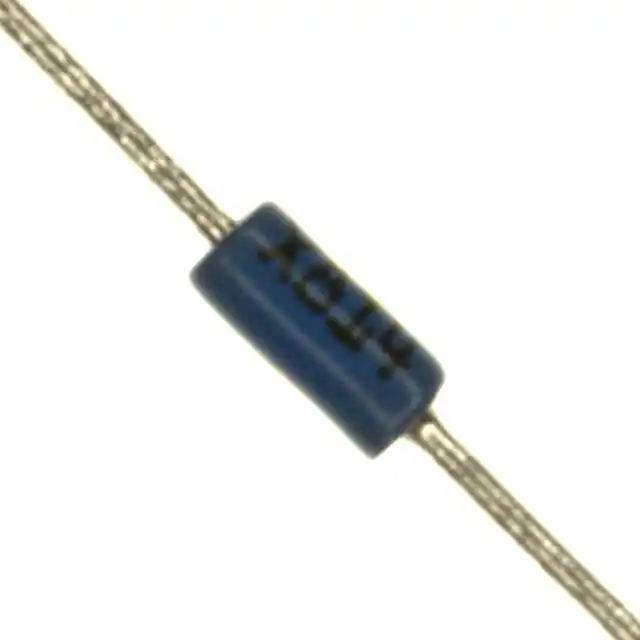
- Part No.:
- DB3TG
- Manufacturer:
- STMicroelectronics
- Category:
- DIACs, SIDACs
- Package:
- DO-204AH, DO-35, Axial
- Datasheet:
-
 DB3TG.pdf
- Description:
- DIAC 30-34V 2A DO35
- Quantity:
- Payment:

- Shipping:

Inventory:40,181
Please send an inquiry. Send us your inquiry, and we will respond immediately.
Product details
Overview
DB3TG from STMicroelectronics is a bidirectional trigger diode (DIAC) in DO-35 package, with tightly specified breakover voltage of 30–34 V (typ. 32 V), max. breakover current of 15 µA, and rise time ≤2 µs. It functions as a voltage-controlled switch for initiating conduction in TRIAC/SCR gate circuits, commonly used in phase-control dimmers and CFL/LED lamp ballast startup.
For engineers reviewing the DB3TG datasheet, DB3TG pinout, DB3TG application, or DB3TG equivalent, key selection criteria include precise VBO tolerance (±2 V), low IBO for reliable triggering at low power, symmetry (ΔVBO ≤2 V), dynamic voltage margin (≥9 V), and thermal stability across –40 to +125 °C junction range.
Technical Context
The DB3TG operates bidirectionally with identical forward/reverse characteristics, enabling symmetrical AC-triggering without polarity sensitivity. Its breakover behavior is defined under standardized test conditions (C = 10 nF, 10 mA measurement current), and exhibits <±5% VBO drift over –40 to +125 °C per Figure 4.
It delivers ≥0.3 A peak output current into a 20 Ω load (per Figure 2 test circuit) and maintains leakage current ≤10 µA at 0.5×VBO, supporting stable operation in high-impedance oscillator and timing networks where low standby current is critical.
Key Specifications
| Parameter | Value and Actual Design Meaning |
|---|---|
| VBO | 30–34 V (typ. 32 V); defines precise AC voltage threshold for bidirectional conduction initiation |
| IBO | ≤15 µA; ensures low-power triggering without loading upstream RC timing network |
| ΔVBO | ≤2 V; guarantees matched forward/reverse breakover for symmetrical phase control |
| tr | ≤2 µs; enables fast, clean switching edge in high-frequency oscillator and dimmer applications |
| IR | ≤10 µA at 0.5×VBO; minimizes standby power loss in always-on ballast or timing circuits |
| IP | ≥0.30 A; provides sufficient gate drive current to reliably trigger common TRIACs (e.g., T410) |
| Tj Range | –40 to +125 °C; supports operation in enclosed lighting fixtures and industrial ambient environments |
Pinout & Package
DO-35 glass axial package: hermetically sealed, leaded, 3.05–4.50 mm body length, 1.53–2.00 mm diameter, 28–31 mm lead length, 0.46–0.55 mm lead diameter.
| Pin/Terminal | Circuit Role | Design Meaning |
|---|---|---|
| Anode (A1) | Bidirectional main terminal | Identical electrical role in both directions; no polarity marking required |
| Cathode (A2) | Bidirectional main terminal | Functionally interchangeable with A1; device conducts when |VA1–A2| ≥ VBO |
Key Features
| Feature | Design Value |
|---|---|
| Tight VBO tolerance | ±2 V around 32 V enables accurate, repeatable phase-angle control in dimmers |
| Low IBO | 15 µA max. allows use with high-value RC timing networks (e.g., 500 kΩ/10 nF) without delay error |
| Bidirectional symmetry | ΔVBO ≤2 V ensures matched turn-on in both half-cycles for flicker-free AC light control |
| Rapid rise time | ≤2 µs supports stable oscillation up to ~100 kHz in relaxation oscillator topologies |
| High thermal stability | VBO variation <±5% over full –40 to +125 °C range maintains timing accuracy in hot lamp enclosures |
Applications
| AC Motor Speed Control | LED Lamp Ballast Startup |
|---|---|
Use Scenario: Phase-controlled speed regulation of universal motors in fans or power tools using TRIAC-based AC line switching. IC Role / Device Role / Timing Role: DIAC acts as voltage-triggered switch to initiate TRIAC conduction at precise point in AC cycle. Use Value: Tight 30–34 V VBO ensures consistent firing angle across temperature and line voltage variations, minimizing motor speed drift. | Use Scenario: Initiating high-voltage pulse generation in electronic ballasts for LED retrofit lamps operating off 220 V/50 Hz mains. IC Role / Device Role / Timing Role: Trigger element in relaxation oscillator that charges C via R until DB3TG breaks over and discharges into transformer primary. Use Value: Low 15 µA IBO permits use of large RC values, extending oscillator period while maintaining low standby power (<100 µW). |
| Fluorescent Tube (TL) Starter | AC Light Dimmer Circuit |
Use Scenario: Cold-start triggering of magnetic or hybrid electronic ballasts for T8/T12 fluorescent tubes. IC Role / Device Role / Timing Role: Voltage-sensing starter that fires when capacitor voltage reaches 32 V, delivering pulse to preheat filaments and strike arc. Use Value: Symmetrical ΔVBO ≤2 V ensures equal performance on both half-cycles, eliminating filament asymmetry and extending tube life. | Use Scenario: Leading-edge phase-cut dimming of incandescent/halogen lamps in residential wall dimmers. IC Role / Device Role / Timing Role: Bidirectional trigger controlling TRIAC gate timing relative to zero-crossing of AC waveform. Use Value: Fast 2 µs rise time prevents misfiring during rapid voltage transients, improving dimmer reliability and EMI profile. |
Equivalent & Alternatives
The following parts are listed as comparable options for similar DIAC trigger applications.
| Alternative Part | Technical Difference | Application Difference | Selection Advice |
|---|---|---|---|
| DB3 (ON Semiconductor) | VBO = 30–32 V, IBO ≤30 µA, no ΔVBO spec | Looser VBO tolerance and higher IBO reduce timing precision in critical dimmer designs | Acceptable for cost-sensitive, non-dimming ballast use where ±1 V VBO shift is tolerable |
| BT169G (NXP) | SCR not DIAC; requires gate drive, not self-triggering | Cannot replace DB3TG directly - needs external timing/control logic | Only suitable if redesigning circuit to add active gate control; not a drop-in substitute |
Compared with DB3TG, DB3 offers lower cost but sacrifices VBO tightness and symmetry; BT169G is functionally incompatible as an SCR requiring gate bias, making DB3TG uniquely suited for passive, self-triggered AC phase control.
Availability
DB3TG is available at Aetrix Electronics and suitable for AC motor speed control, LED lamp ballast startup, fluorescent tube starters, and leading-edge light dimmers requiring stable component supply with tight voltage threshold consistency.
Supply support for DB3TG includes scheduled delivery planning, volume procurement assistance, BOM continuity management, traceable sourcing, and lifecycle availability coordination for OEM customers, industrial embedded developers, connected-device designers, and electronics production programs.
Manufacturer
STMicroelectronics is a global semiconductor leader headquartered in Geneva, Switzerland, designing and manufacturing analog, microcontroller, power, and sensor solutions for industrial, automotive, and consumer markets.
The DB3TG belongs to ST's discrete protection and triggering device portfolio, engineered specifically for robust, low-cost AC phase control and lamp ignition in energy-efficient lighting and motor control systems.
FAQ
What is the maximum allowable repetitive peak on-state current for DB3TG?
The DB3TG is not rated for repetitive on-state current - it is a trigger device, not a power switch. Its absolute maximum rating ITRM = 2.00 A applies only to transient surge conditions during breakover (tp = 20 µs, 120 Hz). Continuous conduction would destroy the device; it must always be used with a series current-limiting resistor and paired with a TRIAC or SCR for power handling.
Can DB3TG be used in DC circuits?
No - DB3TG is strictly an AC-triggering device designed for bidirectional operation. In DC, it will conduct only once upon reaching VBO and remain latched in low-impedance state until current falls below holding level, which it lacks. Its datasheet specifies all parameters for AC or pulsed conditions; DC use violates its operational definition and risks thermal runaway.
How does junction temperature affect DB3TG's breakover voltage?
Per Figure 4 in DS2137, VBO decreases linearly with rising temperature: typical VBO at –40 °C is ~105% of 25 °C value, and ~90% at +125 °C. The coefficient is approximately –0.1%/°C, meaning a 100 °C rise causes ~10% VBO reduction - critical for designs operating in hot enclosures like LED drivers.
Is DB3TG RoHS-compliant and halogen-free?
Yes - DB3TG is manufactured in ST's ECOPACK®-compliant DO-35 package, meeting RoHS Directive 2011/65/EU and halogen-free requirements per IEC 61249-2-21. The "Blue Body Coat" marking indicates compliance; full environmental data is available in ST's ECOPACK documentation at www.st.com.
DB3TG Specifications
- Product attributes
- Attribute value
- Manufacturer:
- STMicroelectronics
- Series:
- -
- Package/Case:
- DO-204AH, DO-35, Axial
- Packaging:
- Tape & Reel (TR)
- Product Status:
- Active
- Voltage - Breakover:
- 30 ~ 34V
- Current - Breakover:
- 15 µA
- Current - Hold (Ih) (Max):
- -
- Current - Peak Output:
- 2 A
- Operating Temperature:
- -40°C ~ 125°C (TJ)
- Supplier Device Package:
- DO-35
DB3TG FAQ
1.How can I place an order for DB3TG through Aetrix?
Please submit a Request for Quotation (RFQ) for DB3TG on Aetrix. Our sales agent will provide a competitive quotation and guide you through the order confirmation once you accept the terms.
2.Are the price and stock information for DB3TG reliable?
The price and inventory of DB3TG are updated periodically and may fluctuate due to market conditions. Stock and pricing data are typically refreshed every 24 hours. Quotation validity for DB3TG is usually 5 days.
3.What payment methods are accepted for DB3TG?
We accept Wire Transfer, PayPal, Credit Card, Western Union, MoneyGram, and Escrow for DB3TG transactions.
Note: Certain payment methods may incur a processing fee.
4.How is shipping managed for DB3TG?
DB3TG orders can be shipped via leading logistics carriers, including DHL, UPS, FedEx, TNT, or Registered Mail.
Once your DB3TG order is processed, you will receive an email with the shipment details and tracking number.
Note: Tracking information may take up to 24 hours to appear. Express delivery typically takes 3–5 business days.
5.How can I obtain technical support or documentation for DB3TG?
For technical support, including DB3TG datasheets, pinout diagrams, or application guidance, please contact our engineering support team. They can provide detailed documentation and assistance for your DB3TG requirements.
6.How does Aetrix verify that DB3TG is sourced from the original manufacturer or authorized distributors?
All DB3TG products on Aetrix are procured from qualified distributors and authorized channels. Our dedicated quality assurance team conducts strict verification, including traceability checks and, if necessary, third-party testing. This ensures that DB3TG meets industry standards.
7.What is the process for return or replacement of DB3TG?
All DB3TG units undergo pre-shipment inspection (PSI). If there is an issue with DB3TG, returns or replacements are accepted under the following conditions:
1.Quantity discrepancies, incorrect items, or visible external defects (such as breakage or corrosion), acknowledged by Aetrix.
2.The issue is reported within 90 days of delivery.
3.The DB3TG part is unused and in its original packaging.
Return procedure for DB3TG:
1.Submit a request within 90 days.
2.Obtain a Return Material Authorization (RMA) from Aetrix.
DB3TG Tags
;;2.jpg)
Tech Hub

Jumper cables guide covering safe connection order, red and black clamp placement, final ground connection, cable gauge, length, clamp quality, copper vs CCA cables, jump starter comparison and battery…

LDO regulator guide covering low dropout voltage, power dissipation, thermal design, PSRR, output noise, capacitor stability, adjustable LDO circuits, LDO vs buck converter and datasheet selection chec…

Conditional Access Module guide covering CAM meaning, CI/CI+ interface, smart card authorization, DVB security workflow, TV and set-top box compatibility, internal electronics, ESD protection, connecto…

Guide to electronic component obsolescence covering EOL risk, PCN/PDN notices, last-time buy planning, replacement options, form-fit-function validation, counterfeit risk and BOM lifecycle management.

18650 battery guide covering lithium-ion cell basics, 3.6V/3.7V voltage, 4.2V charging, mAh and Wh capacity, protected cells, chargers, BMS, series-parallel packs, holders, welding and sourcing checks.…

Hall effect sensor guide covering working principle, linear and digital sensors, Arduino circuits, current sensing, speed detection, automotive applications, A3144 examples, signal filtering and datash…

Product Change Notification guide for electronic components, covering PCN meaning, PCN vs PDN/EOL, common change types, risk levels, form-fit-function review, engineering validation, BOM control, LTB/L…

A practical guide to blend door actuators, covering HVAC function, symptoms, location, AC and heater issues, reset and calibration, replacement cost, electrical diagnosis, compatibility checks, and rep…

Engineering guide to Raspberry Pi alternatives, covering chip-level differences, Orange Pi, ROCK, Jetson, Banana Pi, NanoPi, Compute Module, Pico, GPIO, camera, HAT compatibility, and replacement risks…
Engineering guide to dynamic load response testing for high-current buck converters, covering load step setup, slew rate, Vcore undershoot, overshoot, recovery time, probe location, output capacitors a…


