
 My Inquiry
 My Account


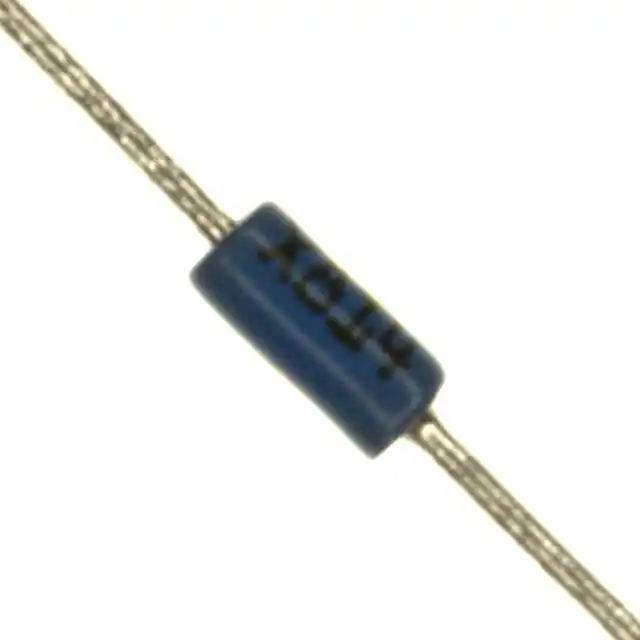
STMicroelectronics DB4
- Part No.:
- DB4
- Manufacturer:
- STMicroelectronics
- Category:
- DIACs, SIDACs
- Package:
- DO-204AH, DO-35, Axial
- Datasheet:
-
 DB4.pdf
- Description:
- DIAC 35-45V 2A DO35
- Quantity:
- Payment:

- Shipping:

Inventory:12,462
Please send an inquiry. Send us your inquiry, and we will respond immediately.
Product details
Overview
DB4 from STMicroelectronics is a bidirectional trigger diode (DIAC) designed for gate triggering of triacs and SCRs in AC phase-control circuits. It features a typical breakover voltage of 40 V (35–45 V range), ≤3 V breakover voltage symmetry, ≤50 µA breakover current, and operates across –40 °C to +125 °C junction temperature. It is used in CFL/LED lamp ballast startup and motor/light dimmer trigger stages.
For engineers reviewing the DB4 datasheet, DB4 pinout, DB4 application, or DB4 equivalent, key selection criteria include its 40 V nominal VBO, low IBO (≤50 µA), tight VBO symmetry (≤3 V), SOT-23-3L surface-mount package, and compatibility with triac-based zero-crossing or phase-angle control topologies.
Technical Context
The DB4 functions as a symmetrical, two-terminal, bidirectional avalanche switch that conducts only after both forward and reverse voltages exceed its specified breakover threshold. Its operation is defined by VBO (35–45 V), ΔV (dynamic VBO ≥5 V), and rise time ≤2 µs - enabling fast, repeatable triggering in high-noise AC line environments.
It requires no external bias and exhibits matched forward/reverse characteristics due to monolithic construction. The device sustains repetitive peak on-state current up to 2.0 A (tp = 20 µs, 120 Hz), with leakage current ≤10 µA at 0.5×VBO max, ensuring stable quiescent behavior in RC-trigger networks.
Key Specifications
| Parameter | Value and Actual Design Meaning |
|---|---|
| VBO (typ) | 40 V - sets precise AC phase angle for triac gate firing in dimmers and ballasts |
| VBO range | 35–45 V - ensures production yield while maintaining functional consistency across operating conditions |
| VBO symmetry | ≤3 V - guarantees matched turn-on in both polarities for balanced AC waveform control |
| IBO (max) | 50 µA - enables use with high-impedance RC timing networks without premature conduction |
| Rise time (max) | 2 µs - supports fast, clean switching transitions in 50/60 Hz and higher-frequency ballast circuits |
| Leakage (max) | 10 µA at 0.5×VBO - minimizes standby power loss and false triggering in low-power lighting systems |
| ITRM (peak) | 2.0 A (20 µs, 120 Hz) - withstands surge currents during repeated triac gate pulse generation |
Pinout & Package
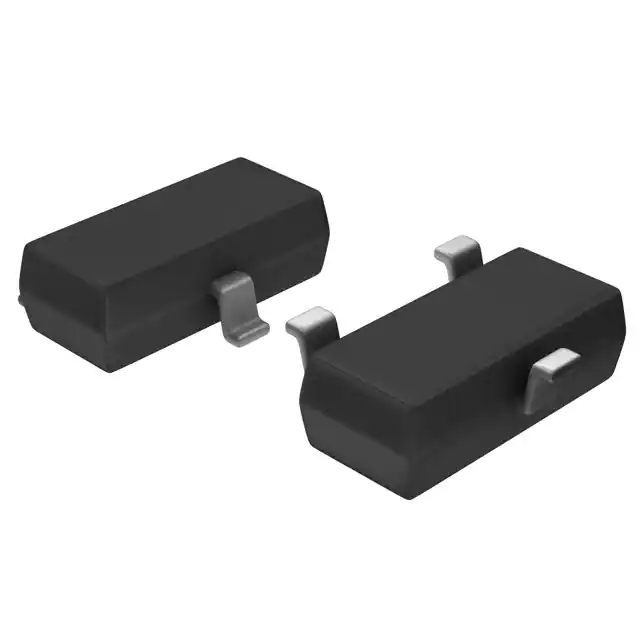
SOT-23-3L surface-mount package: compact, lead-free, ECOPACK®2-compliant, optimized for automated pick-and-place assembly. Pin 1 and Pin 3 must be shorted externally per application circuit requirements.
| Pin/Terminal | Circuit Role | Design Meaning |
|---|---|---|
| 1 | Anode / Main Terminal 1 (MT1) | Bidirectional conduction terminal; connected to MT1 of triac or SCR in standard trigger configuration |
| 2 | Common / Trigger Node | Center connection point; tied to RC network and triac gate; defines symmetric breakover threshold |
| 3 | Cathode / Main Terminal 2 (MT2) | Bidirectional conduction terminal; electrically identical to Pin 1; shorted to Pin 1 in standard layout |
Key Features
| Feature | Design Value |
|---|---|
| Symmetrical bidirectional switching | Matched VBO in both directions (≤3 V asymmetry) enables true AC-phase control without polarity bias |
| Low breakover current | ≤50 µA ensures reliable triggering even with high-value timing resistors (e.g., >100 kΩ) in energy-efficient ballasts |
| Fast rise time | ≤2 µs delivers sharp gate pulses to triac, minimizing conduction delay and improving dimming resolution |
| High-temperature operation | Rated for –40 °C to +125 °C junction temperature - suitable for enclosed LED drivers and industrial dimmer housings |
Applications
| Motor/Light Dimmer Trigger | Oscillator Timing Element |
|---|---|
Use Scenario: Phase-controlled AC power delivery to universal motors or incandescent/halogen lamps using triac-based leading-edge dimmers. IC Role / Device Role / Timing Role: Bidirectional trigger element that initiates triac conduction at precise voltage threshold in each AC half-cycle. Use Value: Enables smooth, flicker-free dimming with minimal EMI due to controlled, symmetric turn-on at 40 V ±5 V. | Use Scenario: Relaxation oscillator in low-cost CFL or LED driver IC startup circuits, generating periodic gate pulses. IC Role / Device Role / Timing Role: Voltage-reference switch that discharges RC network to reset oscillator cycle timing. Use Value: Provides predictable 40 V threshold and sub-2 µs rise time, ensuring stable oscillation frequency and startup reliability. |
| Fluorescent Ballast Starter | LED Lamp Ignition Circuit |
Use Scenario: Preheat and ignition stage in magnetic/electronic TL lamp ballasts, where rapid voltage buildup triggers lamp strike. IC Role / Device Role / Timing Role: High-voltage trigger switch initiating thyristor or diac-thyristor cascade to apply high-voltage pulse across lamp electrodes. Use Value: 40 V VBO and ≤3 V symmetry ensure consistent lamp ignition across line voltage variations and aging components. | Use Scenario: Cold-start assist in integrated LED tube drivers, providing initial current surge to overcome LED forward voltage threshold. IC Role / Device Role / Timing Role: Gate trigger for auxiliary SCR or MOSFET switch that bypasses current-limiting resistor during startup. Use Value: Low IBO (≤50 µA) allows high-impedance RC timing, reducing standby power while maintaining robust cold-start performance. |
Equivalent & Alternatives
The following parts are listed as comparable options for similar DIAC trigger applications.
| Alternative Part | Technical Difference | Application Difference | Selection Advice |
|---|---|---|---|
| DB3 | Lower VBO (28–36 V typ. 32 V); same package and symmetry spec | Used where lower trigger voltage is required - e.g., 24 V AC control circuits or low-line-voltage dimmers | Select DB3 when system RMS voltage or RC time constant demands earlier triac turn-on than 40 V permits |
| SMDB3 | VBO 28–36 V; SOT-23-3L package only; rated ITRM = 1.0 A (vs. 2.0 A for DB4) | Suitable for space-constrained, low-current applications such as portable dimmer modules or sensor-triggered lighting | Choose SMDB3 only for compact SMD layouts with ≤1 A peak gate drive demand; not interchangeable under high-current triac loads |
Compared with DB3 and SMDB3, the DB4 offers higher and more stable breakover voltage (40 V vs. 32 V), greater surge current capability (2.0 A vs. 1.0–2.0 A), and identical thermal and symmetry specs - making it optimal for mains-powered lighting and motor control where robust, repeatable 40 V triggering is required.
Availability
DB4 is available at Aetrix Electronics and suitable for motor dimmers, LED lamp ballasts, AC phase-control circuits, and fluorescent starter modules requiring stable component supply across extended temperature ranges and long production lifecycles.
Supply support for DB4 includes scheduled delivery planning, volume procurement assistance, BOM continuity management, traceable sourcing, and lifecycle availability coordination for OEM customers, industrial embedded developers, connected-device designers, and electronics production programs.
Manufacturer
STMicroelectronics is a global semiconductor leader headquartered in Geneva, Switzerland, designing and manufacturing analog, power, microcontroller, and sensor solutions for industrial, automotive, and consumer markets.
The DB4 belongs to ST's legacy DIAC product line, engineered specifically for robust, low-cost AC line triggering in lighting, appliance, and power control applications - emphasizing symmetry, temperature stability, and high-volume manufacturability.
FAQ
What is the correct pin configuration for DB4 in a triac gate trigger circuit?
DB4 uses a three-terminal SOT-23-3L package with Pins 1 and 3 functionally identical (MT1/MT2) and Pin 2 as the common trigger node. Per ST's application guidance, Pins 1 and 3 must be shorted externally in PCB layout to form a true two-terminal device. This ensures symmetrical conduction and matches the internal die structure.
Can DB4 replace DB3 directly in an existing design?
No - direct replacement is not recommended without circuit validation. DB4 has a higher VBO (35–45 V vs. 28–36 V), which delays triac turn-on in each AC half-cycle. This shifts phase angle, reduces output power, and may cause instability in RC-timed dimmers or oscillators calibrated for 32 V triggering.
Is DB4 compliant with RoHS and REACH requirements?
Yes - DB4 is ECOPACK®2-compliant, meeting EU RoHS Directive 2011/65/EU and REACH Regulation (EC) No. 1907/2006. ST confirms lead-free terminations, halogen-free molding compound, and full substance declaration per ST's published environmental compliance documentation.
What is the maximum allowable continuous power dissipation for DB4 at 85 °C ambient?
DB4 does not specify a standalone power derating curve, but its absolute maximum ratings limit junction temperature to +125 °C. With θJA ≈ 300 °C/W (SOT-23-3L, standard JEDEC pad), max continuous power at 85 °C ambient is ~0.13 W. However, in normal operation, DB4 conducts only transiently (<2 µs), so average power remains <1 mW - thermal design focuses on peak pulse handling, not steady-state dissipation.
DB4 Specifications
- Product attributes
- Attribute value
- Manufacturer:
- STMicroelectronics
- Series:
- -
- Package/Case:
- DO-204AH, DO-35, Axial
- Packaging:
- Tape & Reel (TR)
- Product Status:
- Active
- Voltage - Breakover:
- 35 ~ 45V
- Current - Breakover:
- 50 µA
- Current - Hold (Ih) (Max):
- -
- Current - Peak Output:
- 2 A
- Operating Temperature:
- -40°C ~ 125°C (TJ)
- Supplier Device Package:
- DO-35
DB4 FAQ
1.How can I place an order for DB4 through Aetrix?
Please submit a Request for Quotation (RFQ) for DB4 on Aetrix. Our sales agent will provide a competitive quotation and guide you through the order confirmation once you accept the terms.
2.Are the price and stock information for DB4 reliable?
The price and inventory of DB4 are updated periodically and may fluctuate due to market conditions. Stock and pricing data are typically refreshed every 24 hours. Quotation validity for DB4 is usually 5 days.
3.What payment methods are accepted for DB4?
We accept Wire Transfer, PayPal, Credit Card, Western Union, MoneyGram, and Escrow for DB4 transactions.
Note: Certain payment methods may incur a processing fee.
4.How is shipping managed for DB4?
DB4 orders can be shipped via leading logistics carriers, including DHL, UPS, FedEx, TNT, or Registered Mail.
Once your DB4 order is processed, you will receive an email with the shipment details and tracking number.
Note: Tracking information may take up to 24 hours to appear. Express delivery typically takes 3–5 business days.
5.How can I obtain technical support or documentation for DB4?
For technical support, including DB4 datasheets, pinout diagrams, or application guidance, please contact our engineering support team. They can provide detailed documentation and assistance for your DB4 requirements.
6.How does Aetrix verify that DB4 is sourced from the original manufacturer or authorized distributors?
All DB4 products on Aetrix are procured from qualified distributors and authorized channels. Our dedicated quality assurance team conducts strict verification, including traceability checks and, if necessary, third-party testing. This ensures that DB4 meets industry standards.
7.What is the process for return or replacement of DB4?
All DB4 units undergo pre-shipment inspection (PSI). If there is an issue with DB4, returns or replacements are accepted under the following conditions:
1.Quantity discrepancies, incorrect items, or visible external defects (such as breakage or corrosion), acknowledged by Aetrix.
2.The issue is reported within 90 days of delivery.
3.The DB4 part is unused and in its original packaging.
Return procedure for DB4:
1.Submit a request within 90 days.
2.Obtain a Return Material Authorization (RMA) from Aetrix.
DB4 Tags
;;2.jpg)
Tech Hub

Jumper cables guide covering safe connection order, red and black clamp placement, final ground connection, cable gauge, length, clamp quality, copper vs CCA cables, jump starter comparison and battery…

LDO regulator guide covering low dropout voltage, power dissipation, thermal design, PSRR, output noise, capacitor stability, adjustable LDO circuits, LDO vs buck converter and datasheet selection chec…

Conditional Access Module guide covering CAM meaning, CI/CI+ interface, smart card authorization, DVB security workflow, TV and set-top box compatibility, internal electronics, ESD protection, connecto…

Guide to electronic component obsolescence covering EOL risk, PCN/PDN notices, last-time buy planning, replacement options, form-fit-function validation, counterfeit risk and BOM lifecycle management.

18650 battery guide covering lithium-ion cell basics, 3.6V/3.7V voltage, 4.2V charging, mAh and Wh capacity, protected cells, chargers, BMS, series-parallel packs, holders, welding and sourcing checks.…

Hall effect sensor guide covering working principle, linear and digital sensors, Arduino circuits, current sensing, speed detection, automotive applications, A3144 examples, signal filtering and datash…

Product Change Notification guide for electronic components, covering PCN meaning, PCN vs PDN/EOL, common change types, risk levels, form-fit-function review, engineering validation, BOM control, LTB/L…

A practical guide to blend door actuators, covering HVAC function, symptoms, location, AC and heater issues, reset and calibration, replacement cost, electrical diagnosis, compatibility checks, and rep…

Engineering guide to Raspberry Pi alternatives, covering chip-level differences, Orange Pi, ROCK, Jetson, Banana Pi, NanoPi, Compute Module, Pico, GPIO, camera, HAT compatibility, and replacement risks…

Engineering guide to dynamic load response testing for high-current buck converters, covering load step setup, slew rate, Vcore undershoot, overshoot, recovery time, probe location, output capacitors a…


