
 My Inquiry
 My Account


Infineon Technologies BFP420H6801XTSA1
- Part No.:
- BFP420H6801XTSA1
- Manufacturer:
- Infineon Technologies
- Category:
- Bipolar RF Transistors
- Package:
- SC-82A, SOT-343
- Datasheet:
-
 BFP420H6801XTSA1.pdf
- Description:
- RF TRANS NPN 5V 25GHZ SOT343
- Quantity:
- Payment:

- Shipping:

Inventory:8,825
Please send an inquiry. Send us your inquiry, and we will respond immediately.
Product details
Overview
BFP420H6801XTSA1 from Infineon Technologies is a low-noise silicon bipolar RF transistor optimized for high-gain, low-noise amplifier stages in 1.8 GHz cellular infrastructure and GPS receivers; features NFmin = 1.1 dB at 1.8 GHz, Gms = 21 dB at 1.8 GHz, fT = 25 GHz, VCEO = 4.5 V, and SOT343 package with visible leads.
For engineers reviewing the BFP420H6801XTSA1 datasheet, BFP420H6801XTSA1 pinout, BFP420H6801XTSA1 application, or BFP420H6801XTSA1 equivalent, key selection criteria include noise figure at 1.8 GHz, maximum stable power gain, transition frequency, collector-emitter breakdown voltage, and thermal resistance (RthJS = 250 K/W) for RF front-end thermal design.
Technical Context
This NPN bipolar RF transistor operates in common-emitter configuration with DC current gain (hFE) of 60–130 at IC = 20 mA and VCE = 4 V. Its high fT (25 GHz typ.) and low Ccb (0.15 pF typ.) support stable amplification up to 6 GHz while maintaining low intermodulation distortion (IP3 = 22 dBm at 1.8 GHz).
The device uses a monolithic silicon die in an SOT343 plastic package with exposed emitter leads for thermal management; its ZSopt impedance varies with frequency (e.g., 50 + j25 Ω at 1.8 GHz), requiring matched source networks for minimum noise operation.
Key Specifications
| Parameter | Value and Actual Design Meaning |
|---|---|
| NFmin | 1.1 dB at 1.8 GHz - enables receiver sensitivity down to –115 dBm in LTE/GPS L1 band front-ends |
| Gms | 21 dB at 1.8 GHz - delivers high linear gain without external stabilization in narrowband LNA designs |
| fT | 25 GHz typical - supports stable amplification up to 6 GHz with margin for layout parasitics |
| VCEO | 4.5 V - sets maximum supply rail for single-stage biasing in 3.3 V systems with headroom |
| Ccb | 0.15 pF typical - minimizes Miller effect, enabling wideband matching without neutralization |
| RthJS | 250 K/W - defines thermal rise of 52.5 °C at 210 mW dissipation, critical for PCB copper pour sizing |
| IP3 | 22 dBm at 1.8 GHz - ensures >70 dBc adjacent channel rejection in multi-carrier base station LNAs |
Pinout & Package
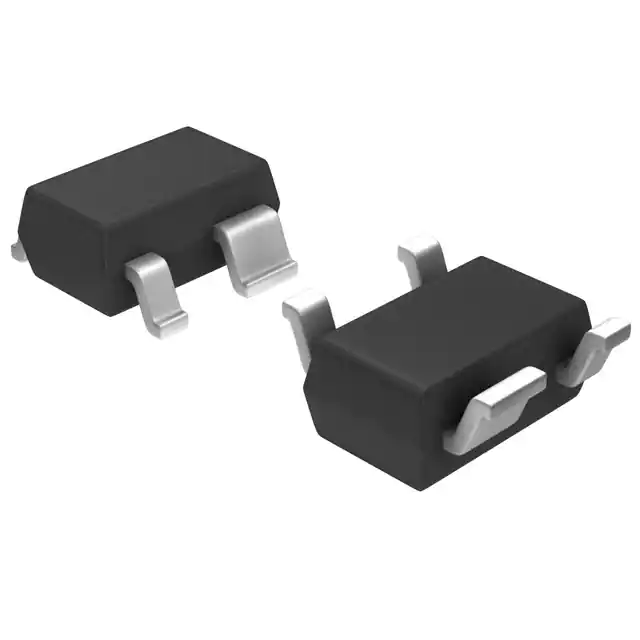
SOT343 (SC-82AB) surface-mount plastic package with visible leads and exposed emitter pad for thermal conduction; 4-pin configuration with pin 1 = Base, pin 2 = Emitter, pin 3 = Collector, pin 4 = Emitter (dual emitter connection).
| Pin/Terminal | Circuit Role | Design Meaning |
|---|---|---|
| 1 (Base) | Input control terminal | DC bias and RF input node; requires series DC blocking and shunt RF bypass for stable operation |
| 2 (Emitter) | Common reference node | Primary thermal path and AC ground; must be connected to large copper area for RthJS compliance |
| 3 (Collector) | RF output terminal | High-impedance output node; matches to 50 Ω via microstrip stub or lumped LC network |
| 4 (Emitter) | Secondary emitter connection | Redundant emitter bond for lower inductance and improved thermal spreading; tied to pin 2 externally |
Key Features
| Feature | Design Value |
|---|---|
| RoHS-compliant & halogen-free packaging | Meets IPC-J-STD-020 moisture sensitivity level 1 (MSL-1) and automotive AEC-Q101 qualification |
| Low Ceb (0.55 pF typ.) | Reduces base-emitter feedback, enabling unconditional stability without emitter degeneration in 1–3 GHz bands |
| P-1dB = 12 dBm at 1.8 GHz | Supports 16-QAM signal handling with <1% EVM in compact GNSS front-ends |
| SPICE GP model with package parasitics | Enables accurate DC + RF co-simulation in ADS/MWO up to 10 GHz without de-embedding |
| ZSopt frequency-dependent impedance | Provides exact source match data (e.g., 50 + j25 Ω @ 1.8 GHz) for optimal noise matching network synthesis |
Applications
| GPS L1 Band Receiver LNA | ISM Band 2.4 GHz Transceiver Front-End |
|---|---|
Use Scenario: Low-noise amplification of 1.575 GHz GPS L1 signals in handheld navigation devices with tight size constraints. IC Role / Device Role / Timing Role: First-stage LNA in cascaded RF chain; provides 21 dB gain and 1.1 dB NF to maximize system noise figure. Use Value: Enables –142 dBm sensitivity with 2.5 dB system NF margin over antenna noise floor (–144.5 dBm). | Use Scenario: Receive-path amplification in Bluetooth 5.0 and Zigbee 2.4 GHz modules operating in industrial environments. IC Role / Device Role / Timing Role: High-linearity LNA before mixer; handles co-channel interferers with IP3 = 22 dBm. Use Value: Maintains >65 dB adjacent channel rejection under –30 dBm blocker conditions per IEEE 802.15.4 spec. |
| Cellular IoT LTE Band 13/17 LNA | UWB Pulse Amplifier Stage |
Use Scenario: Front-end amplification in NB-IoT base stations supporting 700 MHz uplink reception. IC Role / Device Role / Timing Role: Single-transistor common-emitter amplifier biased at IC = 20 mA, VCE = 2 V. Use Value: Delivers 17 dB |S21|² gain and 1.3 dB NF across 746–756 MHz band with <0.2 dB flatness. | Use Scenario: Short-pulse amplification in 3.1–4.8 GHz UWB radar transceivers for occupancy sensing. IC Role / Device Role / Timing Role: High-speed switching amplifier with <1 ns turn-on time and minimal storage delay. Use Value: Supports 500 Mbps pulse modulation with <0.5 ns jitter due to fT > 25 GHz and low Ccb. |
Equivalent & Alternatives
The following parts are listed as comparable options for similar low-noise RF transistor applications.
| Alternative Part | Technical Difference | Application Difference | Selection Advice |
|---|---|---|---|
| BFP640FESD | fT = 45 GHz, NFmin = 0.9 dB at 2 GHz, but higher VCEO = 5.5 V and different SOT343 pinout (pin 1 = C) | Requires re-layout due to swapped collector/base pins; better for 2.4 GHz Wi-Fi 6E LNAs | Select when >20 GHz bandwidth and sub-1 dB NF are mandatory; verify PCB footprint compatibility |
| MMA040407-12 | fT = 18 GHz, NFmin = 1.3 dB at 1.8 GHz, Ccb = 0.22 pF, and SOT-343-4 package with identical pinout | Drop-in replacement with 0.2 dB NF penalty and 3 dB lower Gms; qualified to MIL-PRF-19500 | Choose for defense/aerospace programs requiring radiation-hardened screening and extended temperature range |
Compared with BFP420H6801XTSA1, BFP640FESD offers superior high-frequency gain but demands layout revision, while MMA040407-12 provides mechanical compatibility and ruggedness at the cost of 0.2 dB noise and 3 dB gain reduction.
Availability
BFP420H6801XTSA1 is available at Aetrix Electronics and suitable for GPS receivers, cellular IoT base stations, ISM-band transceivers, and UWB radar systems requiring stable component supply with full traceability and RoHS/halogen-free compliance.
Supply support for BFP420H6801XTSA1 includes scheduled delivery planning, volume procurement assistance, BOM continuity management, traceable sourcing, and lifecycle availability coordination for OEM customers, industrial embedded developers, connected-device designers, and electronics production programs.
Manufacturer
Infineon Technologies is a German semiconductor manufacturer specializing in power management, sensor, and RF solutions, with leadership in automotive, industrial, and communications markets.
The BFP420 belongs to Infineon's high-frequency bipolar transistor product line, designed specifically for low-noise, high-gain RF amplification in sub-6 GHz wireless infrastructure and precision navigation equipment.
FAQ
What is the recommended bias condition for minimum noise figure?
For NFmin = 1.1 dB at 1.8 GHz, bias BFP420H6801XTSA1 at IC = 5 mA and VCE = 2 V with source impedance ZS = ZSopt = 50 + j25 Ω. This condition is validated in Infineon's Application Note AN077 and confirmed by on-wafer S-parameter measurements.
Can this transistor be used in oscillator circuits?
Yes - the BFP420H6801XTSA1 supports oscillator designs up to 10 GHz, as documented in Infineon's BFP420 oscillator application note (AN082). Its high fT and low Ccb enable Colpitts and Clapp topologies with phase noise ≤ –110 dBc/Hz at 100 kHz offset from 2.4 GHz carrier.
Is the SOT343 package lead-free and compatible with standard reflow profiles?
Yes - the BFP420H6801XTSA1 uses a Pb-free, halogen-free SOT343 package qualified to JEDEC J-STD-020C MSL-1. It supports peak reflow temperatures up to 260 °C for 30 seconds and passes thermal cycling (–55 °C to +125 °C, 1000 cycles) per AEC-Q101.
Does Infineon provide S-parameter and noise parameter files for simulation?
Yes - Infineon publishes verified S-parameter (S11/S21/S12/S22) and noise parameter (Fmin, Γopt, Rn) datasets for BFP420H6801XTSA1 up to 10 GHz on www.infineon.com/rf.models. Files are available in Touchstone (.s2p) and ADS-compatible formats with measured cold-FET de-embedding.
BFP420H6801XTSA1 Specifications
- Product attributes
- Attribute value
- Manufacturer:
- Infineon Technologies
- Series:
- -
- Package/Case:
- SC-82A, SOT-343
- Packaging:
- Tape & Reel (TR)
- Product Status:
- Active
- Transistor Type:
- NPN
- Voltage - Collector Emitter Breakdown (Max):
- 5V
- Frequency - Transition:
- 25GHz
- Noise Figure (dB Typ @ f):
- 1.1dB @ 1.8GHz
- Gain:
- 21dB
- Power - Max:
- 160mW
- DC Current Gain (hFE) (Min) @ Ic, Vce:
- 60 @ 20mA, 4V
- Current - Collector (Ic) (Max):
- 35mA
- Operating Temperature:
- 150°C (TJ)
- Grade:
- -
- Qualification:
- -
- Mounting Type:
- Surface Mount
- Supplier Device Package:
- PG-SOT343-3D
BFP420H6801XTSA1 FAQ
1.How can I place an order for BFP420H6801XTSA1 through Aetrix?
Please submit a Request for Quotation (RFQ) for BFP420H6801XTSA1 on Aetrix. Our sales agent will provide a competitive quotation and guide you through the order confirmation once you accept the terms.
2.Are the price and stock information for BFP420H6801XTSA1 reliable?
The price and inventory of BFP420H6801XTSA1 are updated periodically and may fluctuate due to market conditions. Stock and pricing data are typically refreshed every 24 hours. Quotation validity for BFP420H6801XTSA1 is usually 5 days.
3.What payment methods are accepted for BFP420H6801XTSA1?
We accept Wire Transfer, PayPal, Credit Card, Western Union, MoneyGram, and Escrow for BFP420H6801XTSA1 transactions.
Note: Certain payment methods may incur a processing fee.
4.How is shipping managed for BFP420H6801XTSA1?
BFP420H6801XTSA1 orders can be shipped via leading logistics carriers, including DHL, UPS, FedEx, TNT, or Registered Mail.
Once your BFP420H6801XTSA1 order is processed, you will receive an email with the shipment details and tracking number.
Note: Tracking information may take up to 24 hours to appear. Express delivery typically takes 3–5 business days.
5.How can I obtain technical support or documentation for BFP420H6801XTSA1?
For technical support, including BFP420H6801XTSA1 datasheets, pinout diagrams, or application guidance, please contact our engineering support team. They can provide detailed documentation and assistance for your BFP420H6801XTSA1 requirements.
6.How does Aetrix verify that BFP420H6801XTSA1 is sourced from the original manufacturer or authorized distributors?
All BFP420H6801XTSA1 products on Aetrix are procured from qualified distributors and authorized channels. Our dedicated quality assurance team conducts strict verification, including traceability checks and, if necessary, third-party testing. This ensures that BFP420H6801XTSA1 meets industry standards.
7.What is the process for return or replacement of BFP420H6801XTSA1?
All BFP420H6801XTSA1 units undergo pre-shipment inspection (PSI). If there is an issue with BFP420H6801XTSA1, returns or replacements are accepted under the following conditions:
1.Quantity discrepancies, incorrect items, or visible external defects (such as breakage or corrosion), acknowledged by Aetrix.
2.The issue is reported within 90 days of delivery.
3.The BFP420H6801XTSA1 part is unused and in its original packaging.
Return procedure for BFP420H6801XTSA1:
1.Submit a request within 90 days.
2.Obtain a Return Material Authorization (RMA) from Aetrix.
BFP420H6801XTSA1 Tags
-
BFR182WH6327XTSA1
Infineon Technologies
-
BFR92PE6327HTSA1
Infineon Technologies
-
BFR360FH6327XTSA1
Infineon Technologies
-
BFR193FH6327XTSA1
Infineon Technologies
-
BFU550AR
NXP USA Inc.
-
BFR460L3E6327XTMA1
Infineon Technologies
-
MMBTH81
onsemi
-
BFU520WX
NXP USA Inc.
-
BFP840FESDH6327XTSA1
Infineon Technologies
-
BFP650H6327XTSA1
Infineon Technologies
-
BFU520AR
NXP USA Inc.
-
BFS483H6327XTSA1
Infineon Technologies
Tech Hub

Operational amplifier guide covering op amp basics, feedback, ideal vs real op amps, common configurations, buffer circuits, offset, bias current, gain-bandwidth, slew rate, rail-to-rail limits and sel…

Jumper cables guide covering safe connection order, red and black clamp placement, final ground connection, cable gauge, length, clamp quality, copper vs CCA cables, jump starter comparison and battery…

LDO regulator guide covering low dropout voltage, power dissipation, thermal design, PSRR, output noise, capacitor stability, adjustable LDO circuits, LDO vs buck converter and datasheet selection chec…

Conditional Access Module guide covering CAM meaning, CI/CI+ interface, smart card authorization, DVB security workflow, TV and set-top box compatibility, internal electronics, ESD protection, connecto…

Guide to electronic component obsolescence covering EOL risk, PCN/PDN notices, last-time buy planning, replacement options, form-fit-function validation, counterfeit risk and BOM lifecycle management.

18650 battery guide covering lithium-ion cell basics, 3.6V/3.7V voltage, 4.2V charging, mAh and Wh capacity, protected cells, chargers, BMS, series-parallel packs, holders, welding and sourcing checks.…

Hall effect sensor guide covering working principle, linear and digital sensors, Arduino circuits, current sensing, speed detection, automotive applications, A3144 examples, signal filtering and datash…

Product Change Notification guide for electronic components, covering PCN meaning, PCN vs PDN/EOL, common change types, risk levels, form-fit-function review, engineering validation, BOM control, LTB/L…

A practical guide to blend door actuators, covering HVAC function, symptoms, location, AC and heater issues, reset and calibration, replacement cost, electrical diagnosis, compatibility checks, and rep…

Engineering guide to Raspberry Pi alternatives, covering chip-level differences, Orange Pi, ROCK, Jetson, Banana Pi, NanoPi, Compute Module, Pico, GPIO, camera, HAT compatibility, and replacement risks…


