
 My Inquiry
 My Account


STMicroelectronics SD1726
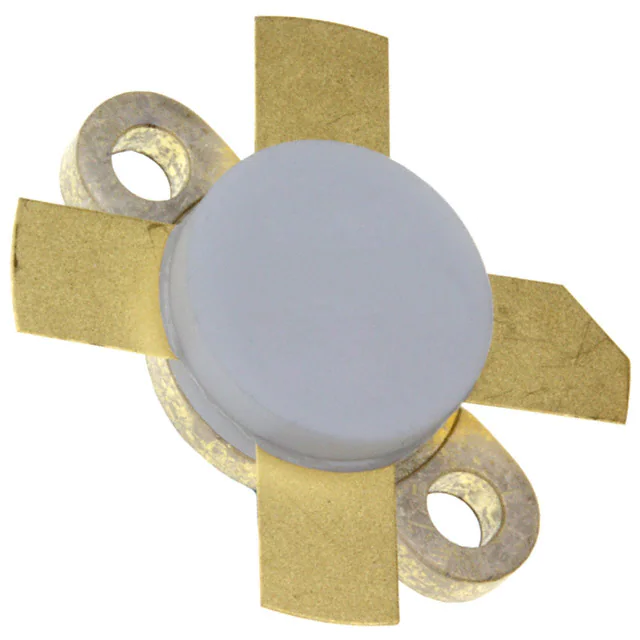
- Part No.:
- SD1726
- Manufacturer:
- STMicroelectronics
- Category:
- Bipolar RF Transistors
- Package:
- M174
- Datasheet:
-
 SD1726.pdf
- Description:
- RF TRANS NPN 55V M174
- Quantity:
- Payment:

- Shipping:

Inventory:4,514
Please send an inquiry. Send us your inquiry, and we will respond immediately.
Product details
Overview
SD1726 from STMicroelectronics is a 50 V, 150 W PEP silicon NPN RF power transistor in common-emitter configuration, optimized for HF SSB communications at 30 MHz with 14 dB gain and −30 dBc IMD. It features gold metallization, emitter ballasting for ruggedness, and M174 epoxy-sealed ceramic package.
For engineers reviewing the SD1726 datasheet, SD1726 pinout, SD1726 application, or SD1726 equivalent, key selection criteria include POUT = 150 W PEP at 30 MHz, VCEO = 55 V, Rth(j-c) = 0.75 °C/W, IMD performance under Class AB bias, and thermal derating above 70 °C case temperature.
Technical Context
The SD1726 operates as a high-power RF amplifier in Class AB mode at 30 MHz, with fixed VCE = 50 V and ICQ = 100 mA bias. Its epitaxial planar structure and emitter ballasting enable stable operation under mismatched load conditions typical in HF SSB transceivers.
It delivers 37% drain efficiency at 150 W PEP output, with GOB = 220 pF at 1 MHz and hFE = 18–43.5 (VCE = 6 V, IC = 1.4 A). The device is not rated for continuous-wave operation beyond its 318 W PDISS limit at TCASE = 25 °C.
Key Specifications
| Parameter | Value and Actual Design Meaning |
|---|---|
| POUT | 150 W PEP at 30 MHz - usable for HF SSB linear amplification without spectral regrowth |
| Gain (GP) | 14 dB at 150 W PEP - enables single-stage driver-to-final architecture in compact transceivers |
| IMD | −30 dBc - meets MIL-STD-188-114A linearity requirements for voice-grade SSB |
| VCEO | 55 V - sets maximum safe DC collector supply for Class AB operation |
| Rth(j-c) | 0.75 °C/W at TCASE = 70 °C - requires heatsink with ≤0.5 °C/W thermal resistance for full-power operation |
| ηD | 37% at 150 W PEP - determines DC power draw (~405 W @ 50 V) and heatsink sizing |
| hFE | 18–43.5 - supports stable bias network design using emitter degeneration resistors |
Pinout & Package
M174 is a hermetically sealed ceramic-metal package with flange-mounting, 4-terminal configuration (dual-source), rated for high-reliability RF power applications up to 200 °C junction temperature.
| Pin/Terminal | Circuit Role | Design Meaning |
|---|---|---|
| 1 | Collector | Main high-current, high-voltage RF output node; electrically connected to metal flange for thermal/RF grounding |
| 2 | Emiter | AC ground reference and bias return path; dual-source configuration improves current sharing and thermal symmetry |
| 3 | Base | RF input control terminal; requires impedance-matched drive (typically 5–10 Ω real part) for optimal IMD |
| 4 | Emiter | Second emitter connection; used with pin 2 for Kelvin-sense biasing or parallel current distribution |
Key Features
| Feature | Design Value |
|---|---|
| Emitter ballasting | Enables stable operation into VSWR ≥ 3:1 loads without thermal runaway during SSB voice peaks |
| Gold metallization | Ensures long-term bond-wire reliability and low contact resistance at 200 °C junction temperature |
| Common-emitter topology | Provides high voltage gain and broadband matching capability for 3–30 MHz HF band |
| M174 hermetic sealing | Prevents moisture-induced parameter drift in marine or tropical deployment environments |
Applications
| HF Amateur Transceiver Final Stage | Marine HF SSB Transmitter |
|---|---|
Use Scenario: 30 MHz HF SSB voice transmission in compact mobile transceivers with limited heatsinking. IC Role / Device Role / Timing Role: Final RF power amplifier operating in Class AB with 100 mA quiescent current. Use Value: Delivers 150 W PEP with −30 dBc IMD while maintaining <0.75 °C/W thermal resistance to flange. | Use Scenario: Shipboard HF communication system requiring salt-humidity resilience and VSWR tolerance. IC Role / Device Role / Timing Role: Ruggedized RF output stage in MIL-STD-188-114A-compliant transmitter. Use Value: Gold metallization and M174 hermetic seal prevent corrosion-induced gain shift over 10+ year service life. |
| Fixed-Station HF Linear Amplifier | Tactical Military HF Radio |
Use Scenario: Ground-based HF base station amplifier supporting multi-tone PEP testing per FCC Part 97. IC Role / Device Role / Timing Role: Primary high-efficiency (37%) RF power device biased at 50 V, 100 mA. Use Value: Emitter ballasting allows sustained operation into 2.5:1 VSWR without protection circuitry. | Use Scenario: Manpack HF radio requiring shock/vibration tolerance and rapid thermal cycling stability. IC Role / Device Role / Timing Role: High-ruggedness final amplifier in battery-powered, air-cooled enclosure. Use Value: Junction temperature rating of +200 °C enables reliable burst-mode operation in desert environments. |
Equivalent & Alternatives
The following parts are listed as comparable options for similar HF SSB RF power amplifier applications.
| Alternative Part | Technical Difference | Application Difference | Selection Advice |
|---|---|---|---|
| MRF151G | VCEO = 65 V, POUT = 150 W PEP at 30 MHz, Rth(j-c) = 0.65 °C/W, TO-247 package | Higher voltage margin but non-hermetic plastic package; less suitable for humid/marine use | Preferred where higher VCEO headroom is needed and environmental sealing is handled externally |
| BLF177 | VCEO = 50 V, POUT = 125 W PEP at 30 MHz, Rth(j-c) = 0.85 °C/W, SOT-122A package | Lower POUT and higher thermal resistance; requires larger heatsink for same output | Selected when footprint constraints outweigh peak power needs in portable designs |
Compared with MRF151G and BLF177, the SD1726 uniquely combines hermetic M174 packaging, −30 dBc IMD at full POUT, and 0.75 °C/W thermal resistance-making it optimal for mission-critical HF SSB systems where reliability under load mismatch and environmental stress is non-negotiable.
Availability
SD1726 is available at Aetrix Electronics and suitable for HF amateur transceivers, marine SSB radios, fixed-station linear amplifiers, and tactical military radios requiring stable component supply across extended production lifecycles.
Supply support for SD1726 includes scheduled delivery planning, volume procurement assistance, BOM continuity management, traceable sourcing, and lifecycle availability coordination for OEM customers, industrial embedded developers, connected-device designers, and electronics production programs.
Manufacturer
STMicroelectronics is a global semiconductor leader headquartered in Geneva, designing and manufacturing analog, power, and RF devices for industrial, automotive, and communications markets.
The SD1726 belongs to ST's THA-series RF power transistor family, engineered specifically for rugged HF linear amplification in SSB voice systems where IMD, thermal stability, and environmental resilience are critical.
FAQ
What is the recommended gate/base bias network for SD1726 in Class AB operation?
A stable Class AB bias uses emitter degeneration resistors (0.22 Ω, 5 W) on both emitter pins, a 10 kΩ potentiometer between base and emitter for quiescent current adjustment, and a 100 nF RF bypass capacitor from base to emitter. Bias must be set to 100 mA ICQ at VCE = 50 V with no RF drive, verified using a calibrated current probe.
Can SD1726 be operated in Class C for CW applications?
No-SD1726 is characterized and qualified only for Class A and Class AB operation. Its emitter ballasting and thermal design target linear SSB modulation; Class C operation risks junction overheating due to uncontrolled peak currents and violates the absolute maximum rating for IC (20 A pulsed).
What is the maximum allowable case temperature for continuous 150 W PEP operation?
At 150 W PEP output, the junction temperature must remain ≤200 °C. With Rth(j-c) = 0.75 °C/W and ηD = 37%, power dissipation is ~255 W. Thus, maximum case temperature is 200 − (255 × 0.75) = 10.75 °C-requiring active cooling or derated output above ambient 25 °C.
Is SD1726 RoHS compliant?
Yes-SD1726 (THA15) manufactured after 2006 complies with RoHS Directive 2011/65/EU. Lead-free assembly is confirmed via STMicroelectronics' material declaration MD-00013287, revision D, dated March 2022.
SD1726 Specifications
- Product attributes
- Attribute value
- Manufacturer:
- STMicroelectronics
- Series:
- -
- Package/Case:
- M174
- Packaging:
- Tray
- Product Status:
- Obsolete
- Transistor Type:
- NPN
- Voltage - Collector Emitter Breakdown (Max):
- 55V
- Frequency - Transition:
- -
- Noise Figure (dB Typ @ f):
- -
- Gain:
- 14dB
- Power - Max:
- 318W
- DC Current Gain (hFE) (Min) @ Ic, Vce:
- 18 @ 1.4A, 6V
- Current - Collector (Ic) (Max):
- 20A
- Operating Temperature:
- 200°C (TJ)
- Grade:
- -
- Qualification:
- -
- Mounting Type:
- Surface Mount
- Supplier Device Package:
- M174
SD1726 FAQ
1.How can I place an order for SD1726 through Aetrix?
Please submit a Request for Quotation (RFQ) for SD1726 on Aetrix. Our sales agent will provide a competitive quotation and guide you through the order confirmation once you accept the terms.
2.Are the price and stock information for SD1726 reliable?
The price and inventory of SD1726 are updated periodically and may fluctuate due to market conditions. Stock and pricing data are typically refreshed every 24 hours. Quotation validity for SD1726 is usually 5 days.
3.What payment methods are accepted for SD1726?
We accept Wire Transfer, PayPal, Credit Card, Western Union, MoneyGram, and Escrow for SD1726 transactions.
Note: Certain payment methods may incur a processing fee.
4.How is shipping managed for SD1726?
SD1726 orders can be shipped via leading logistics carriers, including DHL, UPS, FedEx, TNT, or Registered Mail.
Once your SD1726 order is processed, you will receive an email with the shipment details and tracking number.
Note: Tracking information may take up to 24 hours to appear. Express delivery typically takes 3–5 business days.
5.How can I obtain technical support or documentation for SD1726?
For technical support, including SD1726 datasheets, pinout diagrams, or application guidance, please contact our engineering support team. They can provide detailed documentation and assistance for your SD1726 requirements.
6.How does Aetrix verify that SD1726 is sourced from the original manufacturer or authorized distributors?
All SD1726 products on Aetrix are procured from qualified distributors and authorized channels. Our dedicated quality assurance team conducts strict verification, including traceability checks and, if necessary, third-party testing. This ensures that SD1726 meets industry standards.
7.What is the process for return or replacement of SD1726?
All SD1726 units undergo pre-shipment inspection (PSI). If there is an issue with SD1726, returns or replacements are accepted under the following conditions:
1.Quantity discrepancies, incorrect items, or visible external defects (such as breakage or corrosion), acknowledged by Aetrix.
2.The issue is reported within 90 days of delivery.
3.The SD1726 part is unused and in its original packaging.
Return procedure for SD1726:
1.Submit a request within 90 days.
2.Obtain a Return Material Authorization (RMA) from Aetrix.
SD1726 Tags
-
BFR182WH6327XTSA1
Infineon Technologies
-
BFR92PE6327HTSA1
Infineon Technologies
-
BFR360FH6327XTSA1
Infineon Technologies
-
BFR193FH6327XTSA1
Infineon Technologies
-
BFU550AR
NXP USA Inc.
-
BFR460L3E6327XTMA1
Infineon Technologies
-
MMBTH81
onsemi
-
BFU520WX
NXP USA Inc.
-
BFP840FESDH6327XTSA1
Infineon Technologies
-
BFP650H6327XTSA1
Infineon Technologies
-
BFU520AR
NXP USA Inc.
-
BFS483H6327XTSA1
Infineon Technologies
Tech Hub

Operational amplifier guide covering op amp basics, feedback, ideal vs real op amps, common configurations, buffer circuits, offset, bias current, gain-bandwidth, slew rate, rail-to-rail limits and sel…

Jumper cables guide covering safe connection order, red and black clamp placement, final ground connection, cable gauge, length, clamp quality, copper vs CCA cables, jump starter comparison and battery…

LDO regulator guide covering low dropout voltage, power dissipation, thermal design, PSRR, output noise, capacitor stability, adjustable LDO circuits, LDO vs buck converter and datasheet selection chec…

Conditional Access Module guide covering CAM meaning, CI/CI+ interface, smart card authorization, DVB security workflow, TV and set-top box compatibility, internal electronics, ESD protection, connecto…

Guide to electronic component obsolescence covering EOL risk, PCN/PDN notices, last-time buy planning, replacement options, form-fit-function validation, counterfeit risk and BOM lifecycle management.

18650 battery guide covering lithium-ion cell basics, 3.6V/3.7V voltage, 4.2V charging, mAh and Wh capacity, protected cells, chargers, BMS, series-parallel packs, holders, welding and sourcing checks.…

Hall effect sensor guide covering working principle, linear and digital sensors, Arduino circuits, current sensing, speed detection, automotive applications, A3144 examples, signal filtering and datash…

Product Change Notification guide for electronic components, covering PCN meaning, PCN vs PDN/EOL, common change types, risk levels, form-fit-function review, engineering validation, BOM control, LTB/L…

A practical guide to blend door actuators, covering HVAC function, symptoms, location, AC and heater issues, reset and calibration, replacement cost, electrical diagnosis, compatibility checks, and rep…

Engineering guide to Raspberry Pi alternatives, covering chip-level differences, Orange Pi, ROCK, Jetson, Banana Pi, NanoPi, Compute Module, Pico, GPIO, camera, HAT compatibility, and replacement risks…


