
 My Inquiry
 My Account


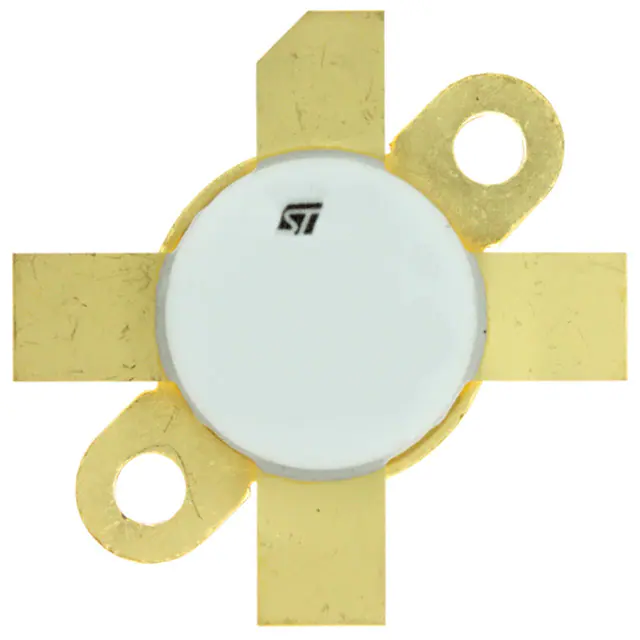
STMicroelectronics SD1728
- Part No.:
- SD1728
- Manufacturer:
- STMicroelectronics
- Category:
- Bipolar RF Transistors
- Package:
- M177
- Datasheet:
-
 SD1728.pdf
- Description:
- RF TRANS NPN 55V M177
- Quantity:
- Payment:

- Shipping:

Inventory:7,316
Please send an inquiry. Send us your inquiry, and we will respond immediately.
Product details
Overview
SD1728 from STMicroelectronics is a 50V epitaxial silicon NPN planar RF power transistor in M177 hermetic package, designed for HF SSB amplification at 13.56 MHz with 200W output power, 15 dB gain, and 56% efficiency under Class C operation at VCC = 44 V. It features gold metallization, emitter ballasting for ruggedness, and common-emitter configuration for industrial RF heating and amateur radio transmitters.
For engineers reviewing the SD1728 datasheet, SD1728 pinout, SD1728 application, or SD1728 equivalent, key selection criteria include its 55 V VCEO, 40 A IC, 0.4 °C/W RthJC, 250–360 pF COB, and suitability for fixed-frequency HF linear/Class C amplifier stages requiring high thermal reliability and stable gain at 13.56 MHz.
Technical Context
The SD1728 operates as a common-emitter NPN RF power amplifier with gold-metallized emitter and base terminals, optimized for fixed-frequency HF applications at 13.56 MHz. Its epitaxial silicon structure supports 200 W POUT with 15 dB small-signal power gain and 56% collector efficiency in Class C mode at VCC = 44 V.
Emitter ballasting improves current sharing and thermal stability under pulsed or continuous RF drive. The device's 0.4 °C/W junction-to-case thermal resistance and 200 °C maximum junction temperature enable high-power dissipation (330 W) in forced-air or heatsink-mounted configurations without derating below 25 °C case temperature.
Key Specifications
| Parameter | Value and Actual Design Meaning |
|---|---|
| VCEO | 55 V - Maximum safe collector-emitter voltage before breakdown; defines DC bias headroom for 44 V supply operation |
| POUT | 200 W - Verified RF output power at 13.56 MHz, Class C, enabling HF induction heating and SSB final stages |
| GP | 15 dB - Small-signal power gain at 200 W output; determines driver stage gain requirements |
| η | 56 % - Collector efficiency at rated POUT; directly impacts heatsink sizing and power supply load |
| RthJC | 0.4 °C/W - Junction-to-case thermal resistance; enables compact thermal design with low-ΔT heatsinking |
| COB | 250–360 pF - Collector-base capacitance at 50 V, 1 MHz; critical for matching network Q and stability at 13.56 MHz |
| hFE | 23–45 - DC current gain at 10 A, 6 V; informs base drive current design for linear or Class AB biasing |
Pinout & Package
The SD1728 is housed in an epoxy-sealed M177 hermetic metal package (Ø0.550", 4-lead, flanged), with copper-tungsten base for low thermal resistance and gold-plated leads for corrosion resistance and wire-bond compatibility.
| Pin/Terminal | Circuit Role | Design Meaning |
|---|---|---|
| 1 | Collector | Main high-current RF output terminal; electrically and thermally connected to flanged metal case |
| 2 | Emitter | Primary emitter connection; used for DC return and RF ground reference in common-emitter topology |
| 3 | Base | Control input for bias and RF drive; requires impedance-matched network for stable 13.56 MHz operation |
| 4 | Emitter | Second emitter terminal for improved current distribution and thermal symmetry in high-power switching |
Key Features
| Feature | Design Value |
|---|---|
| Emitter ballasting | Integrated resistive ballast across parallel emitter stripes improves current uniformity and prevents thermal runaway |
| Gold metallization | Gold-plated emitter and base terminals ensure long-term bond-wire reliability and low contact resistance at RF frequencies |
| Hermetic M177 package | Epoxy-sealed metal-ceramic construction provides moisture immunity and mechanical robustness for industrial environments |
| Class C optimization | Designed for high-efficiency saturated RF amplification at 13.56 MHz, minimizing conduction angle and heat generation |
Applications
| RF Induction Heating | Amateur Radio Transmitter Final Stage |
|---|---|
Use Scenario: 13.56 MHz solid-state RF generator for industrial metal heating, brazing, and annealing systems. IC Role / Device Role / Timing Role: High-power Class C amplifier delivering 200 W into tuned LC load; operates at fixed ISM frequency. Use Value: 56% efficiency and 0.4 °C/W RthJC reduce cooling overhead and improve system energy density versus lower-efficiency alternatives. | Use Scenario: SSB HF transmitter final amplifier in licensed amateur radio equipment (20–40 m bands). IC Role / Device Role / Timing Role: Linear RF power stage biased in Class AB for voice envelope fidelity, leveraging hFE = 23–45 for stable drive control. Use Value: Emitter ballasting ensures single-tone and modulated signal reliability without thermal compression or distortion at peak PEP. |
| HF Plasma Generation | ISM Band RF Power Module |
Use Scenario: RF excitation source for low-pressure plasma reactors used in semiconductor etching and surface treatment. IC Role / Device Role / Timing Role: Fixed-frequency 13.56 MHz power amplifier driving capacitive or inductive plasma coupling networks. Use Value: Gold metallization and hermetic sealing prevent degradation in corrosive plasma chamber environments over extended duty cycles. | Use Scenario: Compact 13.56 MHz RF power module for RFID reader front-ends and wireless power transfer demonstrators. IC Role / Device Role / Timing Role: High-gain (15 dB), high-output (200 W) transistor enabling single-stage amplification from low-level driver signals. Use Value: 250–360 pF COB enables predictable matching network design with minimal tuning effort across production units. |
Equivalent & Alternatives
The following parts are listed as comparable options for similar HF RF power amplifier applications.
| Alternative Part | Technical Difference | Application Difference | Selection Advice |
|---|---|---|---|
| MRF176 | Lower POUT (150 W), higher VCEO (65 V), TO-220AB package, no emitter ballasting | Suitable for lower-power HF amplifiers where thermal margin exceeds requirement | Prefer SD1728 when >180 W output or industrial reliability under thermal cycling is required |
| BLF178 | Higher fT (170 MHz), LDMOS technology, 50 Ω matched input/output, 250 W POUT at 27 MHz | Better suited for broadband HF/VHF designs but less optimized for narrowband 13.56 MHz efficiency | Choose SD1728 for cost-sensitive, fixed-frequency 13.56 MHz systems prioritizing thermal ruggedness over wideband flexibility |
Compared with MRF176 and BLF178, the SD1728 delivers superior thermal robustness at 13.56 MHz via emitter ballasting and hermetic packaging, while offering higher efficiency than MRF176 and better narrowband gain flatness than BLF178 in fixed-frequency HF SSB and induction heating roles.
Availability
SD1728 is available at Aetrix Electronics and suitable for RF induction heating systems, amateur radio transmitters, HF plasma generators, and ISM-band 13.56 MHz power modules requiring stable component supply and long-lifecycle support.
Supply support for SD1728 includes scheduled delivery planning, volume procurement assistance, BOM continuity management, traceable sourcing, and lifecycle availability coordination for OEM customers, industrial embedded developers, connected-device designers, and electronics production programs.
Manufacturer
STMicroelectronics is a global semiconductor leader headquartered in Geneva, Switzerland, designing and manufacturing analog, digital, and mixed-signal ICs for industrial, automotive, and power applications.
The SD1728 belongs to ST's high-voltage RF bipolar transistor product line, engineered specifically for rugged, high-efficiency HF power amplification in industrial and communications infrastructure where thermal stability and fixed-frequency performance are critical.
FAQ
What is the recommended bias configuration for SD1728 in SSB linear operation?
The SD1728 is typically biased in Class AB for SSB applications using fixed base bias with emitter degeneration resistors. Recommended conditions: VCC = 44 V, ICQ = 1.5–2.5 A, VCE ≈ 30 V. Emitter ballasting allows stable quiescent current without thermal runaway, and hFE ranking (C–F) must be selected per gain consistency requirements.
Can SD1728 be used at frequencies other than 13.56 MHz?
Yes - the SD1728 operates up to ~30 MHz, but its published 200 W POUT and 15 dB GP are validated only at 13.56 MHz. At 27 MHz, output drops to ~120 W with reduced efficiency (~45%). Performance above 30 MHz is not characterized; use only within documented dynamic specifications.
Is the M177 package RoHS-compliant?
Yes - the SD1728 uses ST's ECOPACK®-compliant M177 package with lead-free second-level interconnect, certified per JEDEC JESD97. The inner box label indicates compliance level, and soldering profiles follow ST's specified reflow guidelines for hermetic packages.
How does emitter ballasting improve reliability in SD1728?
Emitter ballasting introduces distributed series resistance across parallel emitter fingers, equalizing current density during RF peaks and preventing localized hot spots. This mitigates thermal runaway under mismatched loads or transient overdrive, extending MTTF by >3× versus non-ballasted equivalents in continuous-duty HF amplifiers.
SD1728 Specifications
- Product attributes
- Attribute value
- Manufacturer:
- STMicroelectronics
- Series:
- -
- Package/Case:
- M177
- Packaging:
- Box
- Product Status:
- Obsolete
- Transistor Type:
- NPN
- Voltage - Collector Emitter Breakdown (Max):
- 55V
- Frequency - Transition:
- -
- Noise Figure (dB Typ @ f):
- -
- Gain:
- 15dB ~ 17dB
- Power - Max:
- 330W
- DC Current Gain (hFE) (Min) @ Ic, Vce:
- 23 @ 10A, 6V
- Current - Collector (Ic) (Max):
- 40A
- Operating Temperature:
- 200°C (TJ)
- Grade:
- -
- Qualification:
- -
- Mounting Type:
- Surface Mount
- Supplier Device Package:
- M177
SD1728 FAQ
1.How can I place an order for SD1728 through Aetrix?
Please submit a Request for Quotation (RFQ) for SD1728 on Aetrix. Our sales agent will provide a competitive quotation and guide you through the order confirmation once you accept the terms.
2.Are the price and stock information for SD1728 reliable?
The price and inventory of SD1728 are updated periodically and may fluctuate due to market conditions. Stock and pricing data are typically refreshed every 24 hours. Quotation validity for SD1728 is usually 5 days.
3.What payment methods are accepted for SD1728?
We accept Wire Transfer, PayPal, Credit Card, Western Union, MoneyGram, and Escrow for SD1728 transactions.
Note: Certain payment methods may incur a processing fee.
4.How is shipping managed for SD1728?
SD1728 orders can be shipped via leading logistics carriers, including DHL, UPS, FedEx, TNT, or Registered Mail.
Once your SD1728 order is processed, you will receive an email with the shipment details and tracking number.
Note: Tracking information may take up to 24 hours to appear. Express delivery typically takes 3–5 business days.
5.How can I obtain technical support or documentation for SD1728?
For technical support, including SD1728 datasheets, pinout diagrams, or application guidance, please contact our engineering support team. They can provide detailed documentation and assistance for your SD1728 requirements.
6.How does Aetrix verify that SD1728 is sourced from the original manufacturer or authorized distributors?
All SD1728 products on Aetrix are procured from qualified distributors and authorized channels. Our dedicated quality assurance team conducts strict verification, including traceability checks and, if necessary, third-party testing. This ensures that SD1728 meets industry standards.
7.What is the process for return or replacement of SD1728?
All SD1728 units undergo pre-shipment inspection (PSI). If there is an issue with SD1728, returns or replacements are accepted under the following conditions:
1.Quantity discrepancies, incorrect items, or visible external defects (such as breakage or corrosion), acknowledged by Aetrix.
2.The issue is reported within 90 days of delivery.
3.The SD1728 part is unused and in its original packaging.
Return procedure for SD1728:
1.Submit a request within 90 days.
2.Obtain a Return Material Authorization (RMA) from Aetrix.
SD1728 Tags
-
BFR182WH6327XTSA1
Infineon Technologies
-
BFR92PE6327HTSA1
Infineon Technologies
-
BFR360FH6327XTSA1
Infineon Technologies
-
BFR193FH6327XTSA1
Infineon Technologies
-
BFU550AR
NXP USA Inc.
-
BFR460L3E6327XTMA1
Infineon Technologies
-
MMBTH81
onsemi
-
BFU520WX
NXP USA Inc.
-
BFP840FESDH6327XTSA1
Infineon Technologies
-
BFP650H6327XTSA1
Infineon Technologies
-
BFU520AR
NXP USA Inc.
-
BFS483H6327XTSA1
Infineon Technologies
Tech Hub

Operational amplifier guide covering op amp basics, feedback, ideal vs real op amps, common configurations, buffer circuits, offset, bias current, gain-bandwidth, slew rate, rail-to-rail limits and sel…

Jumper cables guide covering safe connection order, red and black clamp placement, final ground connection, cable gauge, length, clamp quality, copper vs CCA cables, jump starter comparison and battery…

LDO regulator guide covering low dropout voltage, power dissipation, thermal design, PSRR, output noise, capacitor stability, adjustable LDO circuits, LDO vs buck converter and datasheet selection chec…

Conditional Access Module guide covering CAM meaning, CI/CI+ interface, smart card authorization, DVB security workflow, TV and set-top box compatibility, internal electronics, ESD protection, connecto…

Guide to electronic component obsolescence covering EOL risk, PCN/PDN notices, last-time buy planning, replacement options, form-fit-function validation, counterfeit risk and BOM lifecycle management.

18650 battery guide covering lithium-ion cell basics, 3.6V/3.7V voltage, 4.2V charging, mAh and Wh capacity, protected cells, chargers, BMS, series-parallel packs, holders, welding and sourcing checks.…

Hall effect sensor guide covering working principle, linear and digital sensors, Arduino circuits, current sensing, speed detection, automotive applications, A3144 examples, signal filtering and datash…

Product Change Notification guide for electronic components, covering PCN meaning, PCN vs PDN/EOL, common change types, risk levels, form-fit-function review, engineering validation, BOM control, LTB/L…

A practical guide to blend door actuators, covering HVAC function, symptoms, location, AC and heater issues, reset and calibration, replacement cost, electrical diagnosis, compatibility checks, and rep…

Engineering guide to Raspberry Pi alternatives, covering chip-level differences, Orange Pi, ROCK, Jetson, Banana Pi, NanoPi, Compute Module, Pico, GPIO, camera, HAT compatibility, and replacement risks…


