
 My Inquiry
 My Account


STMicroelectronics SD1731
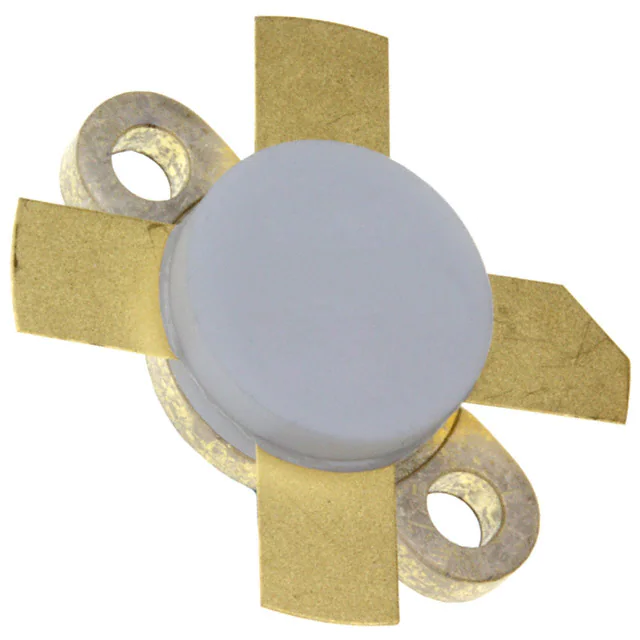
- Part No.:
- SD1731
- Manufacturer:
- STMicroelectronics
- Category:
- Bipolar RF Transistors
- Package:
- M174
- Datasheet:
-
 SD1731.pdf
- Description:
- RF TRANS NPN 55V M174
- Quantity:
- Payment:

- Shipping:

Inventory:3,300
Please send an inquiry. Send us your inquiry, and we will respond immediately.
Product details
Overview
SD1731 from STMicroelectronics is a 50 V, 220 W PEP NPN RF power bipolar transistor in M174 plastic package, optimized for 30 MHz HF SSB communications with 13 dB gain and 40% collector efficiency in common-emitter configuration using gold metallization and emitter ballasting for ruggedness.
For engineers reviewing the SD1731 datasheet, SD1731 pinout, SD1731 application, or SD1731 equivalent, this device serves as a high-power RF amplifier stage in amateur radio transceivers, military HF radios, and fixed-station SSB exciters where thermal stability, intermodulation performance (–30 dBc IMD), and ruggedized biasing are critical selection criteria.
Technical Context
The SD1731 operates in common-emitter mode with VCE = 50 V and ICQ = 150 mA quiescent point, delivering 220 W PEP output at 30 MHz. Its emitter ballasting enhances safe operating area (SOA) under pulsed RF conditions and improves second-breakdown immunity.
Thermal design is enabled by low RTH(j-c) = 0.55 °C/W and RTH(c-s) = 0.2 °C/W, supporting high-duty-cycle SSB operation when mounted on a heatsink maintained at ≤25°C. The 330 pF COB at 50 V enables stable matching network design at HF frequencies.
Key Specifications
| Parameter | Value and Actual Design Meaning |
|---|---|
| VCEO | 55 V - supports 50 V DC supply rail with 10% margin against transient overvoltage |
| POUT | 220 W PEP - delivers full legal-limit HF SSB output power in Class AB linear amplifiers |
| GP | 13 dB - provides sufficient small-signal gain to drive final stage without cascaded preamps |
| ηc | 40% - enables efficient thermal management with <233 W total dissipation at rated output |
| IMD | –30 dBc - meets spectral purity requirements for two-tone SSB transmission without adjacent-channel interference |
| COB | 330 pF @ 50 V - defines input matching network capacitance budget at 30 MHz fundamental frequency |
| RTH(j-c) | 0.55 °C/W - allows junction temperature rise of ≤128°C at 233 W dissipation, staying below 200°C max rating |
Pinout & Package
The SD1731 is housed in the M174 plastic epoxy-sealed 4-lead flange package with isolated collector tab, designed for direct heatsink mounting and high-power RF grounding. Pin 1 is Collector (tab-connected), Pins 2 and 4 are Emitter (dual-emitter configuration for current sharing), and Pin 3 is Base.
| Pin/Terminal | Circuit Role | Design Meaning |
|---|---|---|
| 1 (Collector) | High-current RF output node | Electrically connected to metal flange; must be bolted to heatsink with low-thermal-resistance interface |
| 2 & 4 (Emitter) | Current return path / bias reference | Dual-emitter terminals improve current distribution and reduce parasitic inductance in high-frequency operation |
| 3 (Base) | RF drive input control node | Requires stable 150 mA quiescent bias; sensitive to layout inductance due to fT > 100 MHz |
Key Features
| Feature | Design Value |
|---|---|
| Emitter ballasting | Improves current sharing across emitter stripes, enabling stable 20 A peak collector current without thermal runaway |
| Gold metallization | Ensures long-term bond-wire reliability and corrosion resistance in humid HF operating environments |
| Common-emitter configuration | Provides standard 180° phase inversion and high-voltage gain suitable for grounded-base driver stages |
| M174 flange package | Enables direct thermal coupling to heatsink with <0.75 °C/W total junction-to-ambient resistance in typical layouts |
Applications
| Amateur Radio HF Transceiver Final Amplifier | Military HF Manpack Radio PA Stage |
|---|---|
Use Scenario: Linear amplification of 30 MHz SSB voice signals in QRP-to-full-power transceivers with duty-cycle-limited PEP envelope. IC Role / Device Role / Timing Role: Final RF power amplifier operating in Class AB with fixed 150 mA quiescent bias and broadband 30 MHz matching network. Use Value: Delivers 220 W PEP output while maintaining –30 dBc two-tone IMD, meeting FCC Part 97 spectral mask requirements. | Use Scenario: Ruggedized HF transmitter module for field-deployable manpack radios requiring shock/vibration tolerance and wide ambient temperature operation. IC Role / Device Role / Timing Role: High-reliability RF power stage with emitter ballasting and gold metallization for extended service life in harsh environments. Use Value: Maintains 40% collector efficiency and SOA integrity across –40°C to +85°C ambient, reducing heatsink mass and battery load. |
| Fixed-Station SSB Exciter Driver | HF Broadcast Auxiliary Amplifier |
Use Scenario: Medium-power driver stage preceding a tetrode or LDMOS final amplifier in commercial HF broadcast infrastructure. IC Role / Device Role / Timing Role: High-gain (13 dB), low-IMD intermediate amplifier providing clean 220 W PEP drive signal at 30 MHz. Use Value: Eliminates need for additional gain stages due to sufficient power-added gain, simplifying system-level filtering and shielding. | Use Scenario: Backup or auxiliary amplifier in shortwave broadcast sites where rapid field replacement and proven thermal robustness are prioritized. IC Role / Device Role / Timing Role: Standby-capable RF power transistor with 233 W dissipation rating and 200°C junction limit for intermittent high-duty-cycle operation. Use Value: Supports scheduled maintenance windows via documented thermal derating curves and flange-mount mechanical compatibility with legacy M174 sockets. |
Equivalent & Alternatives
The following parts are listed as comparable options for similar RF power amplifier applications.
| Alternative Part | Technical Difference | Application Difference | Selection Advice |
|---|---|---|---|
| MRF454 | Higher VCEO = 65 V, lower POUT = 150 W PEP, TO-220AB package with higher RTH(j-c) = 0.85 °C/W | Less suited for full 220 W SSB duty; requires larger heatsink for same thermal rise | Select when lower cost and TO-220 compatibility outweigh peak power needs |
| BLF177 | LDMOS technology, 50 V, 250 W PEP, but requires gate protection circuitry and different bias sequencing | Superior IMD (–35 dBc) but incompatible base-drive topology and thermal interface | Select only when redesigning bias/matching networks for MOSFET-specific gate control |
Compared with MRF454 and BLF177, the SD1731 offers optimal balance of proven ruggedness, 220 W PEP capability, and drop-in compatibility with legacy HF amplifier PCBs using M174 footprints and common-emitter bias schemes.
Availability
SD1731 is available at Aetrix Electronics and suitable for amateur radio transceivers, military HF manpack radios, and fixed-station SSB exciters requiring stable component supply despite its obsolete status through controlled legacy sourcing.
Supply support for SD1731 includes scheduled delivery planning, volume procurement assistance, BOM continuity management, traceable sourcing, and lifecycle availability coordination for OEM customers, industrial embedded developers, connected-device designers, and electronics production programs.
Manufacturer
STMicroelectronics is a global semiconductor leader headquartered in Geneva, designing and manufacturing analog, power, and RF components for industrial, automotive, and communications markets.
The SD1731 belongs to ST's legacy RF bipolar transistor family engineered specifically for high-reliability HF linear amplification, emphasizing ruggedness, thermal stability, and spectral purity in mission-critical radio systems.
FAQ
Is the SD1731 still in active production?
No, the SD1731 is marked "Obsolete Product(s)" in ST's official documentation (Rev. 2, June 2004). However, Aetrix Electronics maintains traceable inventory from authorized legacy channels and offers full datasheet compliance verification for ongoing production use.
What is the correct bias voltage for the SD1731 in Class AB operation?
The SD1731 requires a fixed 150 mA quiescent collector current (ICQ) at VCE = 50 V, achieved via base-emitter forward bias typically set between 0.75 V and 0.85 V depending on junction temperature. Bias stability is enhanced by emitter ballasting and gold-metallized contacts.
Can the SD1731 be used at frequencies other than 30 MHz?
Yes - while optimized for 30 MHz SSB, the SD1731 maintains usable gain and efficiency from 1.8 MHz to 54 MHz per ST's test data. Performance degrades above 54 MHz due to decreasing hFE and rising COB; matching networks must be re-tuned for each band.
What thermal interface material is recommended for the M174 flange?
A thermally conductive silicone-based grease (e.g., Dow Corning TC-5123) or 0.1 mm thick thermally conductive pad (e.g., Laird T-flex 400) is recommended. Mounting torque must be 0.5–0.7 N·m to ensure uniform pressure without cracking the epoxy seal while maintaining RTH(c-s) ≤ 0.2 °C/W.
SD1731 Specifications
- Product attributes
- Attribute value
- Manufacturer:
- STMicroelectronics
- Series:
- -
- Package/Case:
- M174
- Packaging:
- Tray
- Product Status:
- Obsolete
- Transistor Type:
- NPN
- Voltage - Collector Emitter Breakdown (Max):
- 55V
- Frequency - Transition:
- -
- Noise Figure (dB Typ @ f):
- -
- Gain:
- 13dB
- Power - Max:
- 233W
- DC Current Gain (hFE) (Min) @ Ic, Vce:
- 15 @ 10A, 6V
- Current - Collector (Ic) (Max):
- 20A
- Operating Temperature:
- 200°C (TJ)
- Grade:
- -
- Qualification:
- -
- Mounting Type:
- Surface Mount
- Supplier Device Package:
- M174
SD1731 FAQ
1.How can I place an order for SD1731 through Aetrix?
Please submit a Request for Quotation (RFQ) for SD1731 on Aetrix. Our sales agent will provide a competitive quotation and guide you through the order confirmation once you accept the terms.
2.Are the price and stock information for SD1731 reliable?
The price and inventory of SD1731 are updated periodically and may fluctuate due to market conditions. Stock and pricing data are typically refreshed every 24 hours. Quotation validity for SD1731 is usually 5 days.
3.What payment methods are accepted for SD1731?
We accept Wire Transfer, PayPal, Credit Card, Western Union, MoneyGram, and Escrow for SD1731 transactions.
Note: Certain payment methods may incur a processing fee.
4.How is shipping managed for SD1731?
SD1731 orders can be shipped via leading logistics carriers, including DHL, UPS, FedEx, TNT, or Registered Mail.
Once your SD1731 order is processed, you will receive an email with the shipment details and tracking number.
Note: Tracking information may take up to 24 hours to appear. Express delivery typically takes 3–5 business days.
5.How can I obtain technical support or documentation for SD1731?
For technical support, including SD1731 datasheets, pinout diagrams, or application guidance, please contact our engineering support team. They can provide detailed documentation and assistance for your SD1731 requirements.
6.How does Aetrix verify that SD1731 is sourced from the original manufacturer or authorized distributors?
All SD1731 products on Aetrix are procured from qualified distributors and authorized channels. Our dedicated quality assurance team conducts strict verification, including traceability checks and, if necessary, third-party testing. This ensures that SD1731 meets industry standards.
7.What is the process for return or replacement of SD1731?
All SD1731 units undergo pre-shipment inspection (PSI). If there is an issue with SD1731, returns or replacements are accepted under the following conditions:
1.Quantity discrepancies, incorrect items, or visible external defects (such as breakage or corrosion), acknowledged by Aetrix.
2.The issue is reported within 90 days of delivery.
3.The SD1731 part is unused and in its original packaging.
Return procedure for SD1731:
1.Submit a request within 90 days.
2.Obtain a Return Material Authorization (RMA) from Aetrix.
SD1731 Tags
-
BFR182WH6327XTSA1
Infineon Technologies
-
BFR92PE6327HTSA1
Infineon Technologies
-
BFR360FH6327XTSA1
Infineon Technologies
-
BFR193FH6327XTSA1
Infineon Technologies
-
BFU550AR
NXP USA Inc.
-
BFR460L3E6327XTMA1
Infineon Technologies
-
MMBTH81
onsemi
-
BFU520WX
NXP USA Inc.
-
BFP840FESDH6327XTSA1
Infineon Technologies
-
BFP650H6327XTSA1
Infineon Technologies
-
BFU520AR
NXP USA Inc.
-
BFS483H6327XTSA1
Infineon Technologies
Tech Hub

Operational amplifier guide covering op amp basics, feedback, ideal vs real op amps, common configurations, buffer circuits, offset, bias current, gain-bandwidth, slew rate, rail-to-rail limits and sel…

Jumper cables guide covering safe connection order, red and black clamp placement, final ground connection, cable gauge, length, clamp quality, copper vs CCA cables, jump starter comparison and battery…

LDO regulator guide covering low dropout voltage, power dissipation, thermal design, PSRR, output noise, capacitor stability, adjustable LDO circuits, LDO vs buck converter and datasheet selection chec…

Conditional Access Module guide covering CAM meaning, CI/CI+ interface, smart card authorization, DVB security workflow, TV and set-top box compatibility, internal electronics, ESD protection, connecto…

Guide to electronic component obsolescence covering EOL risk, PCN/PDN notices, last-time buy planning, replacement options, form-fit-function validation, counterfeit risk and BOM lifecycle management.

18650 battery guide covering lithium-ion cell basics, 3.6V/3.7V voltage, 4.2V charging, mAh and Wh capacity, protected cells, chargers, BMS, series-parallel packs, holders, welding and sourcing checks.…

Hall effect sensor guide covering working principle, linear and digital sensors, Arduino circuits, current sensing, speed detection, automotive applications, A3144 examples, signal filtering and datash…

Product Change Notification guide for electronic components, covering PCN meaning, PCN vs PDN/EOL, common change types, risk levels, form-fit-function review, engineering validation, BOM control, LTB/L…

A practical guide to blend door actuators, covering HVAC function, symptoms, location, AC and heater issues, reset and calibration, replacement cost, electrical diagnosis, compatibility checks, and rep…

Engineering guide to Raspberry Pi alternatives, covering chip-level differences, Orange Pi, ROCK, Jetson, Banana Pi, NanoPi, Compute Module, Pico, GPIO, camera, HAT compatibility, and replacement risks…


